
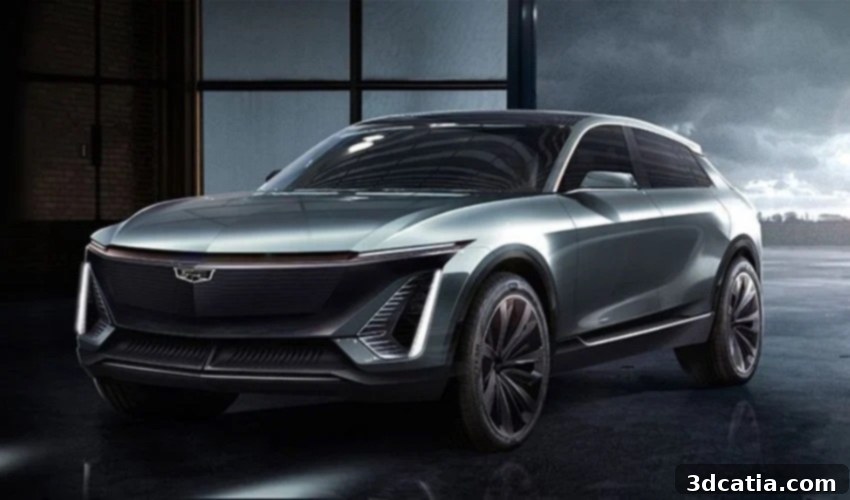
Cadillac CELESTIQ: General Motors’ Luxury EV Flagship Forged with 3D Printing and Ultium Technology
General Motors (GM) continues to make significant strides in the realm of advanced manufacturing and electric vehicle innovation. The American automotive giant recently garnered widespread attention for its strategic adoption of additive manufacturing, notably utilizing 3D printing to produce a remarkable 60,000 critical parts for its Chevrolet Tahoe 2022 models in an astonishing five-week timeframe. This demonstration of speed and efficiency in addressing supply chain challenges underscored GM’s commitment to leveraging cutting-edge technologies. Building on this momentum, General Motors has now unveiled a substantial investment exceeding $81 million into its renowned Global Technical Center in Warren, Michigan. This pivotal investment is specifically earmarked to significantly advance the development and meticulous construction of the highly anticipated Cadillac CELESTIQ, an ultra-luxury electric vehicle poised to redefine the brand’s future. With a diverse portfolio of globally recognized brands including Chevrolet, Buick, GMC, Cadillac, Baojun, and Wuling, GM is strategically accelerating its transition towards a fully electric vehicle lineup, with the CELESTIQ serving as a beacon of this transformative journey.
The substantial $81 million investment in the Global Technical Center is a testament to GM’s unwavering commitment to preparing the campus for the intricate and specialized construction of the Cadillac CELESTIQ. Preparatory work is already well underway, transforming the facility into a state-of-the-art manufacturing hub tailored for this bespoke electric vehicle. A cornerstone of GM’s additive manufacturing strategy is its Additive Industrialization Center (AIC), which officially opened its doors in 2020 on the very same GM Global Technical Center campus. The AIC has been instrumental in the successful integration of advanced 3D printing techniques into GM’s production processes. Its expertise and capabilities were vividly demonstrated in the manufacturing of components for the Cadillac CT4-V and CT5-V, which were GM’s pioneering vehicles to extensively benefit from additive manufacturing. For these performance models, crucial parts such as the intricate shift lever emblem, complex transmission components, and optimized air conditioning ducts were expertly 3D printed, showcasing the design freedom, lightweighting potential, and rapid prototyping advantages that additive manufacturing offers to modern automotive engineering.

The Cadillac CELESTIQ will be built using additive manufacturing at the Global Technical Center in Michigan (photo credits: General Motors)
Harnessing the Power of GM’s Ultium Platform for Advanced Manufacturing
At the heart of the Cadillac CELESTIQ’s advanced build, particularly concerning its integration with additive manufacturing, lies General Motors’ innovative Ultium platform. This groundbreaking platform represents GM’s central pillar for its electric vehicle architecture and is ingeniously designed to be highly versatile and scalable. The Ultium platform encompasses a common electric vehicle architecture, sophisticated powertrain components, state-of-the-art battery cells, modules, and packs, as well as powerful Ultium Drive units, highly efficient electric motors, and seamlessly integrated power electronics. Its modular design allows for immense flexibility, enabling GM to standardize and streamline manufacturing machinery, tooling, and assembly processes across a wide range of future electric vehicles. This standardization not only leads to greater operational efficiency but also significantly reduces capital investment and accelerates the transformation of additional assembly plants for EV production. For the Cadillac CELESTIQ, the Ultium platform’s inherent flexibility provides an ideal foundation for incorporating uniquely designed, 3D-printed components, pushing the boundaries of what is possible in luxury electric vehicle manufacturing and customization.
The CELESTIQ, destined to be the inaugural vehicle constructed at GM’s revamped Global Technical Center, is envisioned as a halo car for the Cadillac brand, embodying the pinnacle of luxury and technological advancement. Among its many innovative features, the CELESTIQ will boast an extraordinary intelligent glass roof, meticulously designed with four distinct quadrants and incorporating floating particle technology. This pioneering roof system offers an unprecedented level of personalization, allowing each passenger to individually control the transparency and tint of their specific section of the roof. This bespoke control elevates the passenger experience, providing unparalleled comfort and privacy. Beyond its opulent features, General Motors anticipates that the Cadillac CELESTIQ will act as a powerful catalyst for innovation throughout its extensive supplier community. The company harbors ambitious goals to significantly scale the production volume of 3D-printed components within the CELESTIQ, encompassing both crucial structural elements and aesthetically vital cosmetic parts. These components will be additively manufactured using a diverse array of advanced polymer and metal materials, pushing the boundaries of material science and manufacturing processes in the automotive sector. While GM has yet to disclose the specific additive manufacturing technologies to be employed for the CELESTIQ’s production, it is anticipated that a combination of methods, such as Selective Laser Sintering (SLS) or Multi Jet Fusion (MJF) for polymers, and Direct Metal Laser Sintering (DMLS) or Binder Jetting for metals, could be utilized to achieve the required precision, strength, and finish for this ultra-luxury vehicle.
The overarching goal for General Motors, in conceiving and bringing to life the Cadillac CELESTIQ, is to masterfully blend timeless craftsmanship with revolutionary technology. This symbiotic approach aims to position the CELESTIQ as the definitive flagship for a new and dynamic era of the Cadillac brand, signaling its resurgence as a leader in luxury mobility. Mark Reuss, President of General Motors, eloquently articulated this vision, stating, “Each one will be hand-built by an amazing team of craftspeople on our historic Technical Center campus, and today’s investment announcement emphasizes our commitment to delivering a world-class Cadillac with nothing but the best in craftsmanship, design, engineering and technology.” This emphasis on “hand-built” artistry, combined with the integration of cutting-edge technologies like additive manufacturing and the Ultium platform, creates a compelling narrative for the CELESTIQ. It represents more than just a vehicle; it embodies GM’s dedication to pushing the boundaries of automotive excellence, offering a unique blend of bespoke luxury and advanced performance that will undoubtedly captivate discerning customers globally. This strategic investment in manufacturing capabilities and a commitment to innovation reflects GM’s forward-looking approach to the evolving automotive landscape and its desire to lead the luxury electric vehicle segment with unparalleled offerings. You can find more comprehensive information about this exciting development HERE.
What are your thoughts on this monumental step in additive manufacturing for General Motors and the future of luxury electric vehicles? We invite you to share your insights in the comments section below or engage with us on our LinkedIn, Facebook, and Twitter pages! Don’t miss out on the latest advancements and news in 3D printing; make sure to sign up for our free weekly Newsletter here, delivering the most current updates directly to your inbox. Furthermore, you can explore all our captivating videos and content on our dedicated YouTube channel. Join the conversation and stay informed about the future of manufacturing and mobility!
*Cover Photo Credits: General Motors