
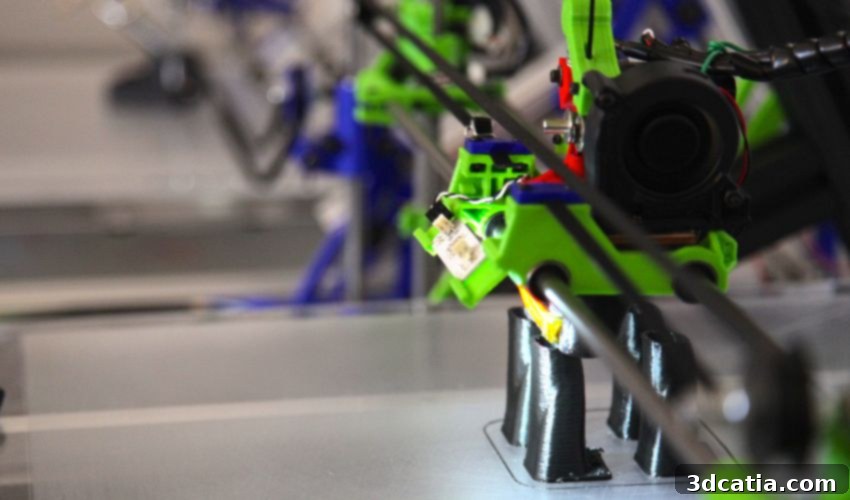
MF3: Revolutionizing FFF 3D Printing with Unprecedented Speed and Precision
In a groundbreaking development for the additive manufacturing industry, researchers at Rutgers University have introduced a novel approach to Fused Filament Fabrication (FFF) 3D printing that promises to overcome many of the longstanding limitations of this widely used technology. Dubbed Multiplexed Fused Filament Fabrication (MF3), this innovative process aims to deliver significantly faster and more precise 3D printing, enabling the creation of large and complex parts at a fraction of the cost associated with other additive manufacturing methods. The MF3 technology is poised to redefine expectations for printing speed, resolution, and the achievable size of printed components, marking a pivotal advancement in the field.
Traditional FFF, also known as Fused Deposition Modeling (FDM), operates by extruding a thermoplastic filament layer by layer to build a three-dimensional object. While popular for its accessibility and versatility, conventional FFF systems typically employ a single, relatively large nozzle, which inherently imposes a trade-off between printing speed and resolution. Larger nozzles can deposit material faster but sacrifice fine detail, whereas smaller nozzles offer superior resolution at the expense of print speed. This fundamental limitation has long challenged engineers and designers seeking to produce intricate, large-scale parts efficiently. The MF3 process directly addresses this by introducing a multi-nozzle system, fundamentally altering the dynamics of material extrusion.
Understanding the Core Innovation: Multiplexed Fused Filament Fabrication (MF3)
The MF3 process deviates significantly from conventional FDM by replacing the single large nozzle with a series of small, independent nozzles, all operating under a unified gantry system. This “multiplexed” arrangement allows for multiple filaments to be extruded concurrently without requiring individual control over each extruder’s motion. This intelligent parallelization is a core differentiator, enabling a dramatic increase in material deposition rates and overall print speed. The research paper detailing this breakthrough, “Scalable, flexible and resilient parallelization of fused filament fabrication: Breaking endemic tradeoffs in material extrusion additive manufacturing,” was authored by Jeremy Cleeman, Alex Bogut, Brijesh Mangrolia, Adeline Ripberger, Kunal Kate, Qingze Zou, and Rajiv Malhotra. Their work illuminates how MF3 achieves its superior performance by leveraging a novel toolpath strategy built upon the discovery of continuous filament retraction and advancement.
The genius of MF3 lies not just in adding more nozzles, but in how these nozzles are orchestrated. Instead of each nozzle printing a distinct section of a part, the system is designed to allow them to contribute to the overall print in a synchronized yet adaptable manner. This avoids the complexities and precision challenges associated with coordinating numerous independent print heads, which often leads to alignment issues and increased hardware costs. By maintaining a single gantry, the mechanical complexity is minimized while maximizing throughput, a critical factor for scalable additive manufacturing. The result is a process that is not only faster but also inherently more precise and capable of handling complex geometries that were previously impractical with traditional FFF.
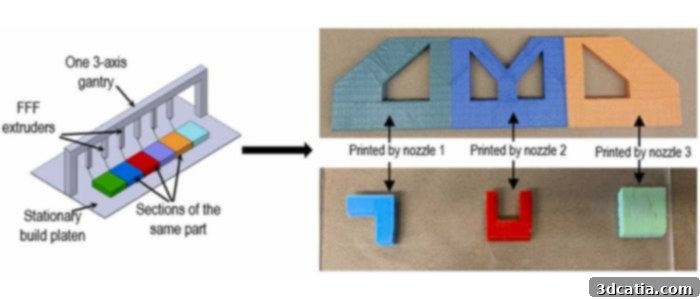
An abstract showing how the MF3 process works as well as the resulting prints (photo credits: Rutgers University)
The Critical Role of Advanced Slicer Software in MF3
A cornerstone of the MF3 process’s success is its custom-developed slicer software. In traditional 3D printing, slicers translate 3D models into machine-readable instructions, dictating the printer’s movements and extrusion patterns. For MF3, this software has been significantly advanced to optimize the gantry arm’s movement while intelligently managing multiple nozzles. The software’s capabilities extend beyond basic slicing; it can dynamically detect which nozzles should be active or inactive at any given moment to ensure peak efficiency and print quality. This intelligent nozzle management is crucial for achieving the desired throughput and resolution simultaneously.
Furthermore, the sophisticated software offers a significant secondary benefit related to printer reliability and maintenance. In the event of a nozzle clogging or malfunctioning, the MF3 software can simply disable the problematic nozzle and reallocate its tasks to other operational nozzles. This allows the printing process to continue uninterrupted, minimizing downtime and increasing overall productivity. In stark contrast, a single-nozzle FDM printer would necessitate a complete shutdown and manual intervention to resolve such an issue, leading to costly delays and potential print failures. This adaptive functionality makes MF3 inherently more robust and resilient, positioning it as a more reliable solution for demanding manufacturing environments. The ability to manage nozzle arrays dynamically also contributes to material efficiency, reducing waste by ensuring only functional nozzles are actively depositing material.
Breaking the Throughput-Resolution Tradeoff in Additive Manufacturing
One of the most significant achievements of the MF3 process is its ability to overcome the long-standing “throughput-resolution tradeoff” inherent in material extrusion additive manufacturing. This fundamental limitation has plagued FFF technology for years: users have had to choose between speed (throughput) and detail (resolution). Larger-diameter nozzles facilitate much faster material deposition, dramatically reducing print times, but inevitably result in lower resolution and a coarser finish. Conversely, smaller nozzles are essential for achieving intricate details and high surface quality, but their slower material deposition rate extends print times considerably, making them impractical for large parts or rapid prototyping.
MF3 fundamentally breaks this paradigm by not merely parallelizing the printing of distinct sections of a part, but by optimizing the use of multiple small nozzles across the entire print. By intelligently increasing the number of active nozzles and optimizing their coordinated operation through advanced software, researchers have found a way to achieve both high speed and high resolution concurrently. This means that complex geometries can be printed with fine details at speeds previously only attainable with low-resolution settings, or large parts can be produced quickly without sacrificing the intricate features. This groundbreaking capability removes existing cost and geometry limitations, opening up new possibilities for designers and manufacturers. It represents a shift from a compromise-based approach to a comprehensive solution, enabling a new class of FFF applications.
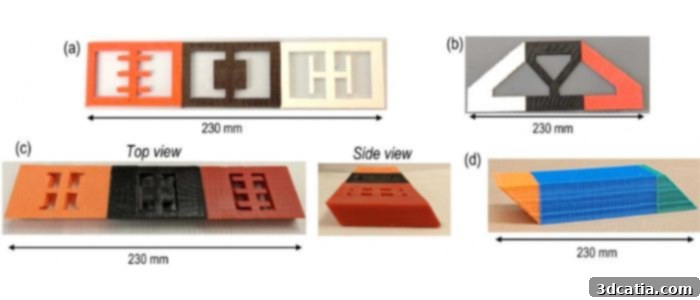
Parts printed with the MF3 prototype with a 0.4 mm diameter nozzle (photo credits: Rutgers University)
The Economic and Practical Advantages of MF3
Beyond its technical prowess, MF3 offers substantial economic and practical advantages. The ability to print large and complex parts at a fraction of the cost of other 3D printing methods is a significant driver for its potential widespread adoption. By drastically reducing printing times, MF3 lowers the operational costs associated with machine hours and energy consumption. The improved reliability due to dynamic nozzle management also contributes to lower maintenance costs and reduced material waste from failed prints. For industries requiring rapid prototyping or the production of custom end-use parts, these cost efficiencies translate directly into faster innovation cycles and more competitive product offerings. Furthermore, the capacity to increase both printing resolution and the overall size of parts simultaneously means that MF3 can address a broader range of manufacturing needs, from intricate medical devices to large architectural models or industrial components, without compromising on quality or speed.
Future Outlook and Industry Impact of this Advanced 3D Printing Technology
The implications of Multiplexed Fused Filament Fabrication for the future of additive manufacturing are profound. As Jeremy Cleeman, lead author of the study and graduate student researcher at the Rutgers School of Engineering, stated, “We have more tests to run to understand the strength and geometric potential of the parts we can make, but as long as those elements are there, we believe this could be a game changer for the industry.” This sentiment underscores the transformative potential of MF3. If ongoing research continues to validate the mechanical properties and geometric accuracy of MF3-printed parts, this technology could revolutionize various sectors including aerospace, automotive, healthcare, and consumer goods. Its ability to produce high-quality, large-scale components quickly and cost-effectively could accelerate product development, enable on-demand manufacturing, and facilitate the creation of highly customized solutions.
The development of MF3 represents a significant leap forward in making FFF technology more competitive with other advanced 3D printing methods. By tackling the core limitations of speed and resolution, Rutgers University researchers have paved the way for more efficient and versatile additive manufacturing. As the technology matures and becomes more widely available, it holds the promise of expanding the application landscape for 3D printing, driving innovation, and democratizing access to advanced manufacturing capabilities on a larger scale. The focus on software intelligence and hardware simplicity through a single gantry system points towards a future where high-performance 3D printing is not only accessible but also incredibly robust and adaptable to a myriad of industrial demands.
Conclusion: A New Era for FFF 3D Printing
The introduction of Multiplexed Fused Filament Fabrication (MF3) by Rutgers University researchers marks a pivotal moment in the evolution of FFF 3D printing. By ingeniously combining a multi-nozzle system with a single gantry and sophisticated custom software, MF3 successfully addresses critical bottlenecks in speed, resolution, and cost that have long hindered the widespread adoption of FFF for large and complex parts. Breaking the traditional throughput-resolution tradeoff, enhancing reliability through dynamic nozzle management, and offering significant cost advantages, MF3 is poised to be a true “game-changer.” This innovative FFF 3D printing process promises to usher in a new era of additive manufacturing, characterized by unprecedented efficiency, precision, and economic viability across diverse industrial applications.
What are your thoughts on the potential of the MF3 3D printing process? Share your insights and predictions in a comment below or join the conversation on our LinkedIn, Facebook, and Twitter pages! Don’t forget to sign up for our free weekly Newsletter here to receive the latest 3D printing news directly in your inbox. You can also explore all our videos on our YouTube channel for more in-depth content.