
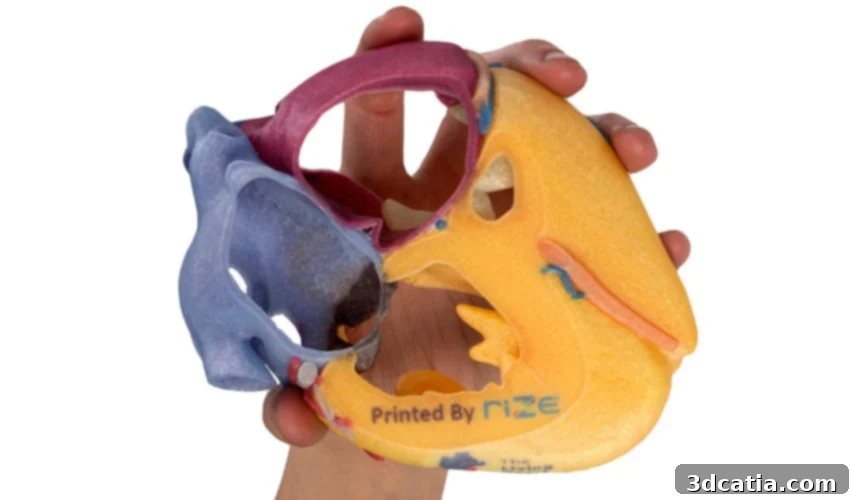
RIZE Unveils RIZIUM GF: Revolutionizing Full-Color, Glass Fiber 3D Printing for Industrial Applications
In a significant stride forward for additive manufacturing, the innovative American manufacturer RIZE recently announced the launch of RIZIUM GF, a groundbreaking glass fiber reinforced filament. This new material is specifically designed to be compatible with RIZE’s acclaimed full-color 3D printing solutions, marking a pivotal moment for the company and the industry at large. This introduction represents a strategic expansion for RIZE, aiming to equip its diverse customer base with an even broader range of applications. The core appeal of RIZIUM GF lies in its exceptional rigidity, superior dimensional stability, and remarkable precision – all while retaining the unique advantage of full-color printing capabilities. As the sole composite material engineered for the industrial xRize color 3D printer, RIZIUM GF seamlessly integrates RIZE’s proprietary Augmented Polymer Deposition (APD) technology, which ingeniously merges material extrusion 3D printing with the advanced projection technology typically found in 2D printers. This synergy allows for the creation of parts that are not only mechanically robust but also visually stunning and highly detailed.
The additive manufacturing landscape has witnessed a rapid evolution in recent years, particularly concerning the development of advanced industrial materials. This includes a growing array of high-performance thermoplastics and sophisticated composite materials. These composite plastics are strategically reinforced with various fibers—such as carbon, Kevlar, or glass—to dramatically enhance their rigidity, strength, and overall resistance, all while maintaining a crucial lightness. Such properties are indispensable in demanding sectors like aerospace, automotive, and general industrial engineering, where high performance and weight reduction are paramount. While the market for composite 3D printers continues to expand, offering robust solutions for engineers and manufacturers, a significant gap has persisted: the ability to design and produce high-strength composite parts in full color. This unmet need became a primary driving force behind RIZE’s development of its RIZIUM Glass Fiber (GF) filament. This innovative glass-reinforced thermoplastic not only delivers exceptional mechanical properties but also integrates seamlessly with the brand’s unique color 3D printing solutions, offering a truly unique proposition to the market.
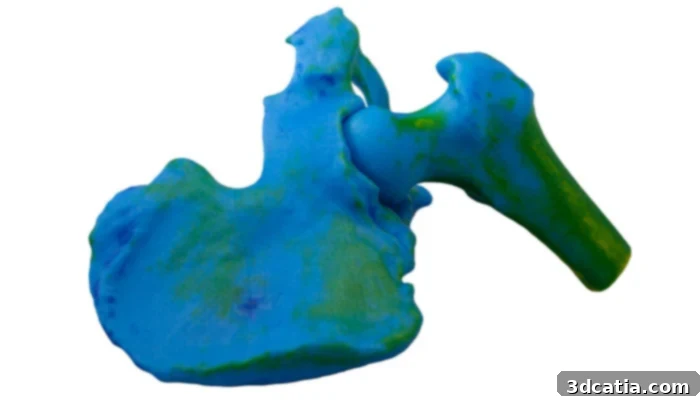
RIZIUM GF unlocks an astonishing 820,000 different color combinations, enhancing both aesthetics and functionality. (Image credits: RIZE)
Unpacking the Advanced Characteristics of RIZIUM GF Filament
The RIZIUM GF filament is engineered with a cutting-edge, proprietary matrix that leverages cyclic olefins. This advanced composition is crucial for its performance, as it is designed to virtually eliminate harmful emissions that are often associated with conventional extrusion temperatures. This makes RIZIUM GF an excellent choice for a wider range of environments, including those where air quality is a significant concern. RIZE highlights that this composite material boasts exceptional chemical resistance, ensuring printed parts can withstand exposure to various substances without degradation. Furthermore, its minimal moisture absorption is a key advantage, contributing significantly to the material’s excellent dimensional stability and preventing part deformation or property changes in humid conditions. The strategic incorporation of fiberglass reinforcement is fundamental to RIZIUM GF’s enhanced mechanical properties, boosting its inherent strength, stiffness, and overall durability. This reinforcement ensures that parts printed with RIZIUM GF are not only rigid but also capable of enduring demanding applications over extended periods.
Beyond its impressive material composition, RIZIUM GF has achieved UL GREENGUARD certification when used with the xRize 3D printer. This prestigious certification signifies that the material meets stringent chemical emissions standards, guaranteeing that it contributes to healthier indoor environments. Consequently, RIZIUM GF can be safely utilized in enclosed spaces, such as typical office settings, educational institutions, or research and development labs, without requiring specialized ventilation systems typically associated with industrial additive manufacturing. This broadens the accessibility and applicability of industrial-grade 3D printing, bringing robust, full-color capabilities closer to the design and engineering workflow.
A cornerstone of RIZIUM GF’s unique offering is its seamless compatibility with RIZE’s proprietary Augmented Polymer Deposition (APD) technology. APD is a revolutionary process that expertly combines filament extrusion with the precise application of functional inks. This innovative fusion enables the creation of parts with previously unattainable properties and an unparalleled spectrum of colors. With RIZIUM GF, manufacturers and designers can now create glass-fiber reinforced objects featuring an astounding array of more than 820,000 distinct color combinations. This is a game-changer for applications requiring both high mechanical strength and vivid, accurate aesthetics, opening up new horizons for product development and customization.
Andy Kalambi, CEO of RIZE, succinctly captures the significance of this innovation: “Until now full-color 3D printing applications could only deliver weak approximations of the original, and users often avoided large parts or complex geometries because they could warp or crack. We’re delighted to help drive a renaissance in industrial manufacturing with better 3D printing materials and technology.” His statement underscores a long-standing challenge in the additive manufacturing sector: the compromise between robust material performance and vibrant, accurate color representation. Historically, attempts at full-color 3D printing often resulted in parts that lacked structural integrity, making them unsuitable for functional prototyping or end-use applications. Furthermore, the inherent material properties of previous color-capable filaments often led to issues like warping and cracking, particularly with larger or more intricate geometries, severely limiting design freedom and part reliability. RIZIUM GF directly addresses these limitations, empowering users to create genuinely functional and aesthetically precise parts without compromise, truly initiating a renaissance in how industrial products are designed, prototyped, and manufactured.
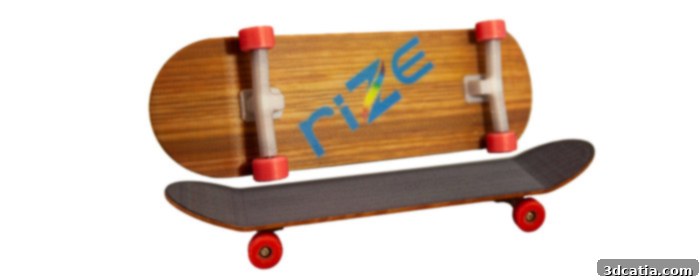
RIZIUM GF enables the creation of highly realistic, aesthetically pleasing, and remarkably resistant parts for diverse industrial needs. (Image credits: RIZE)
Transformative Applications of RIZIUM GF in Industrial 3D Printing
The versatility and enhanced properties of RIZIUM GF make it an ideal material for a wide array of industrial applications, pushing the boundaries of what’s achievable with full-color 3D printing. The manufacturer explicitly states that RIZIUM GF is exceptionally well-suited for the creation of large parts. Its superior dimensional stability and minimal moisture absorption, inherent to its proprietary matrix, significantly reduce the risk of warping and cracking that typically plague larger prints made with other materials. This reliability ensures that even sizable components maintain their intended geometry and structural integrity throughout the printing process and in their final application.
Beyond large-scale production, RIZIUM GF excels in the fabrication of functional prototypes. For engineers and designers, the ability to produce prototypes that accurately represent both the mechanical properties and the final aesthetic of a product is invaluable. RIZIUM GF’s glass fiber reinforcement provides the necessary strength and durability for rigorous functional testing, while its full-color capabilities allow for precise visual communication, branding elements, and ergonomic evaluations. This combination dramatically shortens design iterations and accelerates time to market, as prototypes can be used to validate form, fit, and function simultaneously.
Furthermore, RIZIUM GF opens up new possibilities for creating highly aesthetic pieces. From detailed architectural models to consumer product mock-ups or artistic installations, the material’s capacity for over 820,000 color combinations, coupled with its smooth surface finish and precision, ensures that visual fidelity is paramount. These pieces are not just visually appealing; their inherent strength and resistance make them suitable for display or even light functional use where aesthetics are critical. In the realm of tooling, RIZIUM GF offers significant advantages. Manufacturers can produce robust jigs, fixtures, guides, and custom assembly aids that are not only strong enough to withstand repetitive use but can also be color-coded for enhanced visual management and streamlined workflows on the factory floor. This can lead to improved efficiency, reduced errors, and faster training for operators.
Finally, RIZIUM GF is perfectly positioned for the production of finished parts, especially those requiring a high level of detail, specific chemical resistance, or environmental stability. This includes custom end-use components for machinery, low-volume specialized parts, or replacement components that benefit from both the mechanical strength of a composite and the communicative power of full color. For industries such as medical devices, consumer electronics, or specialized industrial equipment, the ability to produce strong, precise, and visually appealing end-use parts on demand represents a significant operational and strategic benefit. The UL GREENGUARD certification further allows these parts to be deployed in sensitive environments, broadening the scope of potential applications. More comprehensive details and technical specifications on this revolutionary filament can be found directly on the official RIZE website.
What are your thoughts on RIZIUM GF and its potential impact on the future of industrial full-color 3D printing? We invite you to share your insights and comments below, or engage with us on our Facebook and Twitter pages! Don’t miss out on the latest advancements and news in the world of additive manufacturing; sign up for our free weekly Newsletter to receive all the crucial updates straight to your inbox.