
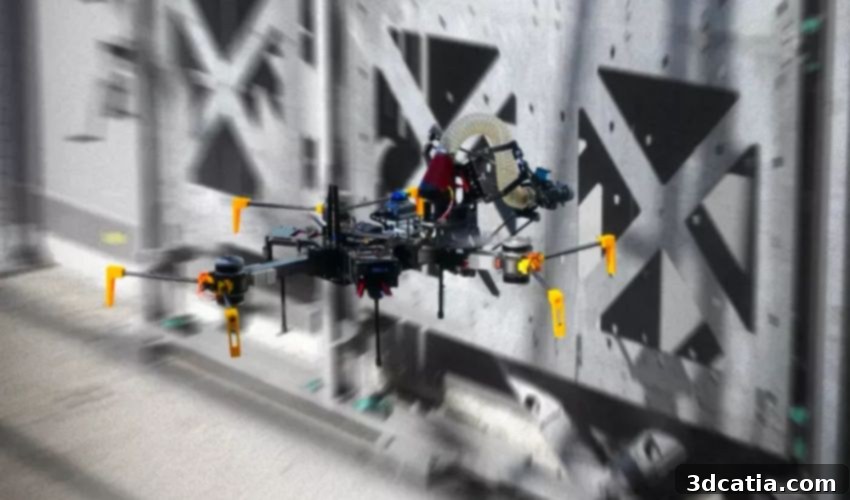
Aerial Additive Manufacturing: Revolutionizing Construction with Drone 3D Printing
Traditional additive manufacturing, commonly known as 3D printing, has dramatically transformed various industries by enabling the creation of complex geometries and custom components. However, its widespread application in large-scale construction and infrastructure development has historically been constrained by significant limitations, primarily concerning print volume and reach. Standard 3D printers are typically confined to a specific build envelope, making them unsuitable for structures exceeding a certain size. While advancements in robotic arm 3D printing have offered a partial solution by providing a greater range of motion and expanded build volumes, even these technologies ultimately face restrictions in terms of mobility and the sheer scale of projects like multi-story buildings or extensive infrastructure. Recognizing these inherent limitations, an ambitious research collaboration involving esteemed institutions such as University College London (UCL), EPFL, EMPA, and Imperial College London has embarked on pioneering research into a truly transformative approach: 3D printing with autonomous drones. Their groundbreaking study, released in May, delves into the nascent field of Aerial Additive Manufacturing (Aerial AM), identifying critical research gaps and laying the groundwork for its future development.
Aerial AM represents a paradigm shift, as drones are not tethered by the physical constraints of ground-based systems. These unmanned aerial vehicles (UAVs) possess the unparalleled ability to print both vertically and horizontally across vast distances and at significant heights, offering unprecedented flexibility and reach. This capability positions drone 3D printing as a potentially game-changing solution for overcoming the volumetric and logistical challenges that have long plagued conventional construction methods. While the promise of Aerial AM is immense, the research is still in its nascent stages. The interdisciplinary university team has meticulously identified several key knowledge gaps and highlighted the foundational problems that must be rigorously addressed to mature this innovative technology into a viable and scalable solution for real-world applications. Their preliminary analysis points to three core areas requiring intensive research and development: ensuring the durability of printed materials in diverse environments, developing robust localization systems for precise outdoor operation, and establishing sophisticated coordination protocols for multiple drones working in unison.
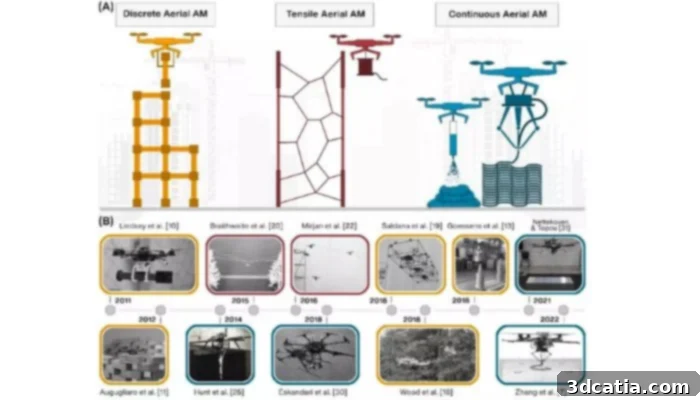
The three different methods of Aerial AM as proposed by the study
To kickstart the exploration of these complex problems and provide initial conceptual frameworks, the study proposes and investigates three distinct methods for how drone-based 3D printing could effectively operate. The first method involves drones precisely placing individual, pre-fabricated components, acting as aerial assemblers for modular structures. This approach could significantly speed up construction by reducing on-site fabrication. The second method explores the possibility of drones producing components while suspended by ropes, allowing for flexible positioning and potentially enabling the construction of intricate structures in hard-to-reach areas. The third and perhaps most ambitious method proposes that drones print continuous layers through an extrusion process, remarkably similar to traditional Fused Deposition Modeling (FDM). This technique would allow for the creation of monolithic structures layer by layer, offering greater design freedom and material efficiency. The overarching vision driving this pioneering project is to develop sustainable and innovative solutions to address pressing global challenges, particularly the severe housing shortage and the escalating infrastructure problems exacerbated by rapid urbanization and unprecedented population growth. The researchers firmly believe that Aerial AM is uniquely positioned to play a pivotal role in this endeavor, offering particularly sustainable, efficient, and adaptable solutions for future construction.
The path to successfully implementing Aerial AM on a broad scale necessitates extensive and rigorous testing in a multitude of environments. To facilitate this crucial development phase, the research team proudly inaugurated the “DroneHub,” a state-of-the-art facility specifically designed for comprehensive drone testing. This specialized hall allows researchers to simulate a wide array of weather conditions and environmental scenarios, from varying wind speeds and temperatures to simulated precipitation, ensuring that the drones and their printing mechanisms can withstand and perform optimally under real-world stresses. Initial tests within the DroneHub have already yielded promising results, demonstrating the feasibility of rapid repairs to existing structures using aerial additive manufacturing techniques. This capability alone holds immense potential for disaster relief, post-event reconstruction, and maintenance of hard-to-reach infrastructure. Furthermore, the researchers are diligently investigating and developing modular assembly techniques that are inherently compatible with drone-based construction. These modular approaches are critical for simplifying on-site assembly, enabling scalability, and facilitating the widespread adoption of Aerial AM for diverse construction projects. By systematically addressing these technical hurdles and refining operational procedures, the team is taking decisive and important first steps towards bridging the significant research gap in this immensely promising field, paving the way for a future where autonomous aerial robots contribute significantly to our built environment.
The potential applications of Aerial AM extend far beyond conventional construction. Imagine drones rapidly deploying emergency shelters in disaster zones, building intricate structures on remote terrains inaccessible to human workers or heavy machinery, or even performing maintenance and repairs on colossal infrastructure like bridges and wind turbines with unprecedented efficiency and safety. This technology could also significantly reduce construction waste, as drones can be programmed for precise material deposition, minimizing excess and promoting sustainable building practices. The development of advanced localization systems, leveraging a combination of GPS, visual odometry, and sophisticated sensor fusion, is paramount to achieving the centimeter-level precision required for structural integrity. Similarly, the ability to coordinate swarms of drones, ensuring collision avoidance, load sharing, and synchronized material delivery, demands groundbreaking advancements in artificial intelligence and robotics. The economic impact could be substantial, lowering labor costs, accelerating project timelines, and fostering innovation in construction materials. As this field progresses, it will undoubtedly raise new considerations regarding airspace regulation, safety protocols, and the integration of these autonomous systems into urban landscapes. The vision is clear: Aerial AM stands poised to redefine how we conceive, design, and construct our future, offering a truly robotic future for the built world.
What do you think of Aerial AM and its potential to revolutionize construction? We invite you to share your thoughts and insights in a comment below or connect with us on our LinkedIn or Facebook pages! Don’t miss out on the latest advancements and news in the world of 3D printing; remember to sign up for our free weekly Newsletter to receive updates directly in your inbox. You can also explore all our fascinating videos and interviews on our YouTube channel.
*Photo Credits: UCL