
Revolutionizing Technical Ceramics: How Additive Manufacturing Unlocks Unprecedented Potential
Technical ceramics represent a class of materials that have been indispensable across numerous industrial sectors for centuries, distinct from their artisanal or artistic counterparts. Esteemed for their exceptional resistance to high temperatures, superior hardness, and robust mechanical properties, these materials offer critical advantages in demanding applications. However, within the rapidly evolving landscape of additive manufacturing, ceramics have historically trailed behind polymers and metals, occupying a somewhat niche market. Despite this, 3D printing technologies present an exceptionally compelling and transformative fit for these materials, effectively addressing their inherent challenges.
The unique characteristics of technical ceramics—such as their brittleness and refractory nature—make them notoriously difficult to shape using conventional manufacturing methods. This is precisely where additive manufacturing emerges as a highly relevant and innovative alternative, enabling the creation of intricate and complex geometries that would otherwise be impossible or prohibitively expensive to produce. Currently, ceramic materials are compatible with several prominent 3D printing processes, including photopolymerization (which encompasses stereolithography and Digital Light Processing), powder bed fusion (like Selective Laser Sintering and Binder Jetting), and material extrusion (similar to Fused Deposition Modeling). These advanced capabilities offer a multitude of advantages to manufacturers, research laboratories, and innovation centers seeking to push the boundaries of material science and product design.
Among the pioneering institutions leveraging these technologies is the Research Center of the Belgian Ceramic Industry (CRIBC). For over two decades, CRIBC has strategically invested in additive manufacturing, driven by the ambition to produce parts with highly complex geometries. Their extensive research and development efforts have involved experimenting with various ceramic 3D printing processes, including the innovative technology offered by French manufacturer Pollen AM, to compare and evaluate the quality, characteristics, and performance of the resulting parts.
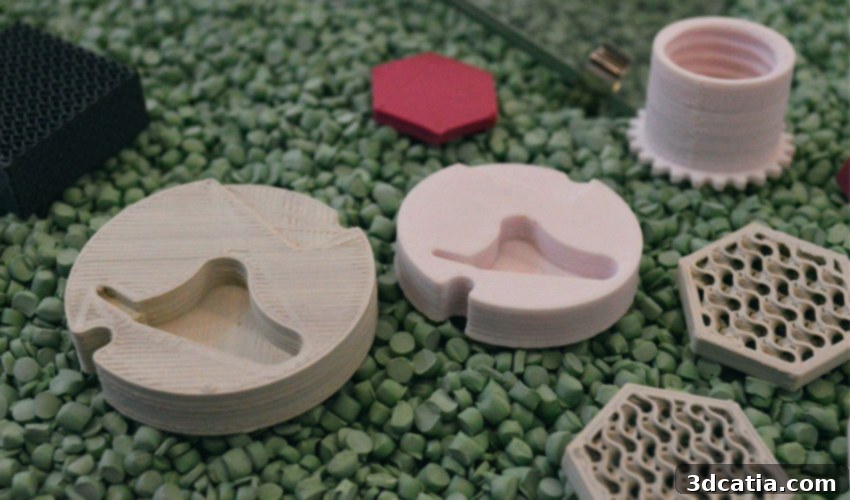
Technical ceramics, traditionally challenging to shape, now benefit from additive manufacturing to realize complex geometries (photo credits: 3Dnatives)
Overcoming Traditional Manufacturing Hurdles for Technical Ceramics
The inherent nature of technical ceramics—their fragility, hardness, and high melting points—renders them intrinsically difficult to shape using conventional methods such as machining, molding, or pressing. When the design calls for intricate or complex geometries, these traditional processes often lead to significantly extended lead times, escalated production costs, and limitations in design freedom. The high material waste, specialized tooling requirements, and the risk of component breakage during post-processing further exacerbate these challenges. Additive manufacturing, or 3D printing, directly addresses these formidable hurdles. Its core promise lies in its ability to fabricate parts with unprecedented geometric complexity and customization, all while meticulously preserving the superior intrinsic properties of the ceramic material. This means engineers can now design parts optimized for performance rather than constrained by manufacturing limitations, paving the way for innovative applications across diverse industries.
Exploring the Diverse World of Technical Ceramics in Additive Manufacturing
The market for technical ceramics is incredibly diverse, offering a wide spectrum of materials engineered to meet specific requirements across various industries. In the realm of additive manufacturing, this diversity is increasingly being harnessed to create components for demanding applications. The most widely utilized family in ceramic 3D printing is undoubtedly **oxidized ceramics**. As their name suggests, these materials are composed of metal oxides like alumina (aluminum oxide) and zirconia (zirconium dioxide). Alumina is highly valued for its excellent electrical insulation, wear resistance, and high strength, making it ideal for electronic substrates, cutting tools, and structural components. Zirconia, on the other hand, is renowned for its exceptional toughness, fracture resistance, and biocompatibility, leading to its widespread use in the medical sector for creating highly durable bone implants and dental prosthetics, as well as in the precision watchmaking industry for intricate, wear-resistant components. Beyond these, oxidized ceramics find applications in aerospace, automotive, and energy sectors due to their thermal stability and chemical inertness.
Following oxidized ceramics, **non-oxidized ceramics** represent another crucial category, distinguished by their superior mechanical performance, exceptional temperature resistance, and specific functional properties. This family primarily includes nitride materials and carbides. Nitrides, such as silicon nitride and boron nitride, combine excellent strength, high hardness, and superior thermal shock resistance, making them suitable for high-temperature structural parts, bearings, and cutting tools where extreme conditions are present. Carbides, exemplified by silicon carbide and tungsten carbide, are celebrated for their extraordinary hardness and outstanding tribological resistance (resistance to wear and friction). To illustrate their impressive properties, silicon carbide is three times harder than steel, highlighting its utility in abrasive environments, ballistic protection, and high-performance braking systems. Tungsten carbide, known for its incredible density and hardness, is widely used in cutting tools, armor plating, and heavy-duty wear parts. The ability to precisely shape these advanced non-oxidized ceramics through additive manufacturing significantly expands their potential applications in areas demanding ultimate durability and performance.
Comparative Analysis of Ceramic Additive Manufacturing Technologies
In the realm of additive manufacturing, developers and researchers can employ various technological approaches to fabricate their ceramic components. However, it is crucial to understand that not all processes are compatible with every family of ceramics, and each technology presents its own set of advantages and limitations. The Research Center of the Belgian Ceramic Industry (CRIBC) has conducted extensive testing across multiple ceramic 3D printing processes, meticulously comparing the quality, characteristics, and performance of the resulting parts.
Fabrice Petit, Program Manager Manufacturing Processes at CRIBC, offers valuable insights: “There is a broad spectrum of additive technologies available for ceramics, but critically, none of them universally supersede the others. The optimal choice is always dictated by the specific application and desired material properties. For instance, **stereolithography (SLA)** and Digital Light Processing (DLP), which fall under photopolymerization, are particularly well-suited for producing small, highly detailed parts with intricate internal structures and low mass. These methods excel in achieving exceptional surface finishes and fine resolution, making them ideal for prototypes, micro-components, or precision molds. However, they can be limited by the viscosity of ceramic-filled resins and the size of printable objects.
**Powder bed fusion** processes, such as Selective Laser Sintering (SLS) or Binder Jetting, offer the capability to design larger parts. However, a common drawback for ceramics in these processes is the high porosity of the ‘green’ (unsintered) parts, which necessitates intensive post-processing like sintering to achieve acceptable density and mechanical strength. This porosity can limit their use in applications requiring high mechanical integrity without extensive secondary operations. Moreover, managing fine ceramic powders in a powder bed system can present occupational health risks, particularly concerning respiratory exposure, and typically requires dedicated, well-ventilated laboratory environments due to the nature of the materials.
In my professional opinion, **extrusion processes** generally remain the most interesting and versatile for ceramic additive manufacturing. I specifically highlight Pollen AM’s technology in this regard because it ingeniously leverages materials in the form of granules, which are commonly found and readily available in the injection molding industry. This approach offers significant advantages: it makes Pollen AM’s machines ‘open’ to a wider range of materials, substantially reduces the cost of raw materials, and dramatically expands the field of possibilities for ceramic 3D printing. The process is also inherently cleaner and more straightforward to manage compared to powder-based systems.”
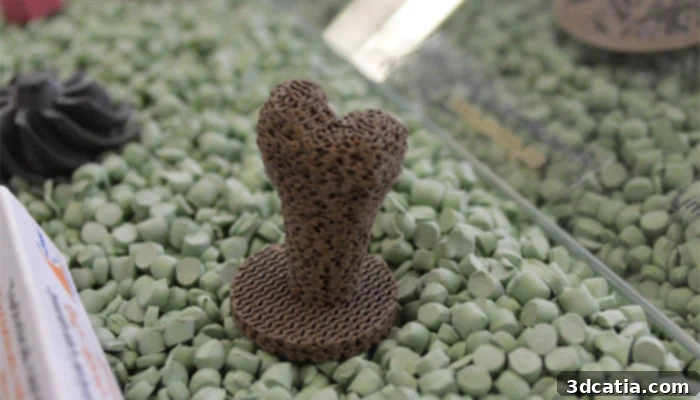
An exemplary 3D printed part in zirconia, fabricated by the CRIBC using a Pollen AM machine (photo credits: 3Dnatives)
The Strategic Choice of Pollen AM Technology by CRIBC
The Research Center of the Belgian Ceramic Industry (CRIBC) has forged a strong partnership with Pollen AM, primarily focusing on the additive manufacturing of oxide ceramics using their advanced extrusion technology. While oxides remain a cornerstone of their research, CRIBC is actively expanding its material portfolio to include nitrides, particularly to address applications demanding superior high-temperature performance and wear resistance. Looking ahead, the research center also plans to rigorously test carbides, including the incredibly hard and durable tungsten carbide, further broadening the scope of materials compatible with Pollen AM’s system.
CRIBC’s evaluation of Pollen AM’s technology is comprehensive, extending to the detailed characterization of manufactured parts, encompassing diverse geometries such as intricate lattice structures, miniature nitride micro-turbines, and robust tungsten carbide cutting tools. The results consistently demonstrate a high level of satisfaction. Pollen AM’s extrusion process reliably produces high-quality ceramic parts that exhibit excellent surface finishes and possess the mechanical integrity necessary to withstand significant stress and demanding operational conditions. This capability is critical for moving ceramic additive manufacturing from prototyping to functional end-use parts.
Indeed, a significant challenge inherent in ceramic additive manufacturing revolves around controlling the porosity of the final parts. If the porosity is too high, the mechanical performance—including strength, hardness, and wear resistance—will be severely compromised, rendering the part unsuitable for its intended application. Achieving high density and low porosity is paramount for unlocking the full potential of engineered ceramics. Furthermore, the surface condition of 3D printed ceramic components is a key determinant of their long-term durability. A degraded or poor surface finish can act as a stress concentration point, leading to the initiation and propagation of cracks, ultimately causing part failure under operational stress. Precision in printing and subsequent post-processing (such as sintering) is therefore essential to ensure robust and reliable performance.
Fabrice Petit elaborates on the broader implications: “Ceramic additive manufacturing, much like all 3D printing technologies, fundamentally offers unprecedented freedom of design. I believe this aspect is even more profoundly relevant when applied to ceramics, precisely because of their unique characteristics and superior properties. The ability to create complex internal structures, optimized topologies, and highly customized components allows for entirely new design paradigms that exploit the inherent strengths of ceramics in ways previously unattainable through conventional methods.” This design freedom translates into lighter, stronger, and more efficient ceramic parts for industries ranging from aerospace to medical devices.
Beyond performance and design capabilities, Pollen AM’s extrusion process offers distinct practical advantages over other ceramic 3D printing technologies. For instance, powder bed processes, while versatile, often pose significant health risks to operators, particularly concerning their respiratory tracts, due to the fine airborne ceramic powders. These systems also typically demand specialized facility installations, including dedicated ventilation and dust management systems, in the working environment. In stark contrast, Pollen AM’s machine can be operated safely and cleanly even within a closed office setting, significantly reducing health and safety concerns and simplifying installation requirements.
Fabrice Petit concludes by summarizing the overall benefits: “From a practical and operational point of view, Pollen AM (PAM) technology presents serious advantages over many other ceramic 3D printing technologies. When you combine this ease of use with its broad material compatibility, the cost-effectiveness of using granular materials, and the consistently high quality of the resulting parts, it truly stands out as an ideal ceramic additive manufacturing solution.” This combination of factors positions Pollen AM as a leader in making high-performance ceramic additive manufacturing more accessible and efficient for industrial applications. You can find more information about engineered ceramics and PAM technology HERE.
Do you currently utilize technical ceramics in your additive manufacturing projects? We invite you to share your experiences and insights in the comments section below, or connect with us on our social media channels: LinkedIn, Facebook, and Twitter. Don’t miss out on the latest advancements and news in the 3D printing world—subscribe to our free weekly Newsletter here, delivered straight to your inbox! Additionally, explore all our informative videos and content on our dedicated YouTube channel.