
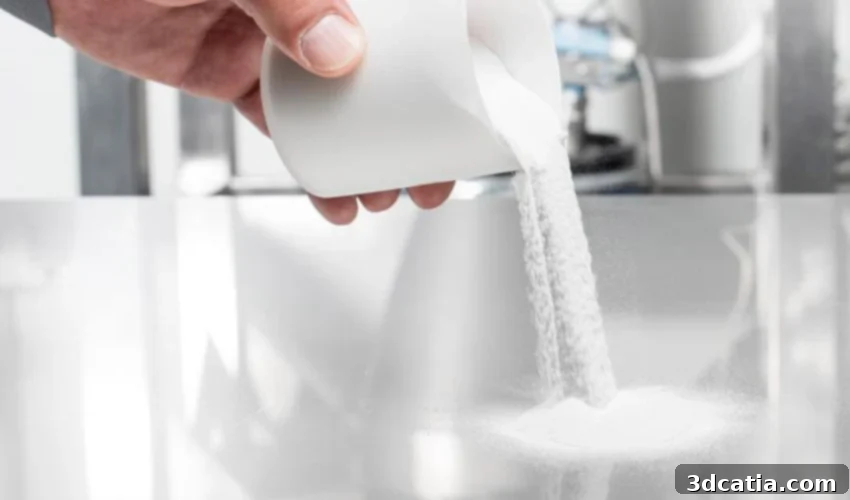
Polymer 3D Printing Market Explodes: SmarTech Analysis Forecasts $55 Billion by 2030 Driven by Industrial Adoption
The landscape of manufacturing is undergoing a profound transformation, with additive manufacturing at the forefront of this revolution. A recent comprehensive report from SmarTech Analysis, a leading research firm specializing in the additive manufacturing industry, sheds crucial light on the burgeoning polymer 3D printing market. Their fourth annual report paints an incredibly optimistic picture, projecting a staggering growth trajectory from $11.7 billion in revenues in 2020 to an estimated $24 billion by 2024, culminating in an impressive $55 billion by the close of 2030. This monumental expansion is not merely a statistical anomaly but a reflection of deep-seated industrial shifts and technological advancements, primarily fueled by the accelerating adoption of powder bed processes across various sectors.
The report highlights that the significant uptick in powder bed fusion technologies is a key driver for this market surge. Manufacturers are increasingly drawn to these processes due to their superior productivity, enhanced scalability, and the unprecedented ability to produce parts in series. This makes them particularly appealing for industrial applications where efficiency, repeatability, and cost-effectiveness are paramount. SmarTech Analysis adopted a meticulous vertical approach for this year’s study, delving into specific applications and crucial sectors such as automotive, aeronautics, and consumer goods. The analysis meticulously examined all categories of parts, ranging from rapid prototypes and complex molds to specialized tooling and, most notably, high-performance end-use components. The study further segmented the vast array of 3D printing processes into four principal families: powder bed fusion, extrusion, photopolymerization, and material jetting, each uniquely aligned with one or more specific polymer material types.
The Enduring Strength of Polymer Additive Manufacturing
While the past few years have undeniably witnessed the impressive rise of metal additive manufacturing, spurred by new entrants aiming to democratize the technology, the polymer 3D printing market has demonstrated remarkable resilience and continued strength. Polymers have consistently offered a broader spectrum of materials and often faster processing speeds, making them exceptionally well-suited for a diverse array of industrial applications. The sheer diversity of materials available in the polymer segment is a testament to its robustness, encompassing standard thermoplastics, advanced technical polymers, high-performance variants, versatile resins, fine powders, and innovative composite materials. This rich material ecosystem empowers professionals to engineer parts with mechanical, chemical, and physical properties that closely emulate those achieved through conventional manufacturing techniques, thereby bridging the gap between prototyping and true production. This ability to replicate traditional material characteristics through additive processes is critical for industries seeking customized solutions without compromising performance.
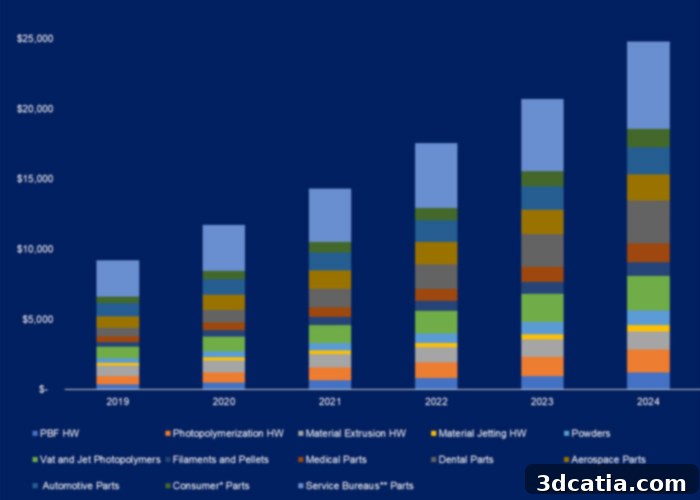
Polymer additive manufacturing revenues from 2019 to 2024 (in millions of dollars)
Shifting Dynamics: Powder Bed Fusion Takes the Lead
For many years, photopolymerization (primarily Stereolithography, SLA, and Digital Light Processing, DLP) and extrusion processes (most notably Fused Deposition Modeling, FDM, or Fused Filament Fabrication, FFF) held sway over the polymer 3D printing market. These technologies were pioneers, establishing the groundwork for the industry and demonstrating immense versatility with a wide range of materials, including resins, filaments, and granules. Their widespread adoption in prototyping and specific functional applications made them ubiquitous, valued for their accessibility and relative simplicity of operation. However, the latest insights from SmarTech Analysis indicate a significant paradigm shift, with powder bed processes rapidly gaining prominence and market share.
The report forecasts that powder bed fusion technologies are poised to generate more revenue than extrusion processes by 2024, and will closely rival photopolymerization in terms of market value. This ascendancy is largely attributable to the inherent advantages of technologies like Selective Laser Sintering (SLS). SLS, for instance, is increasingly aligned with the evolving needs of industrial manufacturers. It offers unparalleled capabilities for volume production, achieving high levels of productivity, and delivering exceptional repeatability batch after batch. Furthermore, parts produced via SLS typically exhibit superior mechanical performance, making them suitable for demanding end-use applications where structural integrity and durability are critical. The ability to print complex geometries without support structures and produce isotropic parts (with uniform properties in all directions) further cements powder bed fusion’s position as a preferred technology for advanced manufacturing. This shift reflects a market demand for more robust, production-ready polymer parts that traditional methods struggled to provide efficiently.
Materials Fueling Innovation: The Rise of Polyamides
Reflecting the shifts in process dominance, it is no surprise that plastic powders, particularly polyamides, are experiencing rapid growth in adoption. Polyamide 12 (PA12) and Polyamide 11 (PA11) are at the forefront of this trend, seeing increasingly widespread use across various industries. This accelerated adoption can be partly attributed to the significant entry of major players like HP into the additive manufacturing market. HP, now firmly established among the top 5 largest international manufacturers, has heavily invested in Multi Jet Fusion (MJF), a powder bed technology that predominantly utilizes PA12 and PA11. These materials offer an excellent balance of mechanical properties, including high strength, flexibility, impact resistance, and chemical inertness, making them ideal for a broad spectrum of industrial applications from automotive components to medical devices and consumer products. The continuous development of new polymer formulations, including flexible TPEs (Thermoplastic Elastomers) and robust PEEK (Polyether Ether Ketone) and PEKK (Polyetherketoneketone) materials for high-performance applications, further expands the possibilities of polymer 3D printing, catering to ever more demanding industry requirements for parts that can withstand harsh environments and rigorous use.
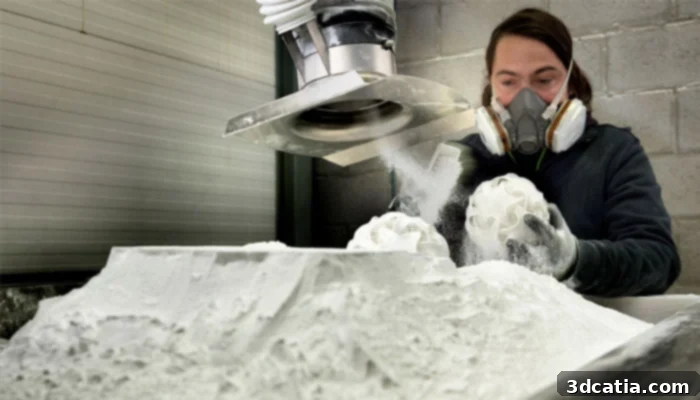
Polyamides are increasingly used | Credits: Flanders Investment & Trade
Sectoral Impact: Automotive, Aeronautics, and Consumer Goods Lead the Way
The SmarTech Analysis study not only forecasts market values but also identifies the key sectors poised to become the largest adopters of polymer 3D printing in the coming decade. Automotive and aeronautics industries are projected to be the leading consumers of plastic 3D printing processes over the next ten years. While these sectors have traditionally utilized additive manufacturing extensively for rapid prototyping and creating specialized tooling, jigs, and fixtures, there is a clear and accelerating trend towards the production of more and more end-use parts. In automotive, this translates to lightweighting components, producing custom interior elements, and rapidly iterating designs for performance vehicles. The ability to quickly produce functional prototypes and short-run production parts significantly reduces development cycles and costs, giving manufacturers a competitive edge.
For aeronautics, polymer 3D printing enables the creation of lighter, more complex cabin interiors, custom ducts, and even functional components that meet stringent aerospace requirements, contributing to fuel efficiency and reduced operational costs. The lightweighting capabilities are particularly valuable in aerospace, where every gram saved translates to substantial savings over the lifetime of an aircraft. Complex geometries, which are often impossible or prohibitively expensive to produce with traditional methods, become feasible with additive manufacturing.
Following closely, the consumer goods sector is also identified as a significant growth area, primarily driven by the burgeoning demand for customization and personalization. From bespoke footwear and eyewear to personalized gadgets and short-run production of niche products, polymer 3D printing offers unparalleled flexibility and speed to market. This capability allows brands to respond swiftly to consumer trends, offer unique product lines, and even involve customers in the design process, creating a more engaging and responsive market. Beyond these primary sectors, the medical and dental fields are also experiencing rapid integration of polymer 3D printing for custom prosthetics, surgical guides, dental aligners, and patient-specific anatomical models, demonstrating the technology’s versatile impact across critical industries and improving patient outcomes.
Future Outlook and Concluding Thoughts
SmarTech Analysis forecasts that the total value of 3D printed plastic parts will reach an impressive $40 billion by 2030. While this figure represents substantial growth within the additive manufacturing realm, it remains relatively modest when compared to the colossal scale of the traditional manufacturing industry as a whole. This indicates that there is still immense untapped potential for polymer 3D printing to penetrate deeper into mass production workflows and mainstream manufacturing. The ongoing advancements in printer speed, material science, automation, and post-processing technologies are continually pushing the boundaries of what is possible, making additive manufacturing an increasingly viable and attractive option for a wider range of applications. Furthermore, the integration of Industry 4.0 principles, including artificial intelligence, machine learning, and IoT (Internet of Things) with 3D printing workflows, promises to unlock even greater efficiencies and capabilities, streamlining the entire production cycle from design to finished part.
The trajectory of polymer 3D printing is unequivocally upward, characterized by technological maturation, expanding material portfolios, and growing industrial acceptance. The shift towards powder bed fusion and the surging demand for robust materials like polyamides underscore a market that is evolving to meet the rigorous demands of production environments. As the technology continues to mature, it will undoubtedly play an even more pivotal role in shaping the future of manufacturing, fostering innovation, and enabling new possibilities for design and production across every conceivable industry. The collaborative efforts between material developers, hardware manufacturers, and end-users are creating a synergistic environment that will further accelerate adoption and broaden the scope of applications. You can find more detailed information regarding SmarTech’s comprehensive projections and analyses HERE.
What are your thoughts on this exciting predicted growth by SmarTech Analysis? Do you believe polymer 3D printing will surpass traditional manufacturing in specific niches? Share your insights in a comment below or join the conversation on our Facebook and Twitter pages! Don’t miss out on the latest advancements and sign up for our free weekly Newsletter, delivering all the essential news in 3D printing straight to your inbox!