
Thermwood Revolutionizes Marine Manufacturing with the World’s First 3D Printed 51-Foot Yacht Hull Mold
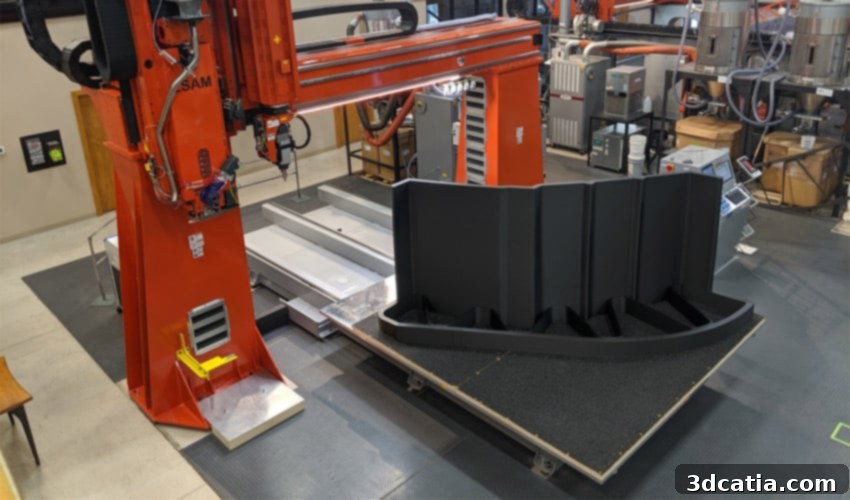
In a monumental leap forward for large-format additive manufacturing, Thermwood, a leading manufacturer of innovative industrial 3D printing solutions, has successfully 3D printed multiple sections of a full-scale mold for a colossal 51-foot yacht hull. This groundbreaking achievement marks a pivotal moment, showcasing the immense potential of additive manufacturing within the demanding marine industry. By meticulously utilizing carbon fiber reinforced ABS — a material celebrated for its strength, durability, and relatively cost-effective nature — Thermwood has not only developed a robust and functional mold but has also firmly established additive manufacturing as a critical player in the fabrication of large vessels. This project is not Thermwood’s first foray into the maritime sector; in 2017, the company successfully printed a master mold that was subsequently used to produce several smaller boat hull molds. The current endeavor, however, elevates the application to an unprecedented scale, illustrating how advanced 3D printing technology can be harnessed to create single, massive molds for the construction of significant vessels like luxury yachts, transforming traditional shipbuilding paradigms.
The design and fabrication of large-format parts present unique engineering challenges across various industries, and the marine sector is no exception. Companies tackling these large-scale projects often explore diverse approaches. Some invest heavily in industrial 3D printers equipped with exceptionally large build plates, providing a single, expansive printing volume. Others opt for sophisticated robotic arms capable of traversing and depositing material over extensive surface areas, offering flexibility and reach. However, a significant proportion of users, particularly for extremely large structures, still rely on a more or less complex assembly phase, where smaller, manageable segments are printed and then joined together to form the complete structure. Despite the inherent complexities and potential constraints associated with multi-part assembly, this technique remains incredibly efficient and often indispensable for manufacturing truly colossal components. Recalling the marine sector’s prior innovations, many will remember MAMBO, the impressive fiberglass boat that was entirely 3D printed, serving as an early testament to the technology’s capabilities. Thermwood, with its LSAM (Large Scale Additive Manufacturing) technology, brilliantly combines the advantages of XXL-scale printing with a streamlined assembly process, enabling them to construct parts that can span an astonishing 51 feet in length, pushing the boundaries of what’s possible in additive manufacturing.
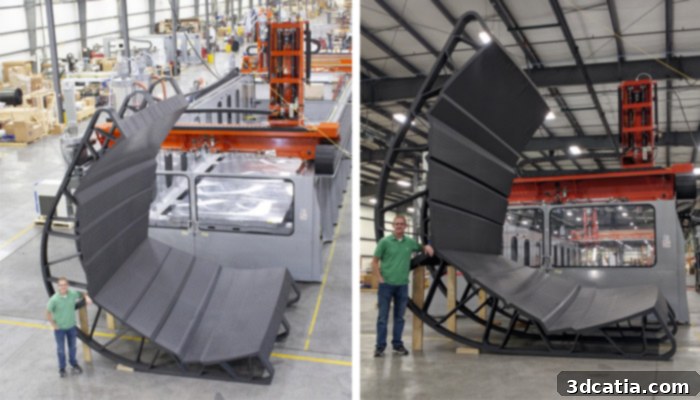
One of the 3D printed sections of the mold of the yacht’s hull (Image credits: Thermwood)
Unveiling Thermwood’s LSAM Technology and Material Selection for Marine Molds
For this ambitious project, Thermwood leveraged their highly capable yet “smallest” industrial 3D printer in the LSAM line, the LSAM MT (Medium Table), which boasts an impressive print volume of 10×10 feet. This machine was instrumental in designing and producing individual mold sections, each reaching up to 5 feet in height. The segmented approach is crucial for managing the sheer scale of the 51-foot yacht hull mold. Once printed, these individual sections undergo a sophisticated joining process. They are chemically bonded using advanced, high-strength polymer cables, creating a robust and seamless connection between segments. Following this, the sections are further reinforced and mechanically bonded, ultimately forming two colossal mold halves. These two halves are then meticulously bolted together to construct the complete, full-sized mold for the yacht hull, ensuring structural integrity and precise alignment. The four primary 3D printed sections, integral to this mold, collectively weigh over 4,012 pounds, a testament to their substantial size and durability. The entire printing process for these critical components alone demanded an intensive 65.5 hours of continuous operation, highlighting the scale and complexity involved.
The choice of material for this monumental mold was a critical factor in its success. Thermwood opted for carbon fiber-reinforced ABS (Acrylonitrile Butadiene Styrene) for the entire assembly. This advanced composite material offers an optimal balance of properties essential for large-scale tooling applications. Carbon fiber reinforcement significantly enhances the mechanical properties of standard ABS, imparting superior strength, rigidity, and dimensional stability. These characteristics are vital for a mold that must withstand the significant stresses of composite lay-up, vacuum bagging, and curing processes typical in yacht construction. Beyond its exceptional performance, carbon fiber-reinforced ABS also stands out for its relative affordability when compared to many other high-performance composites available on the market. This cost-effectiveness, combined with its robust attributes, makes it an ideal material for producing large, durable, and economically viable tooling solutions, further demonstrating the practical advantages of additive manufacturing in industrial contexts. The selection underscores Thermwood’s commitment to delivering high-performance, cost-efficient solutions that push the boundaries of what is achievable in marine manufacturing.
Innovative Design Features for Enhanced Usability and Efficiency
The meticulously designed mold incorporates several innovative features that significantly enhance its usability and efficiency in the boat-building process. Each individual section of the mold, for instance, includes a precisely molded rocker profile. This ingenious design allows the fully assembled mold to rest securely on these rockers, providing inherent stability during various stages of manufacturing. Beyond stability, this rocker system dramatically facilitates the handling of the massive mold. Boat builders can easily turn over and tilt the mold by approximately 45 degrees to either side, allowing for optimal access to different sections of the hull during the lay-up and finishing processes. This flexibility is critical for ensuring uniform material application, easier inspection, and ergonomic working conditions for technicians. According to Thermwood, this thoughtful design minimizes the need for complex and cumbersome crane maneuvers, streamlining the workflow and improving safety in the workshop. The integrated rocker system is a prime example of how additive manufacturing allows for the incorporation of complex, functional geometries directly into the tooling, features that would be difficult and costly to achieve with traditional mold-making techniques.
Further augmenting the mold’s functionality is a set of molded wedges, strategically attached to the scales that support the structure. These wedges play a crucial role in holding the mold firmly in the desired position, preventing unwanted movement during critical manufacturing operations. The precision of 3D printing ensures that these wedges integrate perfectly with the mold’s geometry, offering reliable support. The entire process, from hull creation to release, has been carefully orchestrated for maximum efficiency: “A set of molded wedges is attached to the scales to hold the mold in the desired position. Once the shell has been put in place and completely hardened, the mold is rolled up level and the printed corners are attached on both sides, keeping them level. Then, the two sides of the mold can be unscrewed and moved apart to release the hull from the finished boat.” This detailed explanation highlights the systematic approach to using the mold, from initial composite lay-up to the final demolding of the finished yacht hull. The ability to easily level, position, and then separate the mold halves significantly reduces demolding time and effort, minimizing potential damage to the finished part and extending the lifespan of the mold itself. These sophisticated features underscore the transformative impact of additive manufacturing on tooling design, enabling highly customized and optimized solutions for specialized industrial applications.
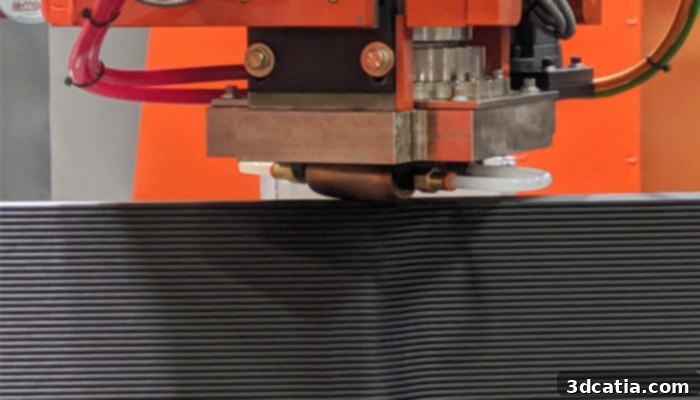
Thermwood chose to 3D print with ABS composite, leveraging its strength and affordability
The Broader Impact of Large-Format Additive Manufacturing on Industry
This project unequivocally demonstrates Thermwood’s exceptional ability to 3D print large-sized molds, proving the viability and efficiency of their LSAM technology for virtually any final application requiring substantial tooling. The successful creation of a 51-foot yacht hull mold serves as a powerful case study, illustrating several key advantages that additive manufacturing brings to industries traditionally reliant on conventional methods. Firstly, it drastically reduces lead times. Traditional mold making, often involving extensive manual labor, carving, and multi-stage fabrication, can take months. With 3D printing, complex geometries can be realized in a fraction of that time, accelerating product development cycles. Secondly, it offers significant cost savings, particularly for custom or short-run production. The ability to print molds directly from digital designs eliminates the need for expensive and time-consuming intermediate steps, such as creating patterns or master models. This direct digital manufacturing process also minimizes material waste, as additive processes build parts layer-by-layer, using only the necessary material.
Beyond the marine sector, the implications of Thermwood’s achievement resonate across numerous heavy industries, including aerospace, automotive, construction, and wind energy. The demand for large, custom, and highly complex tooling in these sectors is constant, and additive manufacturing provides an agile, cost-effective, and highly customizable solution. For instance, in aerospace, large composite tools for aircraft components could be printed faster and lighter. In the automotive industry, molds for large body panels or specialized vehicle parts could benefit from similar efficiencies. The inherent design flexibility offered by 3D printing means that molds can be optimized for specific manufacturing processes, integrating features like cooling channels or vacuum ports directly into the tool’s structure, enhancing performance and longevity. This capability for rapid iteration and customization further distinguishes additive manufacturing from traditional fabrication methods, enabling businesses to respond faster to market demands and innovate more freely.
Thermwood’s pioneering work with their LSAM systems underscores a paradigm shift in how large industrial tools and components are conceived and manufactured. By demonstrating that such immense and intricate structures can be precisely and efficiently 3D printed, they are not just providing a new method; they are opening doors to entirely new possibilities for design, production, and material utilization across global manufacturing landscapes. Their continued innovation, combining robust machinery with advanced material science, positions them at the forefront of this industrial revolution. To delve deeper into the vast capabilities of Thermwood’s diverse range of machines and discover how their LSAM technology is reshaping industries, more comprehensive information can be found directly on their website HERE.
What are your thoughts on Thermwood’s impressive 3D printed yacht hull mold and its potential to transform the marine industry? We invite you to share your insights and comments below, or engage with us on our social media platforms. Join the conversation on our Facebook page and follow us on Twitter for the latest updates in the world of additive manufacturing. For all the newest developments, breakthroughs, and essential news in 3D printing delivered directly to your inbox, don’t forget to sign up for our free weekly Newsletter. Stay informed and connected with the future of manufacturing!