

Microlight3D Revolutionizes Construction: 3D Printed Microstructured Concrete for Natural Building Cooling and Sustainable Cities
In a significant stride towards sustainable urban development, French 3D printer manufacturer Microlight3D has emerged as a beacon of innovation, securing the prestigious European FET-Open program (Future Emerging Technology) award. This recognition highlights their groundbreaking work on microstructured concrete, a revolutionary material designed to allow buildings to cool naturally, significantly reducing energy consumption and environmental impact. Leveraging its advanced micro-printing technology, specifically two-photon polymerization, Microlight3D is pioneering a greener alternative to conventional concrete construction, promising a cooler, more sustainable future for our built environments.
Microlight3D: A Legacy of Precision and Innovation in Micro-Printing
Microlight3D is no stranger to pushing the boundaries of what’s possible with additive manufacturing. For over two years, the company has captivated the industry with its Altraspin machine, a remarkable 3D printer offering unparalleled submicron resolution. This cutting-edge device is capable of creating intricate objects with features less than 0.2 microns wide, demonstrating an extraordinary level of precision that sets Microlight3D apart. Their expertise in crafting minuscule structures has been showcased through astonishing feats, including the creation of the smallest pyramid of 3D printed champagne flutes and the world’s most diminutive replica of the Statue of Liberty. These achievements underscore the company’s mastery over micro-scale fabrication, a capability now being channeled into addressing one of the most pressing global challenges: climate-resilient construction. With this latest endeavor, Microlight3D embarks on a transformative project within the construction sector, joining forces with five leading universities as part of the European consortium MIRACLE. This ambitious four-year project unites researchers from Germany, Belgium, Italy, and Spain, pooling diverse expertise to bring this innovative vision to life.
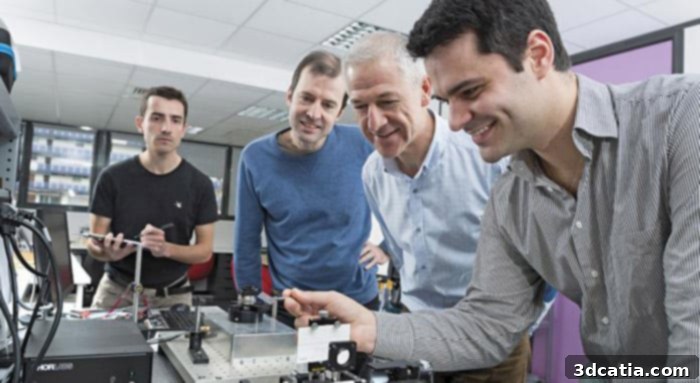
Microlight3D’s advanced two-photon polymerization technology enables the creation of intricate microstructures (photo credits: E.Tolwinska)
The MIRACLE Project: Harnessing Two-Photon Polymerization for Passive Cooling
At the heart of Microlight3D’s involvement in the MIRACLE consortium lies its proprietary two-photon polymerization process. This sophisticated additive manufacturing technique will be instrumental in designing and fabricating highly precise microstructures that will serve as molds for a new generation of concrete. The intricate geometries created through this process are critical to the project’s success, as they enable the formation of a groundbreaking material with inherent cooling properties. As detailed in the official press release, the innovative approach involves: “With the concrete formed using these unique molds, it will be possible to insert microfibers within the microtopographies to create a “photonic metamaterial” that can convert the sun’s heat into infrared wavelengths that are then projected back into the atmosphere. In turn, buildings made from this material would theoretically be able to expel heat back into outer space without using additional energy.” This explains the core mechanism: a passive, energy-free cooling system embedded directly within the building material itself. Unlike traditional cooling methods that require substantial energy input, this photonic metamaterial acts as a thermal radiator, reflecting solar energy and emitting internal heat outwards, providing a sustainable solution to escalating cooling demands.
Transforming Urban Landscapes: Mitigating Heat Islands and Reducing Emissions
The widespread adoption of this microstructured concrete holds immense potential for naturally cooling concrete buildings, especially in dense urban environments. By enabling the concrete to lower its temperature autonomously, the demand for conventional air conditioning systems would be drastically reduced. This, in turn, translates into a significant decrease in electricity consumption and, consequently, a substantial reduction in CO2 emissions—a primary objective of the MIRACLE consortium. As cities continue to expand and global temperatures rise, the phenomenon of ‘urban heat islands’ becomes an increasingly critical concern. These areas experience significantly higher temperatures than surrounding rural locales due to absorbed solar radiation by dark surfaces like asphalt and concrete, leading to increased energy use, discomfort, and health risks during heatwaves. Denis Barbier, co-founder and CEO of MicroLight 3D, underscores the urgency and importance of their work: “We are developing a technology that has the potential to help combat the increasing problem of urban heat islands, which are becoming a growing concern, particularly over the past few years.” This innovative approach offers a tangible solution to mitigate these effects, fostering more comfortable and resilient urban spaces without relying on active, energy-intensive cooling methods.
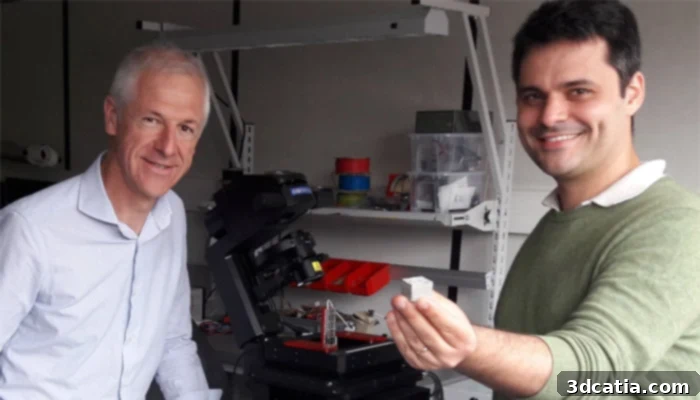
The precisely designed microstructures will serve as crucial molds for the innovative cooling concrete (photo credits: Microlight3D)
A Vision for a Sustainable Future: Microlight3D’s Commitment to Environmental Solutions
The potential impact of Microlight3D’s work extends far beyond individual buildings, promising a paradigm shift in how we design and inhabit our cities. Philippe Paliard, co-founder and head of users and applications at Microlight3D, articulates the company’s pride and dedication to this transformative project: “Microlight3D is proud to participate in a project aimed at creating cities that are more pleasant to live in and more respectful of the environment. It is exciting to see that our two-photon polymerization technology can offer solutions to, and have a real impact on, combatting environmental issues.” This statement encapsulates the core philosophy driving Microlight3D: leveraging cutting-edge additive manufacturing not just for technological advancement, but for tangible, positive environmental and societal change. The MIRACLE project represents a confluence of advanced materials science, micro-3D printing, and sustainable architectural principles, all working in concert to address the pressing challenges of climate change and urbanization. As the project progresses over its four-year timeline, the insights gained and technologies developed are poised to redefine the future of construction, paving the way for truly self-cooling, energy-efficient structures that actively contribute to a healthier planet. We will undoubtedly keep a close eye on the advancements of this pioneering European initiative and keep our readers updated on its progress. More comprehensive details are available in the official press release, which can be accessed HERE.
Engage with the Future of Sustainable Construction
The work being undertaken by the MIRACLE consortium and Microlight3D represents a fascinating intersection of 3D printing technology and sustainable building innovation. We are eager to hear your thoughts on this groundbreaking approach to micro-printing concrete for natural cooling. What do you believe are the biggest implications of this technology for urban planning and environmental sustainability? Share your insights and perspectives in a comment below or join the conversation on our Facebook,Twitter, andLinkedIn pages! To stay informed about the latest developments in additive manufacturing and other cutting-edge technologies like microstructured concrete, sign up for our free weeklyNewsletter here, and get the freshest 3D printing news delivered straight to your inbox!