
Transforming Packaging: How Marchesini Group Leverages Stratasys 3D Printing for Unprecedented Efficiency and Customization
In an era defined by rapid technological advancements, additive manufacturing (AM), commonly known as 3D printing, has emerged as a disruptive force, revolutionizing processes across countless industries. Its unparalleled ability to foster innovation, enhance operational flexibility, and deliver tailored solutions has made it an indispensable tool for forward-thinking enterprises. Among the pioneers eagerly embracing this transformative technology is the Marchesini Group S.p.A. This leading Italian manufacturer has strategically partnered with Stratasys, a global leader in industrial 3D printing solutions, to harness the power of additive manufacturing. This collaboration has enabled Marchesini and its diverse clientele to benefit from highly customized production capabilities, significantly reduced operational costs, and an overall uplift in productivity and performance within their sophisticated packaging machinery.
Marchesini, an esteemed Italian company founded in 1974, has built a formidable reputation as a world-class producer of a comprehensive range of automated packaging machines and integrated lines. Catering to critical sectors such as pharmaceutical, cosmetic, and food industries, their machinery is integral to efficient and safe product packaging globally. What began as a modest local enterprise operating from a garage has, over nearly five decades, burgeoned into a global powerhouse. Today, Marchesini stands as a preeminent manufacturer of automated packaging machinery, extending its reach across the globe through an extensive network of foreign subsidiaries and offices in 68 countries. This vast international presence underscores their commitment to serving a diverse customer base with localized support and innovative solutions. A testament to their deep commitment to cutting-edge technology, Marchesini Group is also recognized as one of Stratasys’s largest European customers, leveraging advanced 3D printing systems to maintain its competitive edge.
Stratasys’s reputation in the industrial 3D printing landscape is built on its robust and versatile technologies. Marchesini primarily utilizes two of their flagship systems: Fused Deposition Modeling (FDM) and PolyJet. FDM technology is celebrated for its exceptional reliability, strength, and ability to produce highly durable parts, making it ideal for functional prototypes, manufacturing tools, and even end-use components that demand mechanical robustness. PolyJet technology, on the other hand, is renowned for its capacity to create parts with exquisitely smooth, detailed surfaces, intricate geometries, and the unique ability to combine multiple materials with varying mechanical and aesthetic properties within a single print job. These attributes allow for the creation of complex assemblies or multi-material components that would be challenging or impossible to produce with traditional manufacturing methods. By integrating both FDM and PolyJet into their operations, Marchesini gains an unprecedented degree of design freedom and material versatility, critical for the innovative development of their packaging solutions.
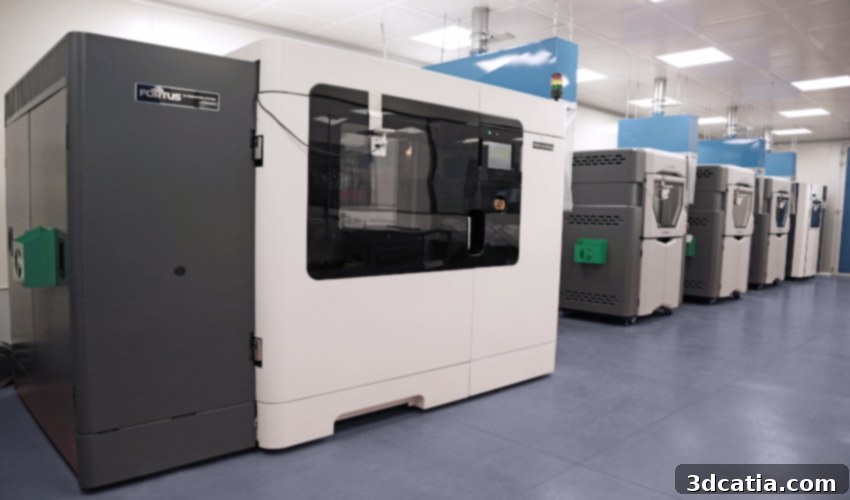
Recognizing the strategic importance of in-house additive manufacturing capabilities, the Marchesini Group has established a state-of-the-art facility entirely dedicated to 3D printing. This specialized hub is equipped with an impressive array of ten Stratasys production-grade FDM 3D printers, forming the backbone of their robust manufacturing operations. This formidable FDM fleet includes five F270 systems, known for their versatility and ease of use in diverse applications, four high-performance Fortus 450mc machines, which offer precision and speed for demanding industrial tasks, and a large-scale Fortus 900mc, capable of producing exceptionally large and complex components with industrial-grade materials. Complementing these FDM powerhouses, the facility also houses two advanced PolyJet multi-material 3D printers. This comprehensive setup empowers Marchesini to utilize 3D technology across the entire product lifecycle – from initial design and rapid prototyping to the development and final manufacture of critical components for its flagship cartoning machines and various other sophisticated packaging lines. This integrated approach ensures that every single packaging machine produced by Marchesini can be precisely tailored to meet the exacting requirements of a specific industry or a particular customer’s unique operational process, thereby offering unparalleled customization and optimized performance.
Mirko Fortunati, who holds the crucial responsibility of coordinating the Mechanical Workshops at Marchesini Group, has unequivocally affirmed the profound positive impact of additive manufacturing on his company’s operational effectiveness. He notes, “Producing complex, customised parts with traditional manufacturing methods has proved extremely costly and time-consuming, which is no longer suited to the growing demands of today’s packaging industry.” This statement highlights a significant challenge faced by manufacturers striving for customization and rapid iteration in a highly competitive market. Traditional methods, often relying on subtractive manufacturing like CNC machining or injection molding, incur substantial expenses and protracted lead times for tooling, jigs, and fixtures, especially for low-volume, highly specific parts. Such an approach often proves prohibitive when developing specialized components that cater to unique client specifications or rapidly evolving machine designs. The inherent limitations of traditional manufacturing in handling complex geometries and intricate designs further exacerbate these challenges, restricting innovation and extending development cycles.
Fortunati elaborated further on how Marchesini Group has successfully navigated these obstacles: “Stratasys additive manufacturing has enabled us to overcome these issues and adopt a customised production model. Having this on-demand production capability enables our engineers to take advantage of the greater design freedom enabled by 3D printing, which has empowered Marchesini Group to achieve higher-quality results.” This shift to an on-demand, customized production model is a game-changer. 3D printing eliminates the need for expensive molds and complex tooling, drastically reducing both upfront costs and production lead times for unique parts. Engineers are no longer constrained by the limitations of conventional manufacturing processes; instead, they can explore highly optimized and complex geometries that enhance functionality, reduce material usage, and improve overall machine performance. This newfound design freedom facilitates innovative solutions that were previously unfeasible, allowing Marchesini to create packaging machinery that is not only highly efficient but also perfectly adapted to specific client requirements, driving superior quality and performance across its product range.
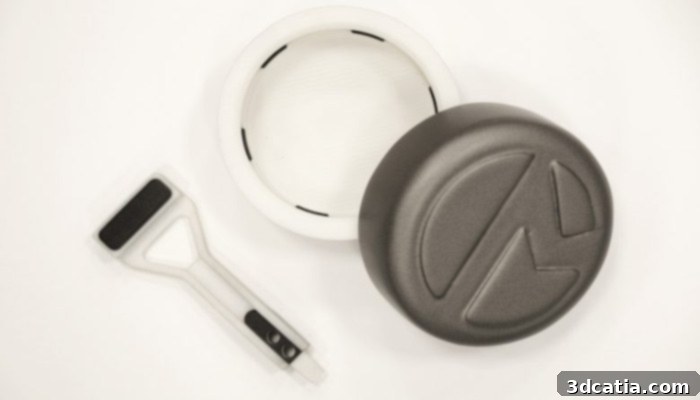
A packaging lid and a pincer 3D printed using PolyJet technology
The practical applications of additive manufacturing at Marchesini Group span a wide array of critical machine components. These include robust protective cases that shield sensitive electronics, intricately designed cable support systems that ensure organized and secure wiring, and durable junction boxes for electrical connections. These parts are frequently produced using high-performance, tough thermoplastics, leveraging the capabilities of Stratasys’ FDM technology. Specific materials of choice include Stratasys FDM Nylon 12CF filament and ULTEM 9085. Nylon 12CF, a carbon fiber-reinforced nylon, offers exceptional stiffness-to-weight ratio, high strength, and excellent thermal properties, making it ideal for functional parts that require structural integrity without excessive mass. ULTEM 9085, on the other hand, is a high-performance thermoplastic known for its flame-retardant characteristics, high strength, and resistance to elevated temperatures and chemicals, crucial for parts operating in demanding industrial environments. By employing these advanced materials, Marchesini ensures that their 3D-printed components not only perform reliably but also contribute to the overall efficiency and longevity of their sophisticated packaging systems.
Beyond structural integrity, Marchesini has also realized significant performance enhancements through the integration of 3D printing. The company proudly reports that by adopting additive manufacturing technology in their production processes, they have successfully managed to reduce the weight of certain machine parts by an astonishing 30%. This substantial weight reduction has a direct and profound impact on the operational dynamics of their automated packaging systems. Lighter moving parts require less energy to accelerate and decelerate, leading to increased machine speed and overall higher productivity. Furthermore, reduced weight translates to less wear and tear on mechanical components, contributing to enhanced machine longevity and lower maintenance requirements. In parallel, the advanced PolyJet technology empowers Marchesini to tackle exceptionally complex designs, enabling the creation of intricate components that seamlessly integrate both hard and rubber-like materials within a single manufacturing process. This multi-material capability is invaluable for creating parts with localized flexible zones, ergonomic grips, or integrated seals, expanding design possibilities and improving functionality that would be impossible with single-material traditional manufacturing methods.
The extensive benefits that additive manufacturing has delivered to Marchesini Group paint a clear picture of its transformative potential. From drastically cutting development costs and accelerating lead times to enabling unparalleled customization and enhancing the performance of packaging machinery, 3D printing has become a cornerstone of their innovation strategy. This success story serves as a compelling case study, indicating a strong likelihood that an increasing number of companies within the dynamic packaging industry, and indeed across many other manufacturing sectors, will integrate 3D printing technologies into their core production processes. The competitive advantages gained through speed, cost-effectiveness, design freedom, and personalized solutions are simply too significant to ignore. As additive manufacturing continues to evolve, it promises to unlock even greater efficiencies and new paradigms in industrial production, solidifying its role as a key driver of the Fourth Industrial Revolution.
We invite you to share your insights and experiences with additive manufacturing in the comments below or engage with our community on our Facebook and Twitter pages! Don’t miss out on the latest advancements and breaking news in the world of 3D printing – sign up for our free weekly Newsletter to receive all the essential updates directly in your inbox!