
NVIDIA LATTE3D: Revolutionizing 3D Model Generation with Text-to-3D AI
Artificial intelligence (AI) continues its remarkable ascent, permeating nearly every facet of our daily lives and transforming industries across the globe. From advanced medical diagnostics and self-driving automotive systems to sophisticated financial algorithms, AI’s capabilities are constantly expanding. One sector experiencing a profound impact from this technological evolution is 3D printing and design. In this exciting landscape, NVIDIA, a leader in graphics processing units and AI computing, has recently unveiled a groundbreaking generative AI model named LATTE3D. This innovative tool promises to redefine the creation of 3D content by allowing users to transform simple text descriptions into complex 3D models in mere seconds – an unprecedented speed that NVIDIA playfully compares to the time it takes to brew a cup of coffee. Essentially acting as a virtual 3D printer, LATTE3D is poised to significantly accelerate workflows and spark new creative possibilities across diverse fields, including immersive game development, industrial design, cutting-edge robotics, and any application demanding rapid creation within virtual environments.
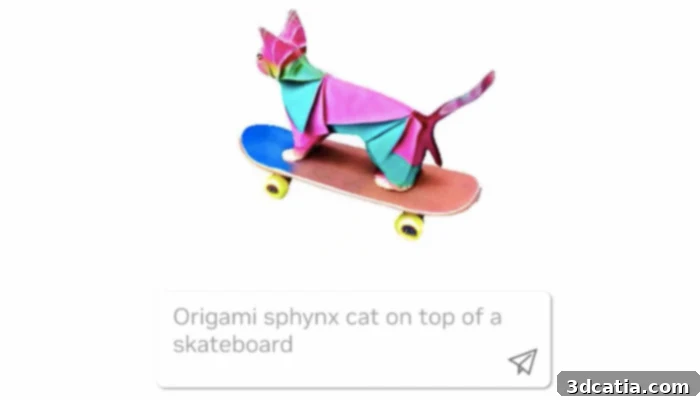
Historically, the process of generating high-quality 3D models has been notoriously time-consuming and resource-intensive. Traditional approaches often demand significant investment in specialized software, extensive training, and meticulous manual effort, whether artists are building models from scratch or painstakingly selecting and modifying objects from existing libraries. This barrier to entry has limited accessibility and slowed down creative iterations. LATTE3D presents a compelling alternative, designed to overcome these conventional hurdles. By leveraging the power of generative AI, this software can produce sophisticated 3D shapes virtually instantaneously from concise text descriptions. Imagine simply typing “a futuristic spaceship with sleek lines and glowing engines” or “a whimsical treehouse with a spiral staircase,” and within seconds, LATTE3D presents you with several corresponding 3D shape options. This unparalleled speed and precision mark a significant leap forward, democratizing 3D content creation and opening up a vast new realm of possibilities for designers, engineers, and creators alike.
Unlocking Rapid 3D Model Creation with Generative AI
One of LATTE3D’s core strengths lies in its ability to offer users unparalleled flexibility and customization. After inputting a text description, the system rapidly generates multiple 3D shape options, allowing users to choose the one that best suits their specific needs and creative vision. This iterative process, where ideas quickly transform into tangible 3D representations, drastically reduces design cycles. Furthermore, once a preliminary model is selected, LATTE3D doesn’t stop there. It provides tools to optimize the chosen object for the highest quality in just a few minutes, refining details and ensuring the model is ready for its intended application. The final, high-fidelity 3D model can then be seamlessly exported to other compatible graphics software or platforms, integrating smoothly into existing design pipelines and workflows. This means designers can leverage LATTE3D for rapid prototyping, asset creation, or even as a starting point for more intricate manual detailing, making it an incredibly versatile tool.
The Power of Speed and Precision in 3D Design
The dramatic acceleration in 3D model generation time is perhaps LATTE3D’s most striking achievement. Sanja Fidler, Vice President of AI Research at NVIDIA, eloquently articulates this breakthrough: “A year ago, it took an hour for AI models to generate 3D visuals of this quality — and the current state of the art is now around 10 to 12 seconds. We can now produce results an order of magnitude faster, putting near-real-time text-to-3D generation within reach for creators across industries.” This statement underscores the rapid progress in generative AI, highlighting an approximately 360-fold improvement in speed over just a year. Such efficiency is not just a convenience; it’s a game-changer for industries where time is a critical factor. For game developers, it means rapidly populating virtual worlds with unique assets. For industrial designers, it allows for countless iterations and visualizations of product concepts in a fraction of the time. In architecture and urban planning, complex models can be generated for initial conceptual designs, fostering quicker feedback loops and more dynamic design processes. The ability to move from an idea to a visual representation in seconds rather than hours empowers creative professionals to experiment more freely, innovate faster, and ultimately bring their visions to life with unprecedented agility.
How LATTE3D Learns and Evolves for Broader Applications
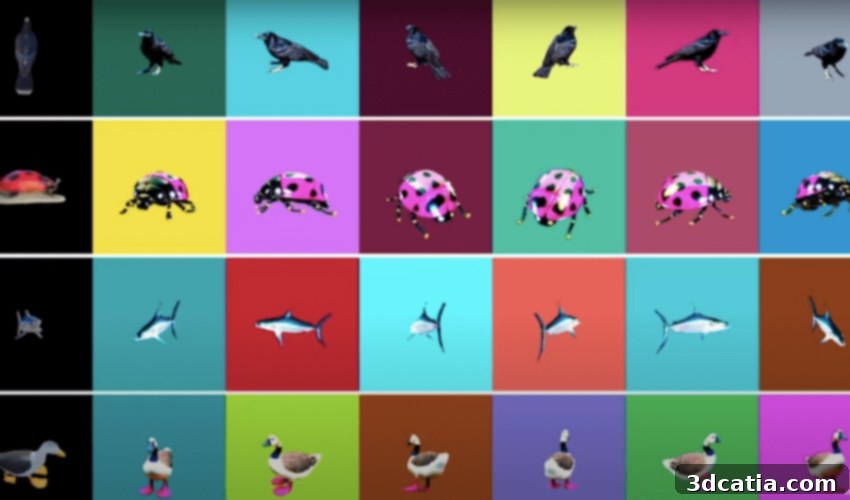
The impressive capabilities of LATTE3D are the result of sophisticated training methodologies. Researchers at NVIDIA are continuously refining the model by training it on diverse and specialized datasets. Currently, the primary focus is on two key categories: one dataset dedicated to various animals, enabling the AI to generate a wide array of creature models, and another focused on everyday objects, allowing it to interpret and create common items. This targeted training ensures high fidelity and accuracy within these specific domains. However, the true potential of LATTE3D lies in its adaptable model structure. Developers can leverage this same underlying architecture to train the AI on entirely new types of data, significantly expanding its utility. For instance, by providing LATTE3D with a comprehensive dataset of 3D plant models, a landscape architect could rapidly generate intricate garden designs or entire botanical environments. Similarly, feeding the model data related to household furniture and appliances could empower it to generate elements for detailed 3D house simulations, assisting interior designers or real estate developers in visualizing spaces.
Beyond raw data, the model’s intelligence has been further enriched through advanced natural language processing capabilities, particularly with the assistance of ChatGPT. This integration has enabled LATTE3D to interpret a far wider array of textual formulations and descriptions of 3D objects. It can now understand nuanced instructions, recognize synonyms, and grasp conceptual descriptions that go beyond simple keywords, making it significantly more versatile and accurate in its application. This means users can employ more natural and descriptive language when prompting the AI, leading to more precise and creatively aligned results. It’s important to note that while immensely promising, LATTE3D is still under active development and has not yet been commercialized. NVIDIA’s researchers are already planning to extend its capabilities beyond static 3D model generation, with ambitious plans to integrate it into fields such as 3D animation generation, paving the way for even more dynamic and expressive AI-powered content creation.
The Future Landscape of AI-Powered 3D Creation
NVIDIA’s LATTE3D represents a significant milestone in the convergence of artificial intelligence and 3D design, offering a glimpse into a future where complex virtual assets can be conjured with unprecedented speed and ease. The ability to transform text into highly customizable 3D models in seconds not only streamlines existing design and development processes but also opens up entirely new avenues for creativity and innovation across multiple industries. From empowering independent game developers to rapidly prototype their visions, to assisting engineers in visualizing intricate components, and enabling architects to swiftly conceptualize structures, the applications are vast and transformative. As the model continues to evolve and its training expands to encompass an even broader range of objects and scenarios, we can expect LATTE3D to become an indispensable tool in the digital creator’s arsenal, fundamentally changing how 3D content is conceived, designed, and produced. The potential for further integration with other AI technologies, such as those for material generation or texture mapping, could lead to even more comprehensive and autonomous design systems.
What are your thoughts on NVIDIA’s LATTE3D and its potential to revolutionize 3D creation? Do you envision integrating such AI tools into your own design or development workflows? We encourage you to share your insights and predictions in the comments section below, or connect with us on our LinkedIn, Facebook, and Twitter pages. Stay informed about the latest breakthroughs in 3D printing and AI by signing up for our free weekly newsletter here, delivering essential news directly to your inbox. You can also explore our extensive video library on our YouTube channel for more in-depth content and demonstrations.
*All Photo Credits: NVIDIA