
Wax 3D Printing: Revolutionizing Lost-Wax Casting for Precision Manufacturing and Intricate Designs
The term “wax 3D printing” often leads to a slight misunderstanding, as it is, in essence, a form of indirect additive manufacturing. Unlike processes where the 3D printer creates the final product directly, wax 3D printing serves as a crucial intermediate step in a larger manufacturing workflow. Its primary purpose is to produce highly detailed wax patterns or molds, which then act as the foundation for creating the ultimate part. The wax itself is not the final material; rather, it is used to precisely define the desired shape and is subsequently removed, typically by melting or burning away. This transformative process, where the wax model is intentionally eliminated, is why it is often referred to as lost-wax casting or investment casting.
The lost-wax casting method boasts a rich history, dating back thousands of years, and is celebrated for its ability to produce small, intricately detailed, and dimensionally accurate cast parts with minimal post-processing. Traditionally, this highly valued technique involves crafting the wax pattern by hand. However, the integration of 3D printing technology brings a modern twist to this ancient art. Wax 3D printing retains all the core objectives of traditional lost-wax casting – exceptional dimensional accuracy, capture of fine details, and superior surface quality – but it replaces the laborious manual creation of the wax mold with the precision and speed of digital fabrication. This shift allows for unprecedented design freedom and efficiency in pattern creation.
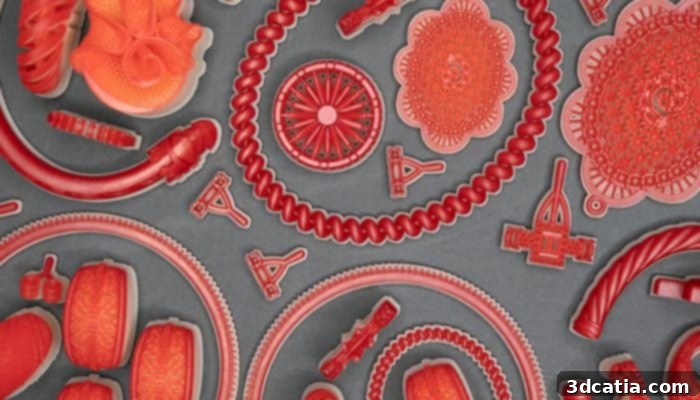
3D wax printing was originally based on the lost-wax principle (photo credits: 3D Systems).
As highlighted, the primary application of wax 3D printing is the creation of patterns for investment casting, particularly for metal objects, whether precious or industrial. The inherent advantages of wax as a pattern material are numerous: it burns or melts away with virtually no residue, ensuring a clean cavity for casting, and it simplifies the mold-making process by eliminating the need for complex mold processing steps common with other pattern materials. Beyond specialized printing waxes, the market also offers burnable filaments and resins designed for the same purpose, expanding the range of compatible 3D printing technologies. This innovative approach allows manufacturers to print almost any complex design with unparalleled precision, effectively combining the robust quality of cast materials with intricate, otherwise impossible structures. Let’s delve deeper into the specific steps involved in this fascinating process.
How Does Wax 3D Printing Work? A Step-by-Step Guide to the Process
The journey of creating a final part using wax 3D printing begins, like most additive manufacturing processes, in the digital realm. The initial step involves designing the desired final part using advanced 3D modeling software, such as CAD (Computer-Aided Design) programs. Alternatively, existing physical objects can be precisely replicated through 3D scanning, generating a digital model for reproduction. Once the digital design is finalized and optimized, the next critical phase is the actual 3D printing of the wax pattern. This requires a specialized wax 3D printer capable of processing wax-like plastic materials or pure wax resins, depending on the chosen technology.
For intricate designs featuring overhangs, undercuts, or bridge-like structures, the use of support materials during the 3D printing phase is often essential. These temporary structures prevent deformation and ensure the integrity of the wax pattern as it is built layer by layer. After the printing process is complete, these support structures must be carefully removed, and the wax model cleaned to achieve its intended form. Minor surface irregularities may also require gentle smoothing to ensure a pristine surface finish. This digital approach stands in stark contrast to traditional lost-wax casting, where the model is meticulously designed and handcrafted by skilled artisans. However, once the wax pattern is ready, the subsequent stages of the casting process largely mirror the time-honored methods.
With the wax model successfully printed, cleaned, and refined, the operator proceeds to assemble it, often alongside multiple other models, onto what is known as a “casting tree.” This structure typically consists of a central hollow bar from which several wax patterns are attached via sprue channels, resembling the branches of a tree. The entire casting tree, laden with wax models, is then carefully immersed in a liquid investment material. This material, which can be ceramic slurry, clay, or plaster, will form the robust outer shell and ultimately become the casting mold. Thin, uniform layers of this investment material are built up around the wax models, often aided by vacuum processes to eliminate air bubbles and ensure complete coverage and fine detail capture. The layer-by-layer coating process is repeated until a sufficiently thick and strong mold is formed. Subsequently, this “green” investment mold must be thoroughly dried or fired in a high-temperature oven to cure and harden.
The next pivotal step is the “burnout” or “dewaxing” phase. During this stage, the dried or fired investment mold is heated to a temperature at which the wax or wax-plastic material completely melts, flows out, or burns off. This leaves behind a perfectly hollow cavity – a detailed negative impression of the original wax pattern – within the ceramic shell. This intricate void represents the exact shape of the final molded part. Once the wax has been completely removed and the mold has reached the appropriate temperature, molten material (e.g., precious metals, steel, aluminum) is carefully poured or injected into this detailed impression. After the molten material solidifies and cools, the ceramic mold is intentionally broken away, revealing the finished object. Depending on the specific application and the material used, the cast object may then undergo various post-processing stages, such as gate removal, grinding, polishing, or heat treatment, to achieve its final specifications and aesthetic.
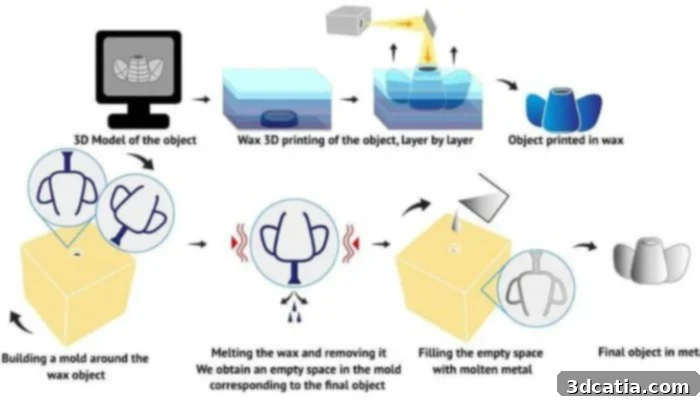
This graphic illustrates the wax 3D printing process (photo credits: Sculpteo)
Advantages and Limitations of Integrating Wax 3D Printing
Wax 3D printing offers significant advantages, particularly its exceptional resolution and accuracy. Depending on the specific 3D printing technology employed, it can achieve accuracies typically around 25 micrometers (μm), making it ideal for applications demanding tight tolerances and fine details. However, it’s crucial to acknowledge that accuracy can vary between different 3D printing processes, so specific capabilities should always be verified. While wax 3D printing enables the production of parts with a remarkably low tolerance margin, adherence to relevant industry standards, such as the VDG standard (which provides construction guidelines for designing cast iron materials) or various DIN ISO standards for casting, remains paramount. Meeting these stringent industrial specifications can still present a challenge, requiring careful design and process control.
Beyond precision, the technology is highly attractive due to its compelling value proposition. 3D printing allows for the cost-effective production of prototypes and small to medium series, reducing tooling costs and lead times significantly. It offers substantial time advantages compared to traditional methods; analog wax patterns, made to order by hand, can take anywhere from two to twelve weeks to manufacture and deliver. In contrast, a 3D-printed wax pattern can be produced in just a few hours, depending on the model’s complexity, and can often be fabricated directly on-site. This rapid turnaround facilitates quick design iterations and immediate addressing of any difficulties or desired modifications, thereby accelerating product development cycles and fostering innovation.
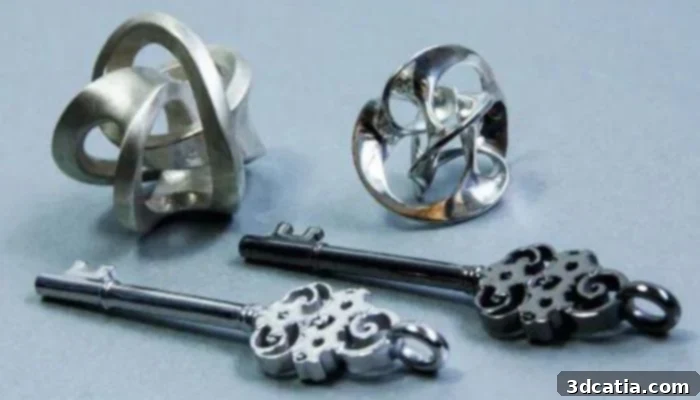
Wax 3D printing allows design freedom and rapid adaptations for prototypes and small series (photo credits: Sculpteo)
The process also garners praise for its sustainability credentials. As an additive manufacturing method, 3D printing only uses the necessary material to construct the model, thereby generating minimal waste. Any wax waste produced, such as support structures or failed prints, can often be incinerated cleanly with almost no residue or even reused in certain applications, further enhancing its environmental profile. This efficiency in material usage contributes to a more eco-friendly manufacturing process.
However, potential users should be aware of certain limitations. Wax 3D printing, while efficient in pattern creation, is an indirect manufacturing method. This means that obtaining the final cast part still involves multiple steps beyond just the 3D printing itself, potentially requiring more overall time compared to direct 3D printing processes where the final part emerges directly from the printer. Furthermore, the process generally requires a degree of patience and is typically not ideal for extremely large models due to printing platform size constraints and the complexities involved in handling large investment molds.
Key Applications of Wax 3D Printing Across Industries
The versatility of wax 3D printing has led to its widespread adoption across numerous industries, particularly in applications where exacting accuracy, precision, and intricate detail are paramount. One prominent area of use is in the medical and dental fields. For instance, the process is extensively utilized in dentistry for creating highly accurate dental impression materials, crowns, bridges, and other prosthetics, ensuring a perfect fit and aesthetic appeal for patients. Another notable application in the medical sector is the manufacturing of complex components like acetabular cups for hip implants. These cups feature shell-shaped heads with surfaces containing hundreds of delicate tripods or cross-shaped filigree anchors, which require extreme precision to ensure proper biological integration and long-term functionality.
Beyond medical applications, wax 3D printing plays a crucial role in mechanical engineering for manufacturing high-quality cast-iron models and original prototypes. This allows engineers to produce complex, functional prototypes for components with intricate internal geometries or optimized designs that would be difficult or impossible to achieve through traditional machining. In addition to general mold making, the process is highly valued in the field of model making, enabling the production of exquisite collector’s items, detailed miniature editions, and prototypes for various products, where every minute detail must be faithfully reproduced.
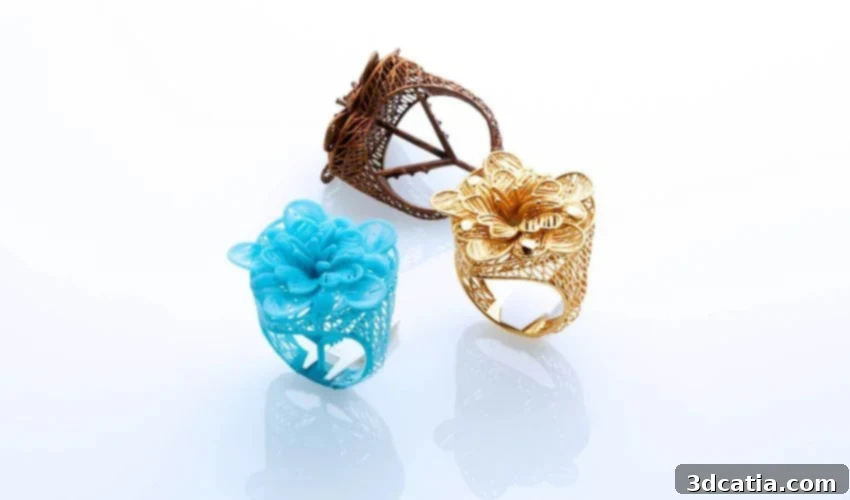
Nevertheless, it is perhaps in the jewelry sector where 3D wax printing has truly demonstrated its transformative power. Jewelers frequently utilize wax prints as master models for creating casting molds. This allows them to rapidly prototype new designs, experiment with different aesthetics, and produce pre-series collections with unparalleled speed and accuracy. Once the perfect wax model is achieved, it serves as the precise mold for casting precious metals like gold, silver, or platinum, ultimately culminating in stunning, intricately detailed pieces of jewelry. The ability to easily iterate designs and achieve complex geometries with fine details has revolutionized custom jewelry creation and mass production alike.
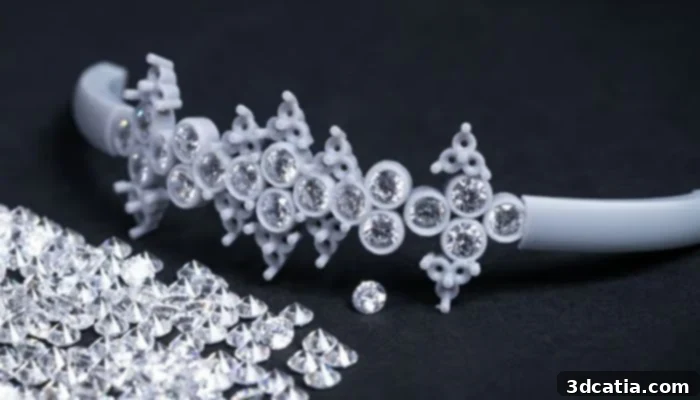
Photo Credits: 3D Systems
Technologies, Manufacturers, and Materials for Wax 3D Printing
The creation of wax patterns for investment casting can be achieved through several distinct 3D printing technologies, each offering unique advantages. If a wax-like filament is chosen, Fused Deposition Modeling (FDM) technology can be employed, offering a relatively accessible entry point. However, for higher resolution and smoother surface finishes, Stereolithography (SLA) and Material Jetting (MJ) technologies are much more commonly utilized. In SLA, a wax-like photopolymer resin is cured layer by layer using a UV laser or projector to form the mold. A notable example is 3D Systems’ QuickCast process, an SLA-based solution specifically developed for printing complex patterns and molds, particularly for demanding industries like aerospace. The company also offers MultiJet Printing (MJP), another proprietary wax 3D printing process that excels in producing smooth, high-resolution wax patterns with soluble supports.
Historically, Prodways, through its Solidscape solutions, was a significant player in the wax 3D printer market, utilizing Drop-on-Demand (DoD) technology to produce extremely fine-detail wax patterns. However, the company recently announced its strategic decision to discontinue activities in this specific segment. Binder Jetting (BJ) is another suitable technology for wax 3D printing, especially for larger patterns or higher throughput. For example, Voxeljet’s impressive printer portfolio includes models like the VX1000, which is capable of printing with a variety of materials including wax, ceramic, and sand, offering flexibility for different casting applications.
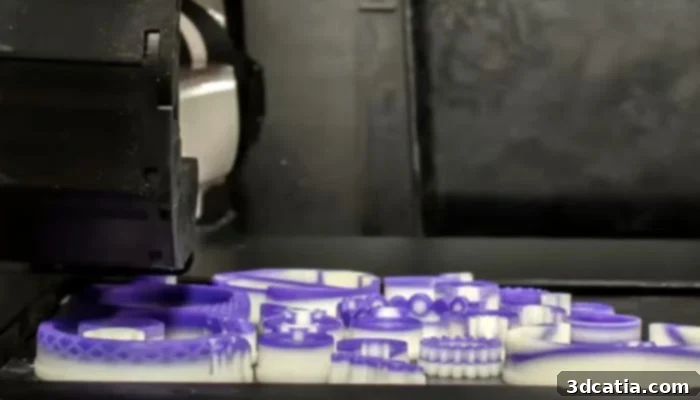
3D Systems offers several printing solutions for 3D wax printing (photo credits: 3D Systems)
It logically follows that the various manufacturers of these specialized 3D printing solutions also develop and offer a range of compatible materials. Wax for 3D printing is typically a wax-based plastic material or a resin with wax-like properties, engineered for specific printing and burnout characteristics. Waxes broadly fall into three categories: natural waxes (e.g., beeswax, soy wax), mineral waxes derived from fossil fuels (e.g., paraffin wax, lignite wax), and synthetic waxes (e.g., polyolefin waxes, hydrosil waxes). For 3D printing applications, synthetic waxes are predominantly used due to their consistent properties, controlled melting points, and clean burnout characteristics, often formulated to leave minimal to no ash residue.
When support structures are necessary for complex geometries, it is common practice to use two different types of wax. The primary model wax forms the intricate details of the part, while a distinct support wax is used for temporary structures. Critically, the support wax must be formulated to have a significantly lower melting point than the model wax. This crucial difference allows for the precise removal of supports through melting or dissolving without affecting the integrity or dimensional accuracy of the main wax model. Leading manufacturers of these specialized wax materials include 3D Systems, Polymaker, and Formfutura, all of whom offer a range of options optimized for different printing technologies and application requirements.
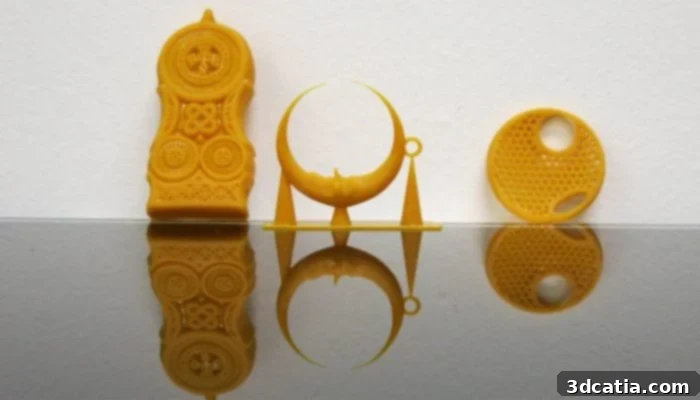
3D-printed wax parts (photo credits: Sculpteo)
While waxes and wax 3D printing may occupy a specialized niche within the broader landscape of additive manufacturing technologies and applications, they offer uniquely powerful solutions that other processes and materials simply cannot achieve with the same efficiency or fidelity. Wax 3D printing is exceptionally popular in the jewelry industry, dentistry, and other sectors where the creation of intricate part details, complex internal structures, and highly accurate patterns is paramount. Its ability to combine ancient casting principles with modern digital fabrication opens up a vast array of possibilities for innovation, rapid prototyping, and precision manufacturing across diverse fields.
Do you use wax 3D printing in your operations? Let us know in a comment below or on our LinkedIn, Facebook, and Twitter pages! Don’t forget to sign up for our free weekly newsletter here, the latest 3D printing news straight to your inbox! You can also find all our videos on our YouTube channel.
*Cover Photo Credits: MOIIN