
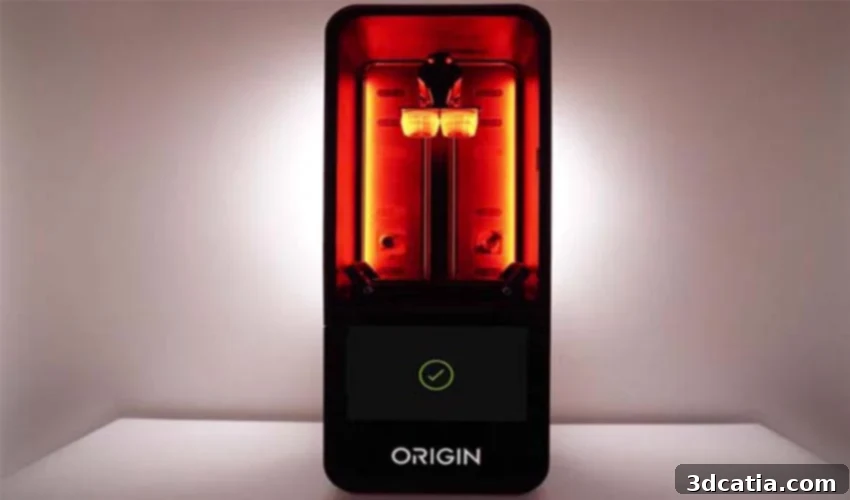
Origin Redefines Industrial 3D Printing with Origin One and Open Additive Production Platform
Origin, the pioneering Californian startup, has made a monumental leap forward in the additive manufacturing landscape with the launch of its groundbreaking 3D printer, the Origin One. This significant announcement reinforces Origin’s commitment to transforming industrial production through its innovative Open Additive Production platform. Designed from the ground up to offer a revolutionary manufacturing method, this platform is characterized by its reliance on open materials, highly expandable software, and modular hardware. The core mission remains steadfast: to address the escalating demand for superior quality materials and unparalleled customization capabilities across a multitude of industries.
The Origin One, at the heart of this latest revelation, is built upon the advanced Programmable Photopolymerization (P3) technology. This proprietary approach enables highly precise and consistent production, pushing the boundaries of what’s achievable with photopolymer-based 3D printing. While its build volume of 192 x 108 x 350 mm might not be the largest in the industrial segment, its impressive height and the underlying P3 technology unlock new possibilities for manufacturing complex, functional parts with exceptional surface finish and mechanical properties. This strategic dimension allows for efficient batch production of smaller components or the creation of taller, more intricate single parts, making it versatile for a range of applications.
Forging Strategic Alliances: The ECCO Partnership
Further cementing its position as an industry disruptor, Origin has simultaneously unveiled a transformative partnership with ECCO, one of Denmark’s most prominent and respected shoe manufacturers. This collaboration is set to revolutionize footwear development and production. The integration of Origin’s advanced P3 SLA/DLP 3D printing capabilities aims squarely at enabling high-volume 3D printing for critical components within the footwear industry. Jakob Møller Hansen, Vice President Research & Development at ECCO, articulated the immense potential of this alliance, stating, “We expect Origin’s open additive approach will enable us to reduce development time, lower costs, and accelerate our time-to-market.” This statement underscores the strategic imperative for manufacturers to adopt agile, cost-effective, and rapid development processes in today’s fast-paced global market.
The partnership with ECCO goes beyond merely adopting new hardware; it represents a philosophical shift towards open innovation. By leveraging Origin’s platform, ECCO gains unprecedented flexibility in exploring new materials and designs, drastically shortening the iteration cycles for new shoe components and prototypes. The ability to rapidly produce functional prototypes with production-grade materials ensures that ECCO can bring innovative designs to market faster, respond to consumer trends more effectively, and maintain its competitive edge in a highly dynamic industry. This is a testament to how advanced additive manufacturing is moving beyond mere prototyping into genuine end-use part production, particularly in consumer goods where customization and rapid design changes are paramount.
The Genesis of Open Additive Manufacturing
Founded in 2015, Origin was established with a clear vision to address a fundamental challenge plaguing the additive manufacturing sector: the pervasive issue of closed solutions. This industry-wide problem often manifested as manufacturers producing materials exclusively compatible with their proprietary machines, thereby restricting innovation, limiting material choices, and imposing vendor lock-in on customers. Recognizing this critical impediment to the widespread adoption of industrial 3D printing, Origin conceived the brilliant idea of creating an open ecosystem. This platform was designed to foster an environment where custom-made materials could thrive, developed by leading chemical companies and optimized for Origin’s hardware.
Origin’s open architecture has been a cornerstone of its strategy since its inception. This approach has allowed the startup to cultivate a broad network of partners, significantly expanding the range of available materials. Unlike traditional models where printer manufacturers dictate material options, Origin empowers its users with an unparalleled selection, driving innovation in material science directly into the hands of manufacturers. Furthermore, this platform grants manufacturing customers immense flexibility regarding the types of parts they can produce, promises higher printing speeds, and facilitates more efficient post-processing workflows, all crucial elements for industrial-scale additive production. This holistic approach ensures that the entire manufacturing process, from design to finished part, is optimized for efficiency and quality.
The Power of Open Materials: Collaborating with BASF
The effectiveness of Origin’s open platform strategy was powerfully demonstrated through its previous partnership with BASF, a global leader in chemicals. This collaboration underscored the potential for specialized material development when a platform is truly open. At the time of that announcement, Arnaud Guédou, Commercial Director of Photopolymer Solutions at BASF 3D Printing Solutions, expressed profound enthusiasm: “We’re really excited about Origin’s open platform and are investing a lot in this partnership. We plan to work with Origin to optimize our photopolymers and other additive materials to create a whole series of new options for high volume manufacturers.” This sentiment highlights the critical role chemical innovation plays in advancing additive manufacturing capabilities, particularly for achieving the scale and performance required for high-volume production.
The BASF partnership allowed for the co-development and optimization of advanced photopolymers, tailoring them specifically for industrial applications on the Origin platform. This means end-users aren’t limited to a handful of generic materials but can access a diverse portfolio developed by experts, capable of meeting stringent performance requirements. From robust elastomers for flexible components to high-temperature and high-impact resins for demanding engineering applications, the collaboration with BASF significantly broadened the material palette available to Origin’s customers. This open material ecosystem fosters a competitive environment among material developers, ultimately driving down costs and improving material properties, which are both essential for expanding the industrial footprint of 3D printing.
Redefining Footwear Manufacturing with Advanced 3D Printing
Building on the success of previous collaborations, Origin’s latest partnership with ECCO is focused squarely on developing a new, more agile approach to manufacturing footwear. This endeavor will see ECCO’s Research & Development department in Denmark utilizing Origin’s sophisticated 3D printing platform, integrated seamlessly with BASF’s specialized materials. This powerful combination is expected to streamline the entire product development lifecycle, from initial concept validation to functional prototyping and ultimately, mass customization. The ability to rapidly iterate designs, test new geometries, and evaluate novel material combinations will provide ECCO with an unprecedented advantage in a competitive market.
The impact of this collaboration extends beyond just speeding up development. It opens the door to creating highly customized footwear components, potentially leading to mass personalization where shoes are tailored to individual feet, improving comfort, performance, and reducing waste. This level of customization was previously unimaginable at scale, making Origin’s P3 technology a game-changer for the footwear industry. The Origin One is not designed for a niche market but is engineered for broad applicability. Clients across diverse industries are expected to leverage its capabilities, including automotive for lightweight components and custom tooling, industrial and contract manufacturers for specialized jigs, fixtures, and end-use parts, and even government organizations for complex defense or aerospace applications. The printer’s versatility and the platform’s open nature ensure it can adapt to evolving industrial needs.
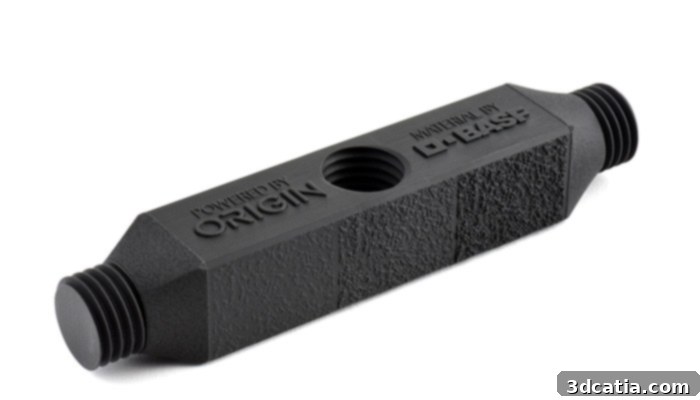
A sample printed by Origin with materials developed by BASF | Source: Origin
Origin’s Unique Value Proposition: Decoupling Material and Printing
Origin’s website succinctly captures its distinctive value proposition, highlighting how it differentiates itself from established players in the additive manufacturing sector. The company explains, “Unlike existing industrial additive equipment from companies like Carbon and 3D Systems, Origin provides modular, scalable hardware and software supplemented by an open materials network which will lean on leading chemical experts to expand the choice of materials available to manufacturers. By decoupling material development and printing, Origin delivers a far broader choice-set of materials specifications (including custom materials), at costs sufficiently lower to enable mass production. Today Origin’s customers can choose from resilient elastomers, silicones, high heat, and high impact materials ready for end use applications.”
This “decoupling” strategy is truly revolutionary. It means that Origin is not constrained by its own material R&D capabilities, nor does it force customers into a closed loop. Instead, it creates an agile ecosystem where chemical companies, unburdened by hardware development, can focus solely on innovating and optimizing materials. This specialization accelerates the development of advanced resins with diverse properties – from exceptional flexibility and durability of elastomers, to the high-temperature resistance of specialized plastics, and the biocompatibility of certain silicones. By fostering this collaborative material ecosystem, Origin is driving down the cost of materials and increasing their accessibility, which is a critical factor for achieving mass production volumes. The platform’s ability to handle such a wide array of high-performance materials makes it suitable for producing genuine end-use parts that meet stringent industry standards, moving 3D printing firmly into the realm of mainstream manufacturing.
The Origin One, powered by the P3 technology and backed by an open material philosophy, represents more than just a new printer; it signifies a strategic shift in how industrial additive manufacturing will evolve. It champions collaboration over proprietary lock-in, material innovation over closed ecosystems, and flexibility over rigid systems. This approach is poised to democratize access to advanced manufacturing capabilities, allowing more companies to leverage the power of 3D printing for true production, customization, and supply chain resilience.
For more detailed information and the latest updates, you can always visit their official news page HERE.
What are your thoughts on Origin’s latest announcement and their open additive manufacturing platform? We invite you to share your insights in a comment below or join the conversation on our Facebook and Twitter pages! Don’t forget to subscribe to our free weekly Newsletter, ensuring you receive all the latest news and developments in 3D printing directly in your inbox!