

The Essential Guide to Isopropyl Alcohol (IPA) for Resin 3D Printing: Cleaning, Post-Processing, and Safety
Embarking on the journey of resin 3D printing opens up a world of intricate possibilities, but success hinges on more than just selecting the right printer or material. To consistently achieve high-quality prints, it’s crucial to understand the entire workflow, from initial design and optimal material selection to the often-underestimated yet vital stage of post-processing. Our comprehensive resources guide you through every step, ensuring you’re well-equipped with the knowledge and tools needed for flawless results.
Today, we delve into a cornerstone element for any resin 3D printing enthusiast or professional: Isopropyl Alcohol, commonly known as IPA. This indispensable ally plays a critical role in both the maintenance of your 3D printer and the meticulous cleaning of your finished prints. Whether you’re a seasoned expert or just beginning your 3D printing adventure, understanding IPA’s characteristics, numerous advantages, and its inherent limitations is key to elevating your printing experience.
What Is Isopropyl Alcohol (IPA) and Its Diverse Uses?
Isopropanol, or isopropyl alcohol (IPA), is a transparent, colorless liquid identified by its chemical formula (CH₃)₂CHOH. It possesses a distinctive strong odor and is highly volatile, evaporating rapidly without leaving behind any residue. Commercially, IPA is primarily synthesized through the indirect hydration of propylene using sulfuric acid, or via the hydrogenation of acetone. This manufacturing process yields a versatile compound with a wide array of industrial and domestic applications.
Its primary utility lies in its exceptional solvency. IPA is widely employed as a solvent for a broad spectrum of sticky substances, including oils, greases, rubbers, and especially resins. Beyond its role as a powerful cleaning agent, it serves as a crucial intermediary in the production of acetone and various other chemical compounds. In the pharmaceutical sector, it’s utilized for extracting certain alkaloids, while in cosmetics, it’s an ingredient in the formulation of products such as creams, lotions, and perfumes due to its emulsifying and solvent properties.
Furthermore, isopropyl alcohol acts as an effective dehydrating agent, making it valuable in laboratory settings. Its antifreeze properties are exploited in various industrial applications. In the medical field, a diluted solution of IPA is commonly used as an antiseptic and disinfectant for skin preparation before injections or minor surgical procedures. Its compatibility with sensitive electronic and electromechanical components makes it an ideal choice for cleaning printed circuit boards, magnetic heads, intricate optical devices, rubber rollers in printers, and delicate disk drives. This broad applicability underscores IPA’s significance across diverse industries, extending its utility prominently into the world of 3D printing.

Photo Credits: r/3Dprinting, Reddit
The Indispensable Role of IPA in Resin 3D Printing Workflows
In the realm of resin 3D printing, particularly with technologies such as SLA (Stereolithography) and DLP (Digital Light Processing), isopropyl alcohol (IPA) is not merely an option but an essential component of the post-processing workflow. Its primary application involves the meticulous cleaning of 3D printed resin parts, alongside the critical maintenance of the printing equipment itself. This ensures not only the longevity of your machine but also guarantees a superior, professional finish for your printed models.
After a part emerges from a resin 3D printer, it typically undergoes a two-stage post-processing regimen. First, the printed model must be thoroughly washed to remove all residual uncured liquid resin that adheres to its surface. This step is crucial because the polymerization process during printing is only partial, leaving a tacky, unset layer. Following this wash, the part is then cured, usually under UV light, to complete the polymerization and harden the model to its final state. IPA is central to this initial washing stage.
Resin prints, particularly those with complex geometries, invariably require support structures to maintain their integrity during the printing process. These supports must be removed cleanly and efficiently without damaging the delicate features of the model. The use of a solvent like isopropyl alcohol is paramount for dissolving the resin attaching these supports, making their removal significantly easier and cleaner. Furthermore, IPA excels at removing any lingering uncured resin residues not only from the freshly printed models but also from the build platform and the resin vat itself. Many manufacturers now offer integrated washing and curing stations designed to streamline this post-processing, often utilizing IPA or other specialized solvents to automate the cleaning and final polymerization steps.
For optimal results, isopropyl alcohol can be used either neat (at its highest purity, typically 99% or greater) or diluted. A common and effective dilution ratio for cleaning 3D prints involves mixing 70% IPA with 30% distilled water. While both concentrations are effective, 99% IPA typically evaporates faster and leaves less residue, which can be advantageous. Its rapid drying characteristic makes it an exceptionally efficient solvent, greatly simplifying the cleaning of both the build plate and the printed model, especially when confronting stubborn material residues. This versatility and effectiveness cement IPA’s status as a cornerstone consumable in the resin 3D printing ecosystem.
Practical Guide: How to Effectively Use Isopropyl Alcohol in 3D Printing
Cleaning 3D Printed Models for Superior Finish
After a resin part completes printing, it’s covered in uncured photopolymer resin, making it sticky and unsuitable for immediate use. Proper post-processing with isopropyl alcohol is therefore critical for achieving a clean, non-tacky finish and ensuring the model’s structural integrity. The goal is to remove all liquid resin without damaging the delicate features of your print.
To clean effectively, carefully detach your printed parts from the build plate (while wearing gloves). Immerse the parts in a container of IPA. Gently agitate the parts, either by hand, with a soft brush, or by using a dedicated wash station that provides automated agitation. For initial cleaning, many users find it beneficial to perform the first wash before completely removing the support structures. This helps maintain the part’s shape during the cleaning process. For models with intricate internal channels or hollow sections, a syringe can be particularly useful to flush IPA into these areas, ensuring all liquid resin is removed and preventing blockages. Sometimes, a single wash might not suffice; two washing cycles, using fresh IPA for the second wash, are often recommended for a complete and thorough cleaning, especially for larger or more complex models. Finally, it is advisable to rinse the parts with clean water after the IPA bath to remove any residual IPA or dissolved resin, ensuring the surface is perfectly clean before proceeding to the final curing stage. Always allow parts to air dry completely or use compressed air before UV curing.
Maintaining Your 3D Printer: Inside and Out
Beyond cleaning prints, diligent maintenance of your resin 3D printer with IPA is paramount for consistent print quality and extending the lifespan of critical components like the resin vat and the build plate. Regular cleaning prevents accumulated resin from causing print failures or damaging the machine.
**Internal Cleaning:** Focus on keeping the top and bottom surfaces of the FEP (or equivalent) film clean. Regularly inspect and remove any cured resin bits or debris left over from previous prints. These small imperfections can cause print failures by blocking UV light or damaging the film. During this process, always wear appropriate personal protective equipment, including nitrile gloves, to prevent any skin irritation or sensitization from contact with liquid resin. If resin does come into contact with your skin, immediately rinse the affected area thoroughly with soap and water.
**Important Precaution for Resin Vats:** It is absolutely crucial NOT to use IPA or other harsh solvents directly on the inner surface of the flexible film (FEP/PFA) inside the resin tank, especially when the film is under tension or if the manufacturer advises against it. While IPA is excellent for general cleaning, certain solvents can degrade or cloud the film over time. Instead, focus on checking for any accumulation or hardening of liquid resin *between* the layers of film or along the edges of the vat. To clean the underside of the film (the exterior of the vat’s base), first carefully empty the liquid resin into an opaque, airtight container. Then, place the vat upside down on a clean, soft, flat surface. Using a lint-free Pec Pad or a soft microfiber cloth lightly dampened with a small amount of IPA, gently wipe away any resin residue. Be careful not to scratch the film.
**External Cleaning:** For the exterior surfaces of the resin tank and the printer body, a simple paper towel or a soft cloth moistened with IPA is sufficient to clean any spilled or remaining resin. It’s vital to keep the sides of the resin tank and the printer’s exterior clean. Resin spills can trickle down and touch the underside of the FEP film, potentially leading to printing errors, light bleed, or even damage to the roller holder mechanism on some printers. Adhering to these cleaning instructions will not only preserve the condition of your resin vat and other components but also significantly improve your print quality and prevent costly damage to your 3D printer in the long run.
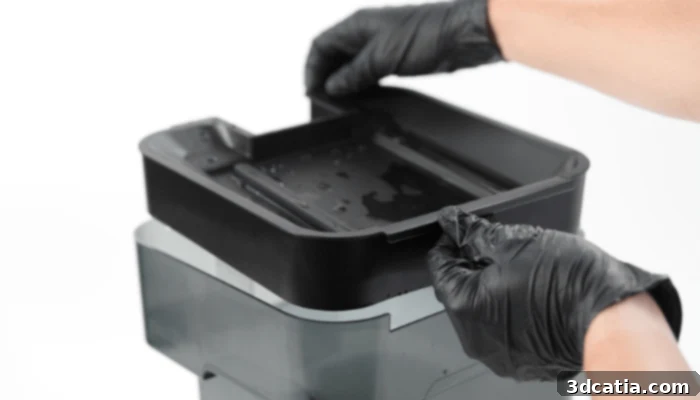
This photo shows the solvent replacement process (photo credits: Formlabs)
Understanding IPA Purity, Cost, and Safe Handling
When selecting isopropyl alcohol for your 3D printing needs, the purity level is a critical factor that directly impacts its effectiveness and performance. Not all alcohols are created equal. The common rubbing alcohol found in supermarkets, often labeled as 70% IPA, typically contains a higher percentage of water and other additives. While suitable for antiseptic uses, this lower concentration is generally not recommended for technical applications like 3D print cleaning, as it can leave more residue and evaporate slower, potentially hindering the pristine finish of your prints.
Instead, always opt for isopropyl alcohol with a purity of 95% or higher, with 99% being the gold standard for resin 3D printing. This higher purity ensures faster evaporation, minimal residue, and superior solvency for uncured resin. Reliable sources for high-purity IPA include online retailers like Amazon, specialized chemical suppliers, and electronics supply stores. It’s often available in convenient 1-liter bottles for individual use or more economical 5-liter cans for frequent users. The price of isopropyl alcohol can vary, typically ranging from $5 for a 500 ml bottle to approximately $30 for a 5-liter container, depending on the quantity purchased and the brand.
Crucial Health Warnings and Safety Protocols
While isopropyl alcohol is an excellent and widely used solvent, it is also a chemical substance that demands respect and proper handling due to its hazardous properties. It can cause irritation to the eyes and respiratory tract upon contact or inhalation. High concentrations, especially well above occupational exposure limits, can affect the central nervous system, leading to symptoms such as dizziness, nausea, headaches, and even loss of consciousness. Prolonged or repeated direct skin contact with pure IPA can strip the skin of its natural oils, causing dryness, cracking, and dermatitis. Furthermore, dispersion or spray application of IPA can rapidly create dangerous vapor levels in the air, increasing inhalation risks and flammability hazards.
Therefore, stringent precautions are essential when working with IPA. Always wear appropriate personal protective equipment, including chemical-resistant gloves (nitrile is recommended) and eye protection (safety glasses or goggles). It is paramount to work in a well-ventilated area, ideally under a fume hood, to minimize vapor inhalation. As IPA is highly flammable, keep it away from open flames, sparks, and hot surfaces. In case of skin or clothing contact with the pure substance, immediately rinse the affected skin area with plenty of water and remove contaminated clothing. If eye contact occurs, rinse continuously with water for several minutes and seek medical attention if irritation persists. Apart from these necessary precautions, there’s no cause for undue panic. Isopropyl alcohol is a regulated product, and when used correctly and according to the manufacturer’s safety data sheet (SDS) and label instructions, it presents a manageable health risk.
Exploring Alternatives to Isopropyl Alcohol
While IPA is a widely accepted standard, some manufacturers and users seek alternatives based on preferences, specific product performance, cost-effectiveness, or safety concerns. The choice of an alternative solvent can depend on the type of resin used, the printer’s specifications, and individual safety priorities.
One common alternative is 95% or 90% ethyl alcohol, often found in various forms. Similar to IPA, it acts as a strong solvent for resins and evaporates quickly. Another option sometimes considered is acetone, readily available in many supermarkets. However, caution is advised with acetone as it is a much harsher solvent than IPA and can potentially damage certain types of resins, printer components (like plastic parts or FEP film), or even irritate skin more severely. Pink alcohol, or denatured alcohol, while sometimes used, is generally not recommended by most 3D printing manufacturers because it can leave stains on prints due to added denaturants. A 99.9% version of pink alcohol might be an alternative in specific industrial settings but is rarely found in consumer supermarkets. For a more basic approach, some users advocate for cleaning machines with soap and water; however, this method often falls short of achieving perfect resin removal and can leave sticky residues, particularly on printed parts.
Formlabs, a leading manufacturer of resin 3D printers, also offers tripropylene glycol monomethyl ether (TPM) as an excellent alternative for cleaning resin from parts made from non-biocompatible materials. TPM is favored for its significantly milder odor and, crucially, its non-flammable nature, making it a safer option for many environments. Moreover, several specialized “resin cleaners” are available on the market, often produced by the same companies that develop 3D printing solutions. These proprietary cleaners are typically formulated to be highly effective at dissolving uncured resin while being less volatile, less flammable, and often safer for skin contact than traditional solvents, providing an enhanced level of safety and convenience.
Responsible Disposal and Recycling of IPA
The responsible disposal of used isopropyl alcohol is as important as its safe handling during use. IPA that has been used for cleaning 3D prints will contain dissolved photopolymer resin, rendering it an environmentally harmful material. Therefore, it cannot be simply poured down the drain or disposed of with regular household waste. Proper disposal is mandated to protect the environment and comply with local regulations.
To dispose of used IPA, it is generally necessary to contact a specialized hazardous waste disposal company or your local waste management facility for guidance. They can provide information on proper collection points or disposal services for chemical waste. The empty plastic bottles in which IPA is typically sold, once thoroughly rinsed and dried, can usually be disposed of in designated plastic recycling bins, depending on local recycling guidelines. Furthermore, isopropyl alcohol can often be recycled and reused, significantly reducing waste and cost. Filtering used IPA can remove resin particles, allowing for its efficient reuse in subsequent cleaning cycles. This not only makes your printing process more sustainable but also more economical. For practical guidance on how to effectively filter and reuse IPA contaminated with resin particles, the following video offers a useful visual guide:
Do you regularly incorporate isopropyl alcohol into your 3D printing workflow? Share your insights, tips, or preferred alternatives with us in a comment below or connect with our community on our LinkedIn, Facebook, and Twitter pages! For the latest advancements and news in the world of 3D printing delivered directly to your inbox, don’t forget to sign up for our free weekly Newsletter here. You can also explore all our instructional and informative videos on our dedicated YouTube channel.