
Anouk Wipprecht’s Pangolin Scales BCI+ Dress: The Future of 3D Printed Mind-Reading Fashion and Neurotechnology
Imagine a dress that doesn’t just adorn the body but actively reflects the intricate landscape of the wearer’s thoughts. This concept, once confined to the pages of science fiction, has now become a stunning reality thanks to the visionary work of Dutch designer Anouk Wipprecht. Known for her avant-garde fashion creations that seamlessly fuse art with cutting-edge technology, Wipprecht has once again pushed the boundaries with her latest masterpiece: the Pangolin Scales BCI+ dress. This extraordinary garment is a testament to the power of interdisciplinary collaboration, bringing together advanced 3D printing techniques, sophisticated electroencephalogram (EEG) technology, and the captivating world of high fashion.
The Pangolin Scales BCI+ dress is more than just an interactive outfit; it represents a monumental leap in wearable technology. Developed in partnership with the Institute for Integrated Circuits at Johannes Kepler University (JKU) and the neurotechnology pioneers at g.tec medical engineering GmbH, this creation harnesses the power of EEG – a non-invasive method used to evaluate the brain’s electrical activity – to translate neural signals into dynamic light and motion patterns. The result is a garment that visually expresses the wearer’s internal state, creating a profound connection between thought and physical manifestation. This groundbreaking project not only redefines fashion but also opens up new dialogues about human-computer interaction and the future of self-expression.
Anouk Wipprecht: A Pioneer at the Intersection of Fashion and Technology
Anouk Wipprecht stands at the forefront of a design revolution, consistently blurring the lines between fashion, engineering, and interactive art. Her philosophy centers on creating experiences rather than just garments, transforming clothing into intelligent systems that react to the environment or the wearer’s biological signals. Wipprecht’s work often explores the concept of “techno-social fashion,” where clothing becomes an extension of our senses and a medium for enhanced interaction with the world around us. Her projects are not merely experimental; they are profound explorations into what fashion could be in an increasingly connected and technologically advanced future.
Building on Innovation: The Legacy of the Proximity Dress
The Pangolin Scales BCI+ dress is not Anouk Wipprecht’s first foray into the realm of intelligent, 3D printed fashion. Her previous projects have consistently showcased her commitment to innovation. A notable predecessor is the acclaimed Proximity Dress. This earlier creation brilliantly utilized Selective Laser Sintering (SLS) 3D printing technology to craft a garment that physically responds to the presence of others. When someone approaches too closely, the Proximity Dress creates a physical barrier, offering the wearer a unique form of personal space management in crowded environments. This project demonstrated Wipprecht’s early mastery of integrating complex electronic systems and reactive mechanisms into aesthetically compelling designs, laying crucial groundwork for the even more ambitious Pangolin Scales BCI+ dress.
The progression from the Proximity Dress, which reacted to external stimuli, to the Pangolin Scales dress, which responds to internal brain activity, marks a significant evolution in Wipprecht’s design trajectory. It signifies a shift from external interaction to an intimate connection with the wearer’s mind, moving beyond mere physical presence to the profound realm of thoughts and emotions. This continuous exploration of human-computer interaction through fashion underscores her unique position as a leading figure in wearable technology and smart apparel.
The Pangolin Scales BCI+ Dress: A Symphony of Brain Waves, 3D Printing, and Design
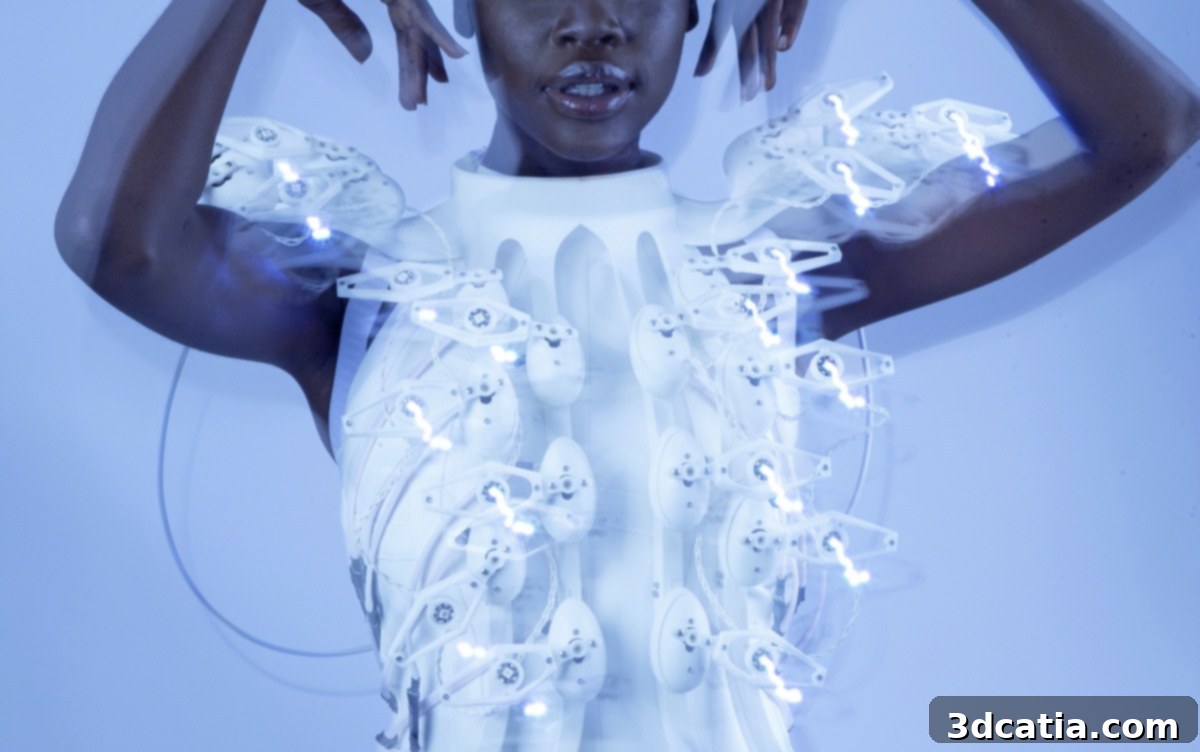
The Pangolin Scales BCI+ dress stands as a monumental achievement, bridging the gap between neuroscience, intricate engineering, and high fashion. At its core, the garment is designed to translate the wearer’s complex brain activity into a dynamic visual experience. When the wearer thinks, concentrates, or experiences emotional shifts, the dress responds, illuminating and moving in mesmerizing patterns. This instantaneous feedback loop transforms the abstract nature of thought into a tangible, beautiful spectacle, effectively turning neuroscience into a form of visual art.
Inspired by Nature: The Pangolin’s Protective Elegance
As its name suggests, the Pangolin Scales dress draws its primary inspiration from the unique, scaly nocturnal mammal, the pangolin. Anouk Wipprecht ingeniously adapted the pangolin’s distinctive overlapping scales into the dress’s modular design. This naturalistic inspiration was not merely aesthetic; it served a crucial functional purpose. The scale-like structure allowed for a lightweight yet robust garment, an essential factor when integrating a sophisticated array of sensors and electronics. The delicate balance between biological elegance and technological prowess is evident in every detail, ensuring the dress remains both wearable and breathtakingly impactful.
The Unprecedented Technological Integration: EEG, BCI, and 3D Printing
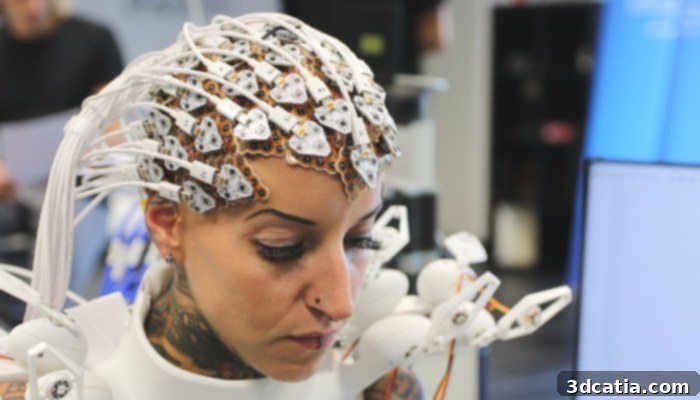
The technical complexity behind the Pangolin Scales dress is truly remarkable. The core of its functionality lies in its ability to accurately read and interpret brain signals. To achieve this, Anouk Wipprecht collaborated closely with the expert teams from JKU and g.tec. They ingeniously incorporated an astounding 1,024 brain-reading EEG sensors directly onto the model’s head, forming an intricate cap that interfaces directly with the garment. These sensors are meticulously designed to measure the minute electrical activity generated by the brain, providing an unprecedented level of resolution for a Brain-Computer Interface (BCI) in a fashion context.
A Brain-Computer Interface (BCI) is a direct communication pathway between an enhanced or wired brain and an external device. In this instance, the BCI’s role is to interpret the complex electrical patterns from the EEG sensors and translate them into actionable commands for the dress. The 1,024 channels represent a significant leap forward in BCI technology, allowing for a much richer and more detailed extraction of information from the human brain than previously possible in a wearable, interactive garment. This high-resolution data is then fed into the dress’s internal processing unit, where algorithms transform the neural data into corresponding light sequences and subtle kinetic movements across the garment’s surface.
3D printing played an indispensable role in the fabrication of this intricate design. To ensure the dress was both lightweight enough for wearability and strong enough to support its integrated electronics, Wipprecht partnered with 3D printing experts from Shapeways. Together, they developed the ultra-thin, yet incredibly resilient, 3mm dress-frame. The precision offered by advanced 3D printing technologies, likely including SLS as seen in her previous projects, was crucial for creating the complex, interlocking scale patterns and internal channels required for wiring and sensor integration. This meticulous approach to design and manufacturing underscores the immense potential of additive manufacturing in realizing futuristic fashion concepts that demand exact specifications and bespoke geometries.
The Future of Fashion: Implications of Brain-Computer Interface Clothing
The Pangolin Scales BCI+ dress is more than just an exhibition piece; it offers a profound glimpse into the future of human interaction with technology and how we express ourselves. Showcasing the world’s first 1,024 channel BCI integrated into fashion, this interactive garment pushes the boundaries of what is considered possible. Its debut at prestigious events like the Ars Electronica Festival allows a wider audience to witness this fusion of art and science, prompting discussions about the societal and personal implications of such advanced wearable technology.
Anouk Wipprecht herself eloquently described the dress’s aesthetic and technical ambition: “It definitely is a dress that is ‘out there’. We are using a lot of wires to create a well-behaved data communication system, and we wanted to go for a very ‘cyborg’ look.” This “cyborg look” isn’t merely a stylistic choice; it’s a statement about the evolving relationship between humans and machines. It represents a future where technology is not just an external tool but an integrated part of our identity and expression, blurring the lines between biological and artificial components.
Beyond the Runway: Potential Applications and Ethical Considerations
The implications of brain-sensing fashion extend far beyond the realm of haute couture. Imagine personalized clothing that adapts to your mood, provides real-time feedback on your stress levels, or even assists in therapeutic contexts by visualizing emotional states. For individuals with communication challenges, such garments could offer novel avenues for expression. In entertainment, they could create deeply immersive experiences, reacting directly to a player’s focus or excitement. The potential applications are vast and transformative, promising a future where fashion is an active participant in our well-being and interaction.
However, such pioneering technology also raises important ethical considerations. If our clothing can display our thoughts and emotions, what does that mean for privacy? Who controls this data, and how can we ensure its security? The “mind-reading” aspect, even if currently limited to broad emotional states, opens up complex questions about personal autonomy and the boundaries of public self-expression. The Pangolin Scales BCI+ dress serves as a powerful prompt for these essential conversations, guiding us to consider the responsible development and integration of neurotechnology into our daily lives.
The Intersection of Art, Science, and Innovation
The Pangolin Scales BCI+ dress epitomizes the profound synergy that can emerge when artistic vision collaborates with scientific rigor and technological prowess. Anouk Wipprecht’s work transcends traditional design, positioning fashion as a dynamic interface for human experience. This project not only showcases the incredible capabilities of 3D printing and neurotechnology but also challenges our perceptions of what clothing can be. It encourages us to look beyond mere aesthetics and consider the deeper, interactive potential of the garments we wear. It’s a powerful example of how multidisciplinary approaches can lead to innovations that are not only functional but also deeply thought-provoking and artistically resonant.
The Pangolin Scales BCI+ dress stands as a beacon of innovation, demonstrating how the blend of neuroscience, advanced manufacturing, and visionary design can create entirely new forms of expression and interaction. It invites us to contemplate a future where our clothing might communicate our inner worlds, offering a unique and captivating glimpse into the potential of brain-computer interface fashion. This is not just a dress; it is a statement about the future of human identity in a technologically advanced world.
For those eager to delve deeper into the technical marvels behind this project, more information can be found on g.tec’s official website, HERE. What are your thoughts on the revolutionary 3D printed Pangolin Scales BCI+ dress? Do you see a future where our clothing reflects our thoughts and emotions? Share your insights and comments below, or join the conversation on our Facebook and Twitter pages! Don’t forget to sign up for our free weekly Newsletter to receive all the latest news and innovations in 3D printing straight to your inbox!