
Navigating the Future: Key Trends and Opportunities in the 3D Printing Job Market in 2022
The landscape of additive manufacturing is continuously evolving, and with its growth comes a dynamic and expanding job market. Every year, 3Dnatives dedicates itself to analyzing these shifts, identifying significant recruitment trends based on the extensive job offers published on its dedicated job board. The year 2022 marked a pivotal period, demonstrating accelerated growth and maturation within the sector. Our platforms across French, English, Spanish, Italian, and German languages showcased more than 900 job opportunities, an impressive figure that more than doubled the number of offers from the previous year. This substantial increase is a clear indicator of the robust expansion and confidence in 3D technologies across various industries.
Consistent with previous years, the market continued to exhibit a strong demand for highly technical profiles, underscoring the specialized nature of additive manufacturing. Furthermore, the prevalence of long-term contracts reflected a significant commitment from key industry players, signaling their strategic investment in 3D technologies and their unwavering belief in its long-term sustainability and transformative potential. This year, however, saw industrial sectors taking a prominent lead in recruitment. Fields such as aerospace, automotive, and medical, among others, were at the forefront. These industries are not merely experimenting with additive manufacturing; they are deeply integrating it into their core value chains, strategically surrounding themselves with experts to fully harness the myriad benefits this innovative technology offers, from accelerated prototyping to complex parts production and mass customization.
Stability and Strategic Investment: A Look at Contract Types in the AM Job Market
The job market trends in 2022 painted a clear picture of confidence and long-term commitment. A striking 76% of all offers published on our job board were permanent contracts. This high percentage is a strong testament to the industry’s belief in the lasting impact and growth potential of additive manufacturing. Companies are not just filling temporary needs; they are investing in foundational teams and developing long-term capabilities. Recruiters are actively strengthening their workforce, seeking qualified professionals who can contribute to the sustained growth and innovation of additive manufacturing for years to come. This commitment translates into greater job security and clearer career pathways for professionals entering or advancing within the field.
Beyond permanent positions, it’s equally noteworthy that the number of internships remained constant at 19% compared to the previous year. This consistency highlights the ongoing importance of nurturing future talent and bridging the gap between academia and industry. Students continue to benefit immensely from practical training opportunities, allowing them to immerse themselves in the dynamic world of additive manufacturing. Such hands-on experience is invaluable for their future professional careers, providing them with real-world insights, strengthening their technical skills, and equipping them with specialized know-how that is directly applicable to the demands of this cutting-edge industry. These internships serve as a vital pipeline for new talent, ensuring a steady stream of skilled individuals ready to push the boundaries of 3D printing technology.
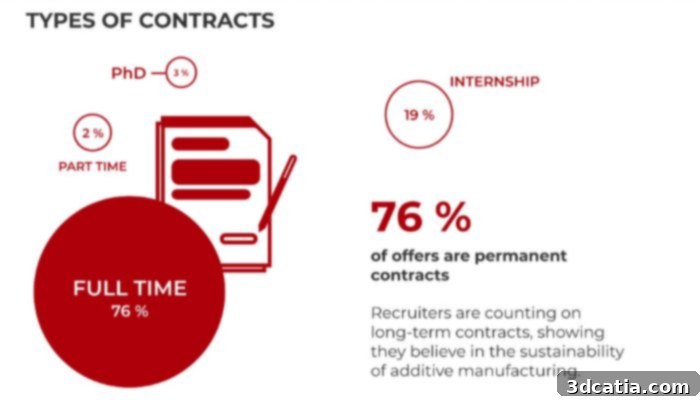
A significant 3D printing job trend in 2022 was that 76% of the published job offers were for permanent contracts, indicating strong industry confidence.
The Demand for Expertise: Key Technical Profiles Driving Innovation
The emphasis on permanent contracts is directly linked to the industry’s critical need for highly technical profiles. Recruiters are specifically seeking individuals with specialized skills to drive innovation and implementation. In 2022, 3D printing jobs primarily focused on design, development, production, and methods were the most coveted. These roles demand a deep understanding of additive manufacturing processes, materials science, and advanced software tools.
For instance, roles such as printing technicians are essential for operating and maintaining advanced 3D printing equipment, ensuring optimal performance and quality output. Additive manufacturing operators are on the front lines, managing the printing process from preparation to post-processing, often working with complex industrial machines. Engineers specializing in additive manufacturing are crucial across the entire product lifecycle, from designing components optimized for 3D printing (using tools like topology optimization and generative design) to developing new materials and refining production methodologies. These professionals are responsible for pushing the boundaries of what’s possible with AM, translating theoretical concepts into tangible, high-performance products.
The design aspect of additive manufacturing is particularly unique, requiring engineers to think beyond traditional manufacturing constraints. They must understand how material properties, print orientation, and support structures impact the final part, leveraging the freedom of design that AM offers to create lighter, stronger, and more complex geometries. Development roles often involve R&D into novel materials, process optimization, and the integration of AM into existing manufacturing workflows. Production specialists are vital for scaling AM processes, ensuring efficiency, quality control, and cost-effectiveness in volume production. Roles in “methods” focus on establishing best practices, standardizing procedures, and continuous improvement of manufacturing processes.
Conversely, support positions such as marketing, while essential for long-term market growth, were less sought after for the time being. This indicates a primary focus within the industry on building foundational technical capabilities and integrating additive manufacturing solutions before scaling up promotional efforts. The current priority is clearly on securing the expertise needed to innovate, produce, and validate AM technologies, reflecting a stage of intensive technological development and adoption.
Leading the Charge: Companies That Recruited the Most in 2022
Analyzing recruitment trends from the perspective of the employers reveals another compelling shift in the 3D printing landscape. In 2022, a significant 31% of recruiting companies were large organizations with over 5,000 employees. This marks a notable increase from just 20% in the previous year, highlighting a growing trend where larger enterprises are actively integrating dedicated additive manufacturing functions within their corporate structures. This isn’t merely a small-scale pilot; it signifies a strategic, enterprise-wide commitment to leveraging 3D printing for competitive advantage.
A prime example of this trend can be seen with several car manufacturers, many of whom have established dedicated 3D printing centers. These centers are often equipped with state-of-the-art machinery and staffed by specialized teams, underscoring their conviction in the profound benefits of 3D printing for their business operations. The automotive sector, in particular, demonstrated this robust growth, with 3Dnatives publishing more than twice as many job offers from this industry compared to the previous year. This surge reflects the automotive industry’s increasing reliance on 3D printing for everything from rapid prototyping and tooling to the production of complex, lightweight components and customized parts, driving efficiency and innovation throughout their manufacturing processes.
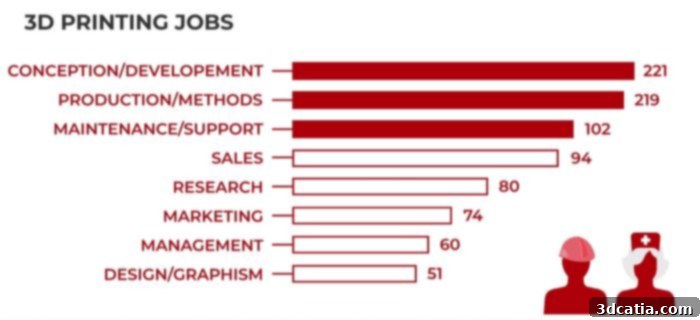
Technical profiles, such as additive manufacturing engineers and operators, were the most sought after in 2022.
Sector-Specific Growth: Manufacturing, Aerospace, Medical, and the AM Ecosystem
Looking at business sectors, manufacturers continued to be the primary drivers of demand for profiles specialized in additive manufacturing. Among these, the aerospace and medical markets stood out prominently. In aerospace, 3D printing is revolutionizing component design for aircraft and spacecraft, enabling the creation of lighter, more complex parts with superior performance characteristics. This sector actively seeks engineers and technicians for design optimization, material qualification, and advanced production processes for flight-critical parts, driven by the quest for fuel efficiency and enhanced performance. For example, roles involving advanced materials engineering for high-temperature alloys or composite 3D printing are increasingly common.
The medical sector, on the other hand, is rapidly adopting additive manufacturing for personalized healthcare solutions. This includes everything from patient-specific surgical guides and custom prosthetic limbs to biocompatible implants and the nascent field of bioprinting. The demand here extends to biomedical engineers, materials scientists focused on biocompatible polymers and metals, and technicians skilled in medical device manufacturing under stringent regulatory environments. The ability of 3D printing to create highly customized, complex geometries is a game-changer for patient care and surgical precision.
Moreover, the 3D printing industry itself — comprising machine manufacturers, service providers, distributors, and software publishers — was also a significant employer. With a robust 405 job offers published, this segment demonstrated its own impressive growth and maturation. As the market consolidates and technologies become more sophisticated, teams within these companies are becoming more structured and specialized. This includes roles for R&D engineers developing new 3D printers, material scientists innovating new filaments and powders, software developers creating advanced slicing and simulation tools, and application engineers who help integrate AM solutions for clients. The professionalization of these internal teams reflects a broader trend towards a more mature and specialized industry.
The ongoing market consolidation points towards a future where specialized expertise and efficient production processes will be paramount. It will be particularly interesting to observe how these diverse players – from large industrial adopters to the core AM technology providers – tailor their recruitment policies in the coming years to meet evolving demands, foster innovation, and secure the talent necessary to maintain their competitive edge in a rapidly accelerating technological landscape.
Large corporations are increasingly seeking profiles specialized in additive manufacturing to integrate this technology into their core operations.
Future Outlook for Additive Manufacturing Careers
The trends observed in 2022 provide a strong foundation for predicting the future trajectory of 3D printing employment. The sustained demand for technical profiles, coupled with a significant shift towards permanent contracts and increased investment from large industrial players, indicates a robust and maturing market. As additive manufacturing technologies continue to advance and become more integrated into mainstream production, we can expect a further diversification of roles and a heightened need for multidisciplinary skills. Professionals with expertise spanning mechanical engineering, materials science, software development, and data analytics will be particularly valuable.
The continuous growth in sectors like aerospace, automotive, and medical, alongside the expansion of the core 3D printing industry, promises a vibrant future for AM careers. Education and training programs will play an even more crucial role in preparing the next generation of additive manufacturing specialists, ensuring they possess both theoretical knowledge and practical skills demanded by this cutting-edge field. The 3D printing job market is not just growing; it’s evolving, offering exciting and stable career paths for those ready to innovate and shape the future of manufacturing.
You Can Find the Full Infographic Here
What are your thoughts on the 3D printing job market trends in 2022 and beyond? Let us know in a comment below or connect with us on ourLinkedIn,Facebook, andTwitter pages! Don’t forget to sign up for our free weeklyNewsletter here to get the latest 3D printing news straight to your inbox! You can also find all our insightful videos on ourYouTube channel.
*Cover Photo Credits: 3Dnatives