

Transforming Flight: The Impact of Additive Manufacturing on the Aerospace Industry
The aerospace sector, a realm defined by relentless innovation and an unyielding pursuit of performance, stands at the precipice of a significant manufacturing revolution. A recent study by Research and Markets underscores this transformative shift, highlighting the profound impact of additive manufacturing (AM) on the industry. The consulting firm reported an impressive growth rate of 23.01% between 2017 and 2021, a clear indicator of the immense potential and expanding adoption of 3D printing technologies in aerospace applications, alongside numerous other sectors.
Additive manufacturing has steadily cemented its place within aerospace for some time now, offering a diverse array of applications that span the entire lifecycle of aircraft components. From the intricate creation of critical aircraft or helicopter parts to the development of lighter, more efficient engine components and high-performance 3D printed turbines, the benefits are clear. These advanced technologies consistently deliver substantial savings in both time and cost, while simultaneously yielding finished products that boast enhanced strength, superior efficiency, and complex geometries previously unattainable through traditional manufacturing methods. The Research and Markets study not only confirms these advantages but also reflects the widespread enthusiasm among industry players who recognize AM as a powerful disruptor and a catalyst for future growth.
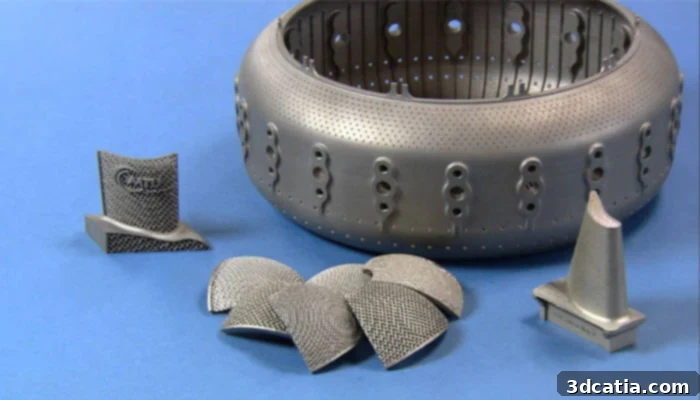
3D printed parts by EOS for MTU Aero Engines
The Synergy of Additive and Traditional Manufacturing in Aerospace
Prepared with insights from a panel of leading industry experts, the comprehensive Research and Markets report delves into the intricate dynamics of the aerospace additive manufacturing market, outlining its current state and projecting its growth trajectory over the coming years. One of the most compelling trends identified in this report is the increasing convergence of additive manufacturing with traditional production techniques. Rather than a complete replacement, 3D printing is poised to complement established methods, forming a powerful hybrid approach that leverages the strengths of both. This integration is particularly impactful during the product development phase, where additive manufacturing offers unparalleled capabilities for rapidly creating functional prototypes and custom molds. This results in significantly faster iteration cycles and a more cost-effective pathway to design validation and optimization, accelerating the entire innovation process.
According to the report, a primary driver for the aerospace sector’s adoption of additive manufacturing is its exceptional ability to enhance part performance and achieve significant weight reduction. This lightweighting capability is paramount in aviation, directly translating to improved fuel efficiency, increased payload capacity, and reduced operational costs. 3D printing technologies provide engineers with unprecedented freedom in design, enabling the creation of highly complex geometries, internal lattice structures, and consolidated assemblies that are not only more efficient but also stronger. This expanded design envelope facilitates the integration of multiple functions into a single component, streamlines assembly processes, and effectively removes many of the traditional design and production constraints that have long challenged the industry. The ability to optimize material distribution precisely where it’s needed and eliminate unnecessary mass is a game-changer for critical aerospace components, from structural elements to engine parts.
Unlocking Design Freedom and Performance Advantages
The inherent flexibility of additive manufacturing allows for the creation of intricate designs that are virtually impossible with subtractive methods. This includes complex internal channels for optimized fluid flow or cooling, organic shapes inspired by biomimicry, and sophisticated lattice structures that provide excellent strength-to-weight ratios. Such design freedom directly contributes to superior aerodynamic performance, enhanced thermal management, and improved structural integrity, all crucial factors in aerospace engineering. Beyond individual part optimization, AM enables part consolidation, where multiple components can be redesigned and printed as a single, integrated unit. This not only reduces the overall part count and assembly time but also minimizes potential points of failure, thereby increasing reliability and simplifying the supply chain for spare parts.
Current Challenges and Future Outlook for Additive Manufacturing in Aerospace
Despite its myriad benefits, the report also acknowledges the significant challenges that still confront the widespread adoption of additive manufacturing in the aerospace market. One of the most frequently cited limitations is the restriction on build volume and the overall size of printable products. While an aircraft is composed of numerous small, intricate components, it also incorporates very large structural elements. Historically, additive manufacturing technologies have been limited by the physical dimensions of 3D printers, making them primarily suitable for smaller components. This constraint has, to some extent, slowed the market’s growth, particularly for primary structural applications. However, ongoing advancements are rapidly pushing these boundaries. Companies like STELIA Aerospace have already demonstrated the feasibility of creating fairly large pieces, such as fuselage panels, through AM. Furthermore, industry giants like GE are actively investing in research and development to expand print envelopes and overcome these size limitations step by step, pioneering new large-format AM systems.
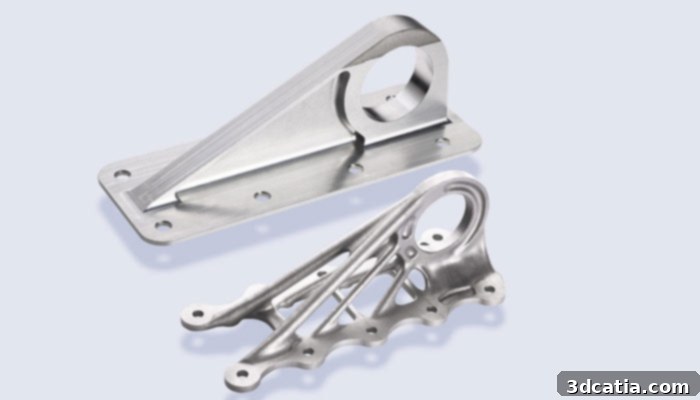
Parts for Airbus, 3D printed by GE
Beyond size constraints, other critical challenges include the stringent requirements for material qualification and certification in aerospace. Every component, especially those used in flight-critical applications, must undergo rigorous testing and validation to meet exacting safety and performance standards set by regulatory bodies such like the FAA and EASA. This process can be lengthy and expensive for new additive manufacturing materials and processes. Ensuring consistent part quality, repeatability, and robust process control across different machines and production batches is also paramount. Furthermore, the high initial investment in AM equipment, coupled with the cost of specialized aerospace-grade materials (such as titanium, nickel-based superalloys, and high-performance polymers), can present barriers to entry for smaller firms. Finally, there’s a growing need for a skilled workforce proficient in design for additive manufacturing (DfAM), advanced material science, and sophisticated post-processing techniques to fully leverage the potential of these technologies.
Key Innovators and Emerging Players in Aerospace AM
The report concludes with an insightful overview of the main players currently driving innovation in the aerospace additive manufacturing market. Established leaders such as Arcam (now part of GE Additive, renowned for Electron Beam Melting), Arconic (a pioneer in advanced aluminum alloys and manufacturing technologies), EOS (a global leader in Direct Metal Laser Sintering), GKN Aerospace (a major supplier of aerospace components), and Stratasys (a dominant force in polymer 3D printing with FDM and PolyJet technologies) continue to push the boundaries of what’s possible. Simultaneously, other innovative companies like 3D Systems and Concept Laser (also acquired by GE Additive, specializing in metal laser melting) are increasingly focusing their expertise on aerospace applications, rapidly emerging as key experts and significant contributors to the industry’s evolution. This dynamic ecosystem, comprising equipment manufacturers, material suppliers, software developers, and service bureaus, is collectively propelling the aerospace AM market forward.
The future of aerospace manufacturing is undeniably intertwined with additive technologies. As these methods mature and overcome existing challenges, they promise to unlock unprecedented capabilities for aircraft design, production, and maintenance, fueling the next generation of air and space travel. The full details of this comprehensive analysis can be found in the complete study available on the official Research and Markets website.
Do you believe additive manufacturing will revolutionize the aerospace industry in the coming decades? We invite you to share your thoughts and insights in the comments section below, or engage with us on our Facebook and Twitter pages! For all the latest news, trends, and breakthroughs in 3D printing delivered directly to your inbox, don’t forget to sign up for our free weekly Newsletter.