
3D Printed Prosthetics at the Myanmar Border: A Beacon of Hope in Mae Sot
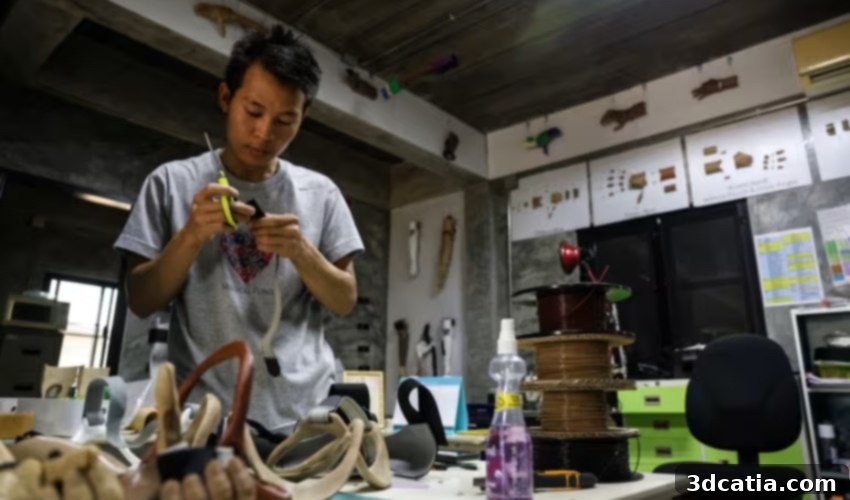
In Mae Sot, Thailand, a bustling border town adjacent to Myanmar, an extraordinary humanitarian effort is quietly reshaping the lives of amputees through advanced prosthetic care. Here, in a place often defined by its proximity to conflict and displacement, 3D printing technology is being leveraged to restore independence and dignity. At the heart of this initiative is Aung Tin Tun, a dedicated 3D printing manager, whose meticulous oversight ensures the creation of functional plastic prosthetic arm grips. These seemingly simple devices — often just hoops or basic attachments — offer profound freedom and newfound capabilities for individuals grappling with limb loss, enabling them to navigate daily life with greater ease.
The Burma Children’s Medical Fund (BCMF) stands at the forefront of this transformative project. Driven by an unwavering mission to provide critical assistance and hope to vulnerable populations, BCMF operates within the supportive environment of the Mae Tao Clinic compound. The team has strategically embraced 3D printing as a crucial tool to address the escalating demand for custom-fitted prostheses, a tragic consequence of the ongoing civil conflict in neighboring Myanmar. The conflict has led to a significant increase in injuries requiring amputation, making rapid and accessible prosthetic solutions more vital than ever.
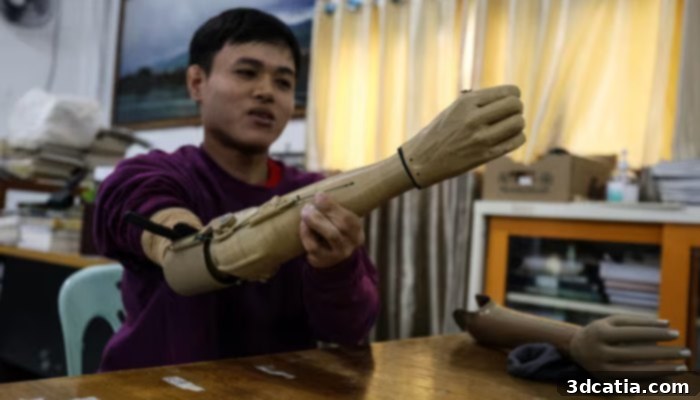
Chan Thar, a 25-year-old library manager at the Mae Tao Clinic, undergoes a fitting session for a 3D printed prosthetic arm in the clinic’s library.
Since its integration into BCMF’s medical toolkit in 2019, 3D printing technology has ushered in a new era of prosthetic possibilities, significantly enhancing both design and functionality. This innovative approach has allowed BCMF to move beyond basic aids, creating a diverse range of devices tailored to individual needs. From straightforward utensil holders that empower users to eat independently, to highly intricate limb-and-torso devices composed of over a hundred components, 3D printing offers unparalleled customization. This adaptability is particularly crucial for recipients living near the volatile border region, where access to traditional, often expensive, prosthetics is severely limited. The benefits are tangible and immediate, helping individuals regain essential motor functions and improve their overall quality of life.
The ability of 3D printing to produce lightweight, durable, and highly personalized devices quickly and affordably has revolutionized BCMF’s capacity to serve its community. Unlike conventional prosthetic manufacturing, which often involves lengthy casting and fabrication processes, additive manufacturing allows for rapid prototyping and iteration. This means that a patient can have a custom-fitted device designed, printed, and fitted in a fraction of the time, dramatically reducing waiting periods and enabling quicker rehabilitation. Moreover, the digital design files can be easily modified and shared, allowing for continuous improvements and adaptations as a patient’s needs evolve or as materials and technologies advance. This flexibility is a game-changer for a region where resources are scarce and demand is high, proving that innovation can bridge significant healthcare gaps.
The genesis of this groundbreaking initiative came from an unexpected source. Kanchana Thornton, the visionary founder of the BCMF, vividly recalls an evening when a BBC documentary about 3D printing caught her attention. Watching the intricate details of how objects could be built layer by layer, a profound realization struck her: this technology held immense potential to revolutionize prosthetic care within the clinic’s challenging environment. Kanchana immediately grasped the implications of 3D printing for creating custom medical devices, envisioning a future where rapid, affordable, and personalized prosthetics could be made directly at the point of need. This serendipitous discovery ignited a passion to integrate additive manufacturing into BCMF’s operations, transforming a flickering idea into a tangible solution for hundreds of amputees.
With crucial support from the Brodtbeck Philanthropy Foundation, BCMF was able to transform this vision into reality. The foundation’s generous contributions enabled the procurement of state-of-the-art 3D printers, significantly enhancing the quality and accessibility of the prosthetic care BCMF could deliver. However, the path was not without its challenges. Integrating a cutting-edge technology like 3D printing into a humanitarian clinic involved a steep learning curve. The team encountered various obstacles, including lengthy production times for complex devices, the need for frequent calibration to maintain print accuracy, and the significant training required for staff to master the design software and machine operation. Despite these technical hurdles, the organization’s unwavering commitment to its mission propelled them forward, continuously refining their processes and expanding their capabilities to provide crucial aid.
To ensure that no one is left behind, especially those in remote or conflict-affected areas, BCMF operates a highly specialized mobile team that ventures directly into Myanmar. This team is equipped with portable 3D printers, ingeniously powered by solar energy, allowing them to reach individuals who are unable to access the Mae Tao Clinic directly due to geographical barriers, financial constraints, or security risks. The logistical complexities of operating in such a sensitive region are immense, requiring careful planning and resourcefulness. The use of solar power exemplifies BCMF’s innovative spirit, ensuring sustainability and self-sufficiency even in areas without reliable electricity. This mobile outreach is a testament to their dedication, bringing vital prosthetic care directly to those most in need, regardless of their location.
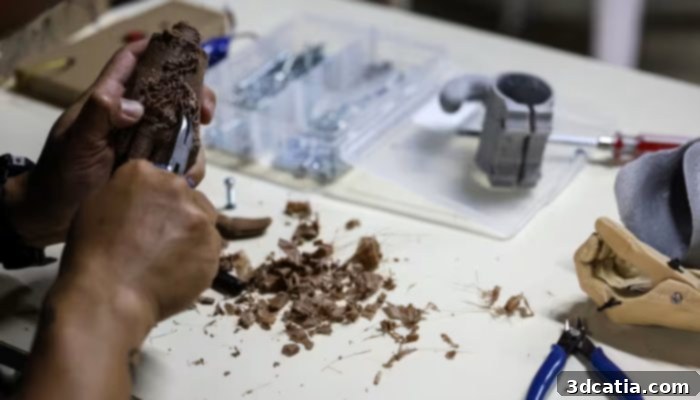
Post-processing of a 3D printed prosthesis at the BCMF clinic.
Navigating Challenges: The Mobile Clinic in a Conflict Zone
Aung Tin Tun, the 3D printing manager, shed light on the extraordinary efforts required to operate the mobile clinics. “Some patients cannot come [to the Mae Tao Clinic] or cross the border, so it’s our responsibility to help them,” he explained, emphasizing the moral imperative that drives their work. The border between Thailand and Myanmar can be porous yet heavily controlled, making safe passage for vulnerable individuals extremely difficult. This reality necessitates BCMF’s proactive approach. Aung Tin Tun detailed the discreet methods they employ: “We box up the 3D printer and cover it if we have to move it. Otherwise, we may get asked questions if [the Myanmar military] sees it.” This poignant statement highlights the constant threat and political sensitivities involved in delivering humanitarian aid in a conflict zone. The team operates with extreme caution, navigating treacherous routes and avoiding detection to ensure they can continue their life-saving work without putting themselves or their patients at undue risk. Their resilience and dedication in the face of such adversity are truly inspiring, embodying the humanitarian spirit that defines BCMF.
As the demand for prosthetic care continues to surge, exacerbated by the devastating and increased use of landmines and cluster munitions in the region, Kanchana Thornton looks towards a future where 3D printing can provide even more significant benefits to those along the Thailand-Myanmar border. The ongoing conflict in Myanmar has led to a horrific rise in injuries, particularly among civilians, intensifying the need for effective and scalable rehabilitation solutions. Kanchana’s ultimate goal is to empower these individuals to regain not just basic mobility but nearly full dexterity, enabling them to easily reintegrate into their daily lives and reclaim a profound sense of normalcy. This extends beyond merely replacing a lost limb; it encompasses restoring the ability to work, care for families, participate in community life, and pursue educational opportunities. 3D printing, with its capacity for mass customization and cost-effective production, is seen as the key to achieving this ambitious vision, offering hope for a future where amputees can thrive despite their circumstances.
The impact of BCMF’s work resonates deeply within the communities they serve. Each prosthetic device represents not just a piece of plastic and circuitry, but a renewed chance at life, independence, and hope. Children can return to school, adults can resume their livelihoods, and families can find stability. The clinic’s commitment to training local personnel in 3D printing techniques also fosters long-term sustainability, creating a skilled workforce capable of continuing this vital work for generations to come. This empowerment through technology ensures that the benefits of additive manufacturing extend far beyond the immediate recipients, building capacity and resilience within the community itself.
What do you think of this inspiring 3D printed prosthetics initiative at the Myanmar border? We’d love to hear your thoughts! Let us know in a comment below or share your views on our LinkedIn, Facebook, and Twitter pages! Don’t miss out on the latest advancements in additive manufacturing – sign up for our free weekly newsletter here to receive the freshest 3D printing news directly in your inbox! You can also explore all our compelling videos on our YouTube channel for more insights into the world of 3D printing innovation.