

The Future of Sound: How 3D Printing is Revolutionizing the Music Industry
Additive manufacturing, commonly known as 3D printing, is rapidly emerging as a transformative force with the potential to fundamentally reshape the music industry. While 3D printing has already left its indelible mark on numerous sectors, its impact on music is particularly profound. Here, the technology isn’t merely optimizing the production of musical instruments or artistic components; it’s actively enhancing their value, significantly improving accessibility to music for diverse audiences, and fostering greater sustainability. Beyond these core benefits, 3D printing facilitates the revival of historical instruments, empowers individuals with unique needs, and pushes the entire industry towards more eco-conscious practices.
This raises crucial questions: Are 3D printed instruments genuinely more accessible? Does the technology truly lead to superior design and customization of musical products? And does it provide musicians with an invaluable tool to shape their artistic future? To thoroughly understand the true influence of additive manufacturing on music and address these pertinent inquiries, we delve into the specific ways 3D printing is revolutionizing various facets of the sector.
A Path to Sustainability Through 3D Printing in Music
3D printing is renowned for its exceptional ability to enhance the efficiency of production processes. By enabling users to digitally design a product and then construct it layer-by-layer with remarkable precision, it dramatically streamlines development. This digital-first approach significantly simplifies the prototyping phase, allowing for accurate visualization and iterative testing of designs at a much lower cost and with greater efficiency than traditional methods. Crucially, this advanced manufacturing technique inherently minimizes waste, a common byproduct of conventional production processes, thereby paving the way for more sustainable practices.
Within the specific realm of music, 3D printing holds immense potential to champion a more sustainable global outlook. This potential is evident both in the manufacturing processes themselves and in the innovative ways these technologies are being applied to resolve entrenched industry problems. Consider vinyl records, for instance; traditionally, they are far from sustainable. Made primarily from polyvinyl chloride (PVC), a non-biodegradable plastic, their production and disposal contribute to significant environmental concerns, including air pollution when incinerated. Furthermore, the globalized production of vinyl records, often concentrated in a few overseas facilities, has repeatedly demonstrated vulnerabilities to supply chain disruptions, as seen during recent global events.

Photo Credits: Unsplash
In contrast, 3D printing offers a compelling alternative by enabling the manufacture of musical instruments, high-fidelity audio components, and even vinyl records using a broader spectrum of environmentally friendly materials. Embracing additive manufacturing allows for a significant reduction in reliance on non-biodegradable plastics and encourages the exploration of innovative, sustainable material options. A prime example of this pioneering spirit is Green Vinyl Records, a Dutch company committed to producing more eco-conscious vinyl. Eschewing traditional plastics, they utilize sustainable materials to craft records that uphold the same audio quality and aesthetic appeal. Beyond material innovation, Green Vinyl Records also reports a remarkable 60% reduction in energy consumption during their manufacturing process, alongside significantly faster production times, highlighting the comprehensive environmental and operational advantages of this approach.
Moreover, the music world is witnessing a growing movement where artists, musicians, and engineers are collaborating to forge both astonishing and sustainable products. The “Greenaxe” electric guitar, conceived by designer Olaf Diegel, perfectly embodies this ethos. By ingeniously utilizing recycled sawdust, a wood binder, and a 3D printer, Diegel successfully minimized overall manufacturing costs while creating a stunning instrument. The result is a beautifully handcrafted guitar, fashioned entirely from recycled materials, which not only makes music more affordable and accessible but also eliminates the reliance on environmentally detrimental, unsustainable processes. This collaborative, innovative spirit is driving the music industry towards a greener future.
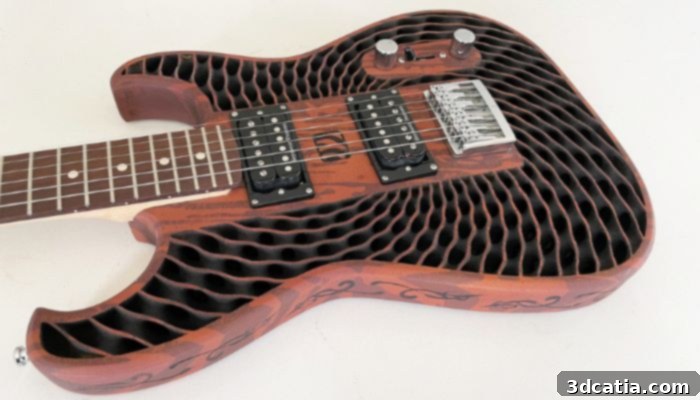
The “Greenaxe” electric guitar made by Olaf Diegel (photo credits: Olaf Diegel)
Martin Juarez Brizzi, CEO of Fona, a company specializing in 3D printed instruments, elaborates on the benefits: “The main impact is the simplicity and the reduction of the manufacturing cost. If we compare traditional lutherie with respect to our Digital Lutherie, all the modifications we make to the instruments must first be designed by means of a 3D modeling program. Here it is possible to explore artistic and/or functional options, plan the instrument, combine materials, etc.” This digital workflow not only reduces costs and complexity but also inherently supports more sustainable practices by minimizing material waste and allowing for precise, on-demand production.
Revolutionizing Musical Instrument Production with 3D Printing
Beyond sustainability, 3D printing plays a pivotal role in how musicians create, market, and access their products. Additive manufacturing technologies enable the production of highly customized and exclusive items, opening up unprecedented opportunities for artists and musicians to craft unique and visually captivating products for their fans. Whether it involves faithfully reproducing rare vintage instruments for live performances or developing innovative new designs for merchandise, 3D printing has become a pathway to more accessible and cost-effective production of diverse music-related goods. However, the convergence of technology and traditional art often sparks debate. More purist musicians and instrument designers sometimes voice concerns that 3D printed instruments may not achieve the same acoustic quality as their handcrafted counterparts. Conversely, a growing number of advocates argue that this technology facilitates more precise, ergonomically superior, and structurally lighter designs, ultimately leading to instruments of higher performance and quality, capable of unique sonic palettes.
Despite these ongoing discussions, it is undeniable that 3D printing has fundamentally transformed the creation and accessibility of musical instruments, establishing itself as an invaluable tool in modern instrument making. By leveraging specific materials and advanced manufacturing techniques, instruments can now be engineered with precise sonic and physical characteristics that were previously unattainable through conventional production methods. This technological leap has also democratized access to musical instruments, making them significantly more accessible and affordable for aspiring and established musicians worldwide. This benefit is particularly impactful for communities where access to traditional instruments is limited or cost-prohibitive. Musicians can now acquire custom-tailored instruments that perfectly align with their specific needs and preferences, without being constrained by market availability or high prices, or even producing them independently from digital blueprints available on platforms like Thingiverse or MyMiniFactory.
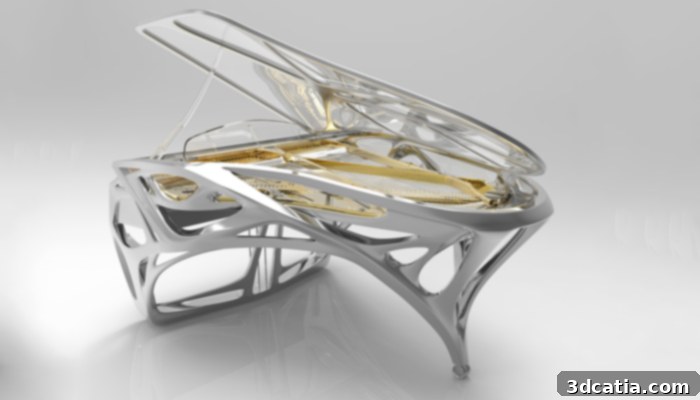
The Grand Piano by Monad Studio (photo credits: Monad Studio)
Furthermore, 3D printing empowers the creation of entirely new musical instruments that seamlessly integrate elements from various existing instruments. This innovative approach leads to the development of “hybrid instruments” possessing truly unique sonic characteristics and physical designs. The technology offers unparalleled freedom in exploring novel instrument concepts and crafting bespoke instruments perfectly adapted to the individual requirements of musicians. Such combinations of disparate elements can also inspire entirely new methodologies for composing and performing music. As Martin Juarez Brizzi of Fona further explains: “The most interesting thing about digital fabrication is not the fact of replacing all components by 3D printing, but combining 3D printing with existing methods and, in that way perhaps, impacting productivity, expanding the customization of an instrument, giving it more artistic or functional argument.” This blend of traditional craftsmanship with cutting-edge technology unlocks a new era of musical innovation.
Technologies and Materials for 3D Printed Musical Instruments
When discussing 3D printed musical instruments, understanding the diverse range of materials and technologies employed is crucial. For instruments with predominantly plastic structures, several common polymers are utilized, including Polylactic Acid (PLA), Acrylonitrile Butadiene Styrene (ABS), Polycarbonate (PC), Polyetherimide (ULTEM), Acrylonitrile Styrene Acrylate (ASA), and Polyethylene Terephthalate Glycol (PETG). These materials offer varying properties such as strength, flexibility, and heat resistance, making them suitable for different components and instrument types. Beyond these, instruments can also be fabricated from liquid resins using technologies like Stereolithography (SLA) or Digital Light Processing (DLP), or from nylon in both powdered form (for Selective Laser Sintering – SLS) and filament form (for Fused Deposition Modeling – FDM). In addition to polymers, powdered metals can also be employed for 3D printed instruments, opening possibilities for enhanced durability, specific acoustic properties, and weight distribution.
The choice of material, whether polymer or metal, is fundamentally driven by the manufacturer’s specific objectives for the instrument. For instance, to enhance the overall structural integrity and acoustic performance of 3D printed musical instruments, they are frequently reinforced with short or continuous fibers, creating advanced composite materials. After the printing process, various post-processing techniques, such as sanding, polishing, or coating, can be applied to achieve the desired surface finish and aesthetic quality. Maxime Carron, co-founder of Syos, a company specializing in 3D printed saxophone and clarinet mouthpieces, highlights their material selection: “From the beginning, we have used FDM (fused deposition modeling) to manufacture Syos mouthpieces. Our catalog of conditions is very demanding, especially since musicians are going to put the product in their mouths. We had a French company develop a material specifically adapted to our needs.” This demonstrates the meticulous approach to material science when creating musician-facing products.
Regarding the manufacturing technologies themselves, the selection is similarly dictated by the material and the specific instrument being created. For example, a ukulele made from ABS plastic would most likely be produced using Fused Filament Fabrication (FFF), a common and cost-effective 3D printing method. Conversely, if we consider a 3D printed trumpet, the use of powdered metals would necessitate advanced technologies such as Direct Metal Laser Sintering (DMLS), Selective Laser Sintering (SLS) for metal powders (often referred to as DMLS), or Electron Beam Melting (EBM). These metal additive manufacturing processes are capable of creating intricate, durable, and acoustically resonant metal components, providing strength and precision unachievable with plastics.
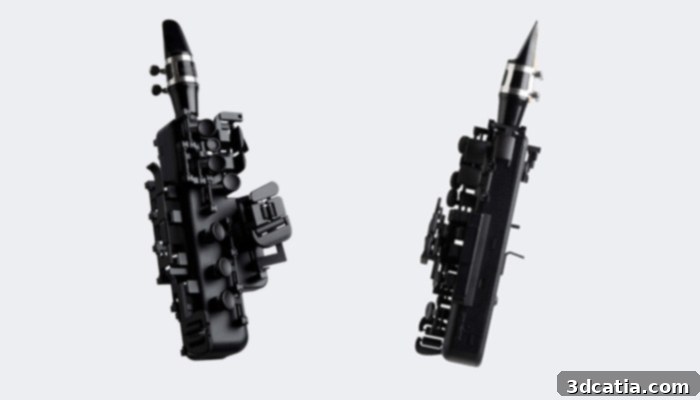
The saxophone has a small size and is very light (photo credits: Odisei Music)
A compelling real-world application comes from the Catalan company Odisei Music, which specializes in the design and manufacture of 3D printed electronic wind instruments. Their most renowned creation is the “Travel Saz,” an electronic saxophone produced using Multi Jet Fusion (MJF) technology. Odisei Music’s overarching goal is to globalize music education and performance by providing musicians with tools that accelerate and simplify the development of their musical skills, vividly demonstrating the transformative potential of additive manufacturing within this industry.
Ramón Mañas from Odisei Music explains their choice of technology: “We use one of HP’s Multi Jet Fusion printers to manufacture our 3D printed saxophones. This machine allows us to manufacture final parts with very good aesthetic and mechanical finishes. We also use this technology because of its high production. We believe that for the type of products we design and manufacture it is the one that best suits our needs.” This highlights MJF’s ability to deliver both high-quality finished parts and production efficiency, making it ideal for innovative musical instrument manufacturing.
Enhancing Accessibility to Music Through New Technologies
It is unequivocally clear that 3D printing offers powerful solutions to support and empower musicians. Frank DeFalco, manager of Canada Makes, an organization dedicated to promoting 3D printing, aptly commented in an interview with Design Engineering that “3D printed instruments are no worse or better, just different in their approach.” This difference often lies in the technology’s ability to profoundly enhance the musician’s experience and address their specific needs in ways previously unimaginable.
A compelling illustration of creating instruments for enhanced accessibility and comfort comes from Robert Hunter, a PhD student in engineering at the University of Ottawa. Drawing inspiration from his own high school experiences of intense thumb tendon pain after hours of clarinet practice, he designed an innovative clarinet combined with a specialized wrist strap. This integrated system works synergistically to help musicians comfortably support the instrument’s weight for extended periods, mitigating strain and potential injuries, thereby making prolonged practice and performance more sustainable for musicians.
Beyond physical comfort, 3D printing is also breaking down barriers for visually impaired musicians. The “3D printed staves for the blind” project, spearheaded by Kim Yeaji and a team of researchers at the University of Wisconsin, offers an accessible method for reading musical scores. Kim, who experienced gradual vision loss, found a profound connection to the world through music. One of the engineers involved in the project emphasized: “It wasn’t just building a prototype for her or the music school. It’s a true collaboration where we worked with Kim to understand her needs and find solutions together.” This collaborative spirit underscores the empathetic application of technology.
Known as “Tactile Stave Notation,” this groundbreaking project aims to recreate traditional paper musical scores using distinct, raised reliefs that can be not only read but also intuitively recognized through the sense of touch. Achieving the necessary level of detail and precision for these tactile scores required advanced 3D printing capabilities. Consequently, the team employed Selective Laser Sintering (SLS), a technology renowned for its high resolution and ability to produce intricate geometries, allowing for the faithful recreation of musical notes as subtle elevations on the score. This innovation promises to open up the world of musical notation to countless visually impaired individuals.
Maxime Carron from Syos further elaborates on the broader accessibility impact: “There is still a long way to go to make music more accessible, and the fact that new technologies such as 3D printing are being used for manufacturing can help whet the appetite of technology fans. Music still has a very traditional image, at least in France. The use of color and unusual materials, as well as the breaking of codes, can also generate a form of attraction by the novelty it brings to an aging and very old-fashioned market. In any case, that’s what we hope for at Syos!” It is clear that while the journey towards universal musical accessibility continues, 3D printing stands out as an indispensable tool, driving this crucial evolution within the music industry.
Optimizing Acoustics and Production Processes with Additive Manufacturing
As we’ve explored, 3D printing’s influence extends far beyond mere instrument manufacturing; it has significantly enhanced music accessibility for diverse users, particularly for those facing challenges in enjoying it in various capacities. Furthermore, 3D printing has ushered in an era of faster and more efficient production of acoustic components. This translates directly into reduced manufacturing costs and improved overall efficiency in the production of high-quality sound equipment. Critically, this technological advancement empowers engineers and designers to rigorously test and validate their projects through rapid prototyping before committing to mass production, thereby greatly increasing the accuracy and quality of the final products. The ability to quickly iterate and refine designs, especially for complex internal geometries that influence sound, is a game-changer for acoustic engineering.
Adding to these remarkable applications, music is widely recognized as a powerful ally in combating memory-related disorders often associated with aging. In this humanitarian aspect, 3D printing has also made significant contributions. A prime example is the “Memory Loss Music Box,” a specially designed gramophone created through 3D printing using sustainable bamboo. This innovative device can be easily manufactured at home, making it accessible to a broader audience. Its primary objective is to bring the profound joy and therapeutic benefits of music to individuals suffering from memory loss conditions, such as dementia or Alzheimer’s disease, offering comfort and connection through personalized sound experiences.
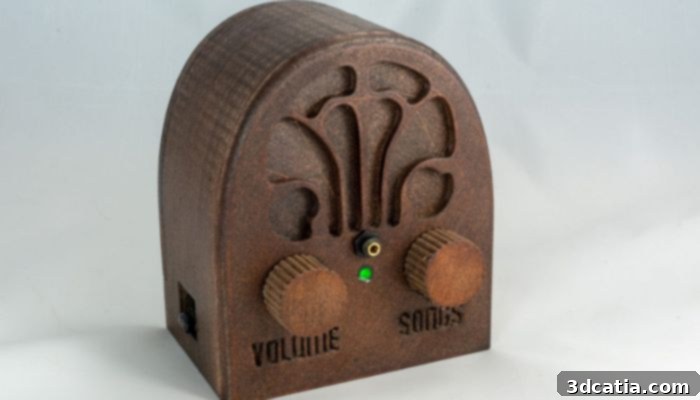
Memory Loss Music Box from Makers Making Change (photo credits: Makers Making Change)
In conclusion, it is no secret that 3D printing has exerted a profoundly positive and disruptive impact across a multitude of industries. Among these, the music sector stands out as a prime beneficiary. The continued adoption of 3D printers to create instruments, audio components, and assistive devices that are both environmentally beneficial and universally accessible will undoubtedly define the future landscape of music. This transformation begins with innovations in material science and a significant reduction in waste, coupled with an active and empathetic approach to addressing the diverse needs of musicians and listeners. Imagine a future where sustainably sourced vinyl records could be printed on-demand directly in local record stores, or where a visit to a musical instrument shop offers the unprecedented possibility to customize an instrument precisely to one’s unique physiological and artistic requirements. The possibilities unlocked by additive manufacturing are vast, promising a more inclusive, innovative, and sustainable musical world for all.
How do you think 3D printing has most influenced the music sector? Let us know in a comment below or on ourLinkedIn,Facebook, andTwitter pages! Don’t forget to sign up for our free weeklyNewsletter here, the latest 3D printing news straight to your inbox! You can also find all our videos on ourYouTube channel.