
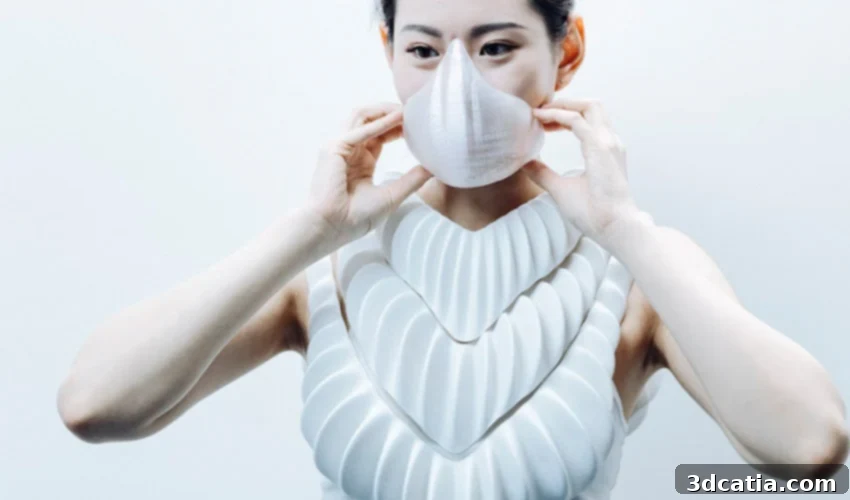
Amphibio: Pioneering 3D Printed Gills for Sustainable Underwater Living and Human Evolution
In an era marked by pressing environmental concerns and the relentless march of technological innovation, Japanese designer Jun Kamei emerges as a visionary specializing in biomimic design and advanced materials. His latest groundbreaking creation, Amphibio, represents a significant leap towards reimagining humanity’s relationship with our planet’s increasingly dynamic aquatic environments. Unveiled as his final project for the esteemed Royal College of Art in London, Amphibio introduces a fascinating concept: a series of three 3D printed “gills” meticulously designed to facilitate future underwater habitation. This ambitious endeavor provokes a profound question: could such an invention genuinely pave the way for humanity to establish thriving underwater cities, much like those once confined to the imaginative realms of science fiction cinema?
Kamei’s inspiration for Amphibio stems from a stark understanding of one of the 21st century’s most alarming global challenges: climate change and its direct consequence, global warming. As the designer meticulously articulates, “In 2100, an increase in temperature of 3.2 degrees Celsius is expected to occur, causing an increase in sea level that will affect between 500 million and one billion people. Submerging the large cities located in the coastal areas,” he soberly explained. This grim forecast underscores the urgency of developing innovative solutions, not merely to mitigate the effects of climate change, but to foster human adaptation and resilience in the face of inevitable environmental shifts. Amphibio isn’t just an invention; it’s a proactive vision for survival and a testament to the power of design to address existential threats.

Amphibio hopes to be the solution so that in the future we can create aquatic cities.
While Jun Kamei primarily envisions Amphibio as a critical pathway for human survival and adaptation in a changing world, his project also subtly but powerfully intersects with the broader concept of enhancing human capabilities. This revolutionary device is far from an isolated experiment in human augmentation. Indeed, the drive to expand our natural abilities through technology is a rapidly evolving field. For instance, just a few months prior to Amphibio’s presentation, the ambitious project Third Thumb was announced, captivating the world with its promise of providing an additional, fully functional thumb to our hands. This invention aims to transcend the natural limitations of human dexterity, opening new possibilities for interaction and manipulation. Similarly, the innovative bionic arm developed by Youbionic seeks to dramatically increase our capacity to perform multiple complex tasks simultaneously, pushing the boundaries of human efficiency and multitasking. Amphibio, with its aspiration to enable underwater respiration, fits seamlessly into this continuum of human-centered design that leverages advanced technology – particularly additive manufacturing – to augment our biological potential and adapt to new environments. These projects collectively signal a new era where technology isn’t just about convenience, but about fundamental human evolution and expanded interaction with our world.
Manufacturing the 3D Printed Amphibio Gills: A Fusion of Materials and Innovation
The creation of the Amphibio gills is a testament to the power and precision of modern additive manufacturing, specifically 3D printing. This sophisticated device is ingeniously fabricated in two distinct parts, meticulously designed to optimize function and material properties. At its core, the respiration unit is crafted from a specialized microporous material that allows for the selective passage of air while repelling water. This unique characteristic is fundamental to the system’s ability to mimic biological gills. Inspired directly by the highly efficient respiratory systems found in fish and aquatic insects, Amphibio’s design enables it to actively extract dissolved oxygen from the surrounding water and, concurrently, release accumulated carbon dioxide from the wearer’s breath. This biomimetic approach ensures that the device functions as a true gas exchange membrane, overcoming the physiological barrier that prevents humans from breathing underwater.
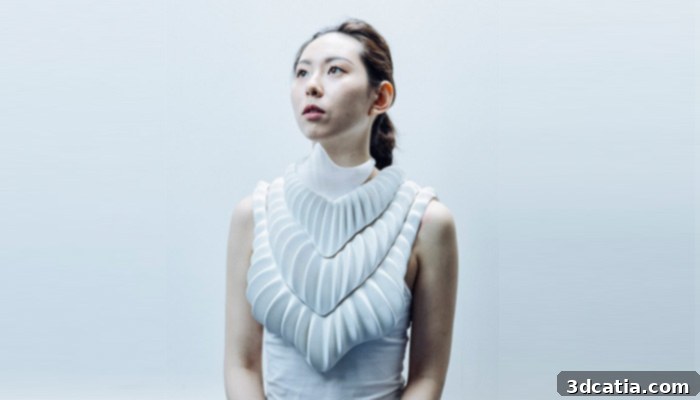
The Amphibio gills are physically embodied as three multimaterial rings, designed to be comfortably worn around the neck, an area optimized for minimal obstruction and efficient gas exchange. Jun Kamei elaborated on the innovative material science behind these rings, stating that “the material is a combination of hydrophobic material, elastomeric material” and “some other things” that he is not yet at liberty to disclose. This hints at a highly proprietary blend, carefully engineered to possess both water-repelling (hydrophobic) properties to maintain the air pocket and elastic (elastomeric) qualities for flexibility, comfort, and durability in a dynamic aquatic environment. The use of multi-material 3D printing is crucial here, allowing for the precise integration of diverse properties within a single, complex geometric structure, a feat that would be nearly impossible with conventional manufacturing methods. This advanced material composition is key to the gills’ functionality, enabling them to form a stable air-water interface essential for passive gas diffusion and active oxygen uptake.
Operation of the 3D Amphibio Gills: Biomimicry in Action
To rigorously test and demonstrate the operational principles of the Amphibio gills, Kamei devised a clever experimental setup. The respirator unit is precisely suspended between two connection tubes positioned at the center of a water-filled tank. This controlled environment allows for accurate monitoring and simulation of real-world breathing conditions. Through the left tube, Kamei initiates the experiment by filling the gill membrane with a gas mixture comprising 70% CO2. This specific concentration is chosen to realistically mimic the typical level of carbon dioxide present in a person’s exhaled breath, thus simulating the physiological input from a human user. Attached to the second tube, a sophisticated sensor continuously monitors the oxygen level within the gill, providing real-time data on the efficiency of gas exchange. As Kamei explained to 3D Printing Industry, “The system is enclosed with a one-way sealed valve, therefore, the only way oxygen can be replenished in the Gill is through the surrounding water membrane.” This critical design feature ensures that the experiment accurately reflects the device’s reliance on the aquatic environment for its oxygen supply.
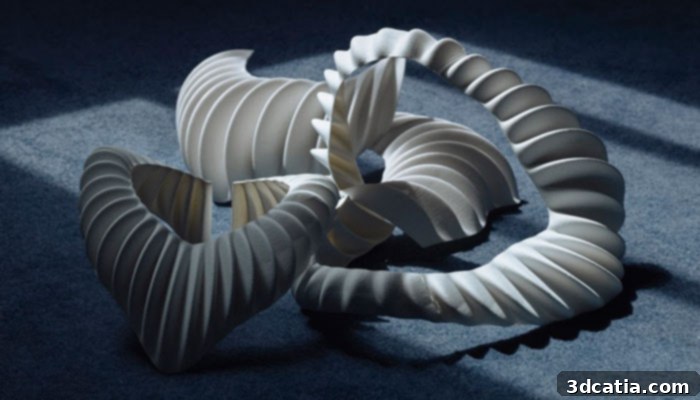
The scientific principle underpinning Amphibio’s operation is diffusion, specifically the process of osmosis. Water naturally contains dissolved oxygen, vital for aquatic life. When the concentration of oxygen inside the Amphibio gill is significantly lower than the concentration of dissolved oxygen in the surrounding water (due to consumption by the simulated “breather”), these oxygen molecules naturally travel across the microporous membrane. This movement occurs along the concentration gradient, from an area of higher concentration (the water) to an area of lower concentration (inside the gill), effectively replenishing the oxygen supply for respiration. “The surrounding water has dissolved oxygen in it, and because the percentage of oxygen is low inside the gills, these oxygen molecules in the water travel through the membrane inside the gills to compensate for the difference in concentration,” Kamei elucidated, comparing the mechanism to the natural process of osmosis. This elegant solution harnesses a fundamental physical phenomenon to achieve biological function.
Further enhancing its biomimetic brilliance, “The technology was inspired by aquatic diving insects that survive under the surface of a superhydrophobic skin surface, working as gas exchange,” Kamei revealed. These remarkable insects create a thin air layer around their bodies when submerged, using their superhydrophobic (extremely water-repellent) cuticles. This air layer acts as a physical gill, allowing them to extract oxygen from the water and release carbon dioxide without having to return to the surface frequently. Amphibio emulates this natural marvel, translating the principles of efficient gas exchange from the insect world into a human-wearable device. Kamei emphasized the role of advanced manufacturing: “The newly developed material can be shaped into complex shapes using recent additive manufacturing technologies, such as 3D printing.” This highlights how 3D printing is not just a tool for prototyping, but an essential technology for creating the intricate, biomimetic geometries and multi-material structures required for such a high-performance, adaptable respiratory device.
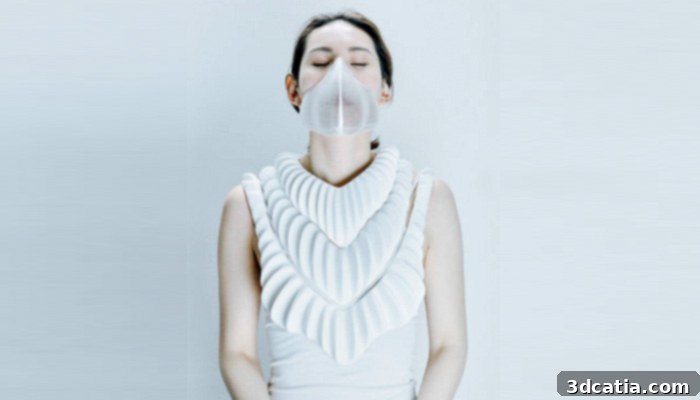
Despite the impressive scientific and design achievements, a significant challenge remains: Amphibio gills are not yet capable of producing enough oxygen for a human being in their current iteration. Human oxygen consumption is considerable, and the surface area required for sufficient gas exchange is substantial. However, Kamei’s ambitious next objective is to scale up the device dramatically. He aims to test Amphibio underwater with a minimum functional surface area of 32 square meters. In this scaled-up configuration, the augmented gill system theoretically could support the oxygen consumption of a person, enabling prolonged underwater respiration without external tanks. The engineering challenge lies in creating such a large, yet wearable and efficient, membrane system that can be seamlessly integrated into a dive suit or personal apparatus. This monumental scaling effort underscores the complexity of mimicking natural biological processes and integrating them into human-centric technology, pushing the boundaries of material science, fluid dynamics, and ergonomic design.
Jun Kamei, with his forward-thinking approach, does not view his development as a mere technological fix for an apocalyptic future. Instead, he perceives Amphibio as a tangible manifestation of how human beings will need to evolve and adapt to the profound environmental changes already underway. For Kamei, it’s about embracing a future where humanity is not just a passive recipient of environmental shifts but an active participant in shaping its own biological and technological evolution. He firmly believes that 3D printing, or additive manufacturing, will play an indispensable role in these future developments. The inherent potential of 3D printing to create highly complex geometries, customize products to individual needs, and rapidly iterate designs makes it an unparalleled tool for crafting personalized, biomimetic solutions like Amphibio. This technology allows designers and engineers to precisely control material properties at a microscopic level, leading to devices that are not only functional but also perfectly tailored for individual comfort and optimal performance in challenging environments. The ability to produce bespoke products at various scales will be crucial for the widespread adoption and effectiveness of such advanced adaptive technologies.
To gain a deeper appreciation for the ingenious operation of Amphibio and witness its principles in action, the following video provides a visual demonstration of Jun Kamei’s innovative design. For more comprehensive information and a detailed exploration of the project, we encourage you to visit Jun Kamei’s official website here, where you can delve further into the vision and technical intricacies behind this remarkable invention.
What are your thoughts on this groundbreaking development by Jun Kamei and the potential of Amphibio to redefine human interaction with aquatic environments? Do you believe 3D printed gills could truly enable future underwater cities, or do significant hurdles remain? Share your insights and opinions with us by leaving a comment below, or join the ongoing discussion on our Facebook and Twitter pages! Furthermore, don’t miss out on the latest advancements and news from the dynamic world of additive manufacturing. Be sure to sign up for our free weekly Newsletter, which delivers all the essential updates and exciting innovations in 3D printing directly to your inbox!