
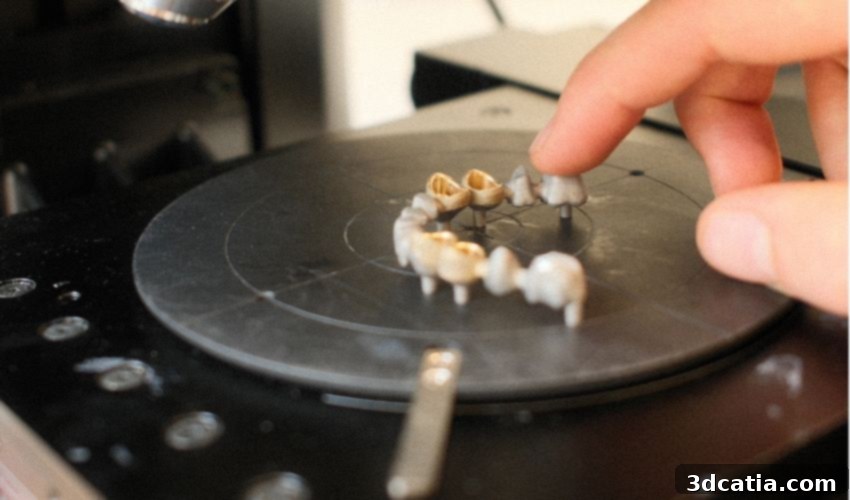
FIDENTIS: Pioneering Multi-Material 3D Printing for Advanced Dental Prosthetics
The dynamic field of dentistry demands an intricate balance of precision, aesthetic excellence, and robust functionality. Meeting these stringent requirements is crucial for patient comfort, oral health, and overall well-being. Historically, the production of dental devices has been a meticulous craft, heavily reliant on skilled manual labor and conventional manufacturing techniques. However, the advent and rapid evolution of 3D printing, or additive manufacturing, have brought forth a transformative shift, offering unparalleled opportunities for innovation, customization, and efficiency within this technically demanding sector. Among the pioneering companies leading this revolution in dental production methods, FIDENTIS® emerges as a standout innovator. This visionary start-up, a successful spin-off from the renowned Fraunhofer IGCV institute, has garnered significant attention for its groundbreaking multi-material 3D printing solution, meticulously engineered for the creation of advanced dental prostheses, particularly complex telescopic prostheses. FIDENTIS’s proprietary technology significantly elevates existing standards by seamlessly integrating state-of-the-art laser powder bed fusion (L-PBF) with a sophisticated robotized system. This unique combination allows for the precise deposition of multiple materials within a single, continuous manufacturing process, opening new frontiers in prosthetic design and performance. To delve deeper into this innovative approach and understand its profound implications for the future of dentistry, we recently had the privilege of speaking with Max Horn, the insightful co-founder and CEO of FIDENTIS.
The Genesis of FIDENTIS: A Spin-Off Driving Dental Innovation
During our conversation, Max Horn provided valuable insight into the origins of FIDENTIS®. He explained that FIDENTIS® was born as a pioneering spin-off from Fraunhofer IGCV, an institution globally recognized for its leadership in cutting-edge research, particularly in the domain of multi-material additive manufacturing applied to metals. As a dedicated researcher at this esteemed institute and a doctoral student at the Technical University of Munich (TUM), Max Horn, alongside his talented colleagues, played a pivotal role in the foundational development of this innovative technology. The initial breakthroughs occurred as early as 2017, laying the groundwork for a process that held immense promise for various industrial applications. Today, FIDENTIS® has channeled this advanced multi-material 3D printing process specifically towards revolutionizing the production of high-quality dental prostheses, leveraging years of expertise and refinement in additive manufacturing to address critical needs within the dental sector.
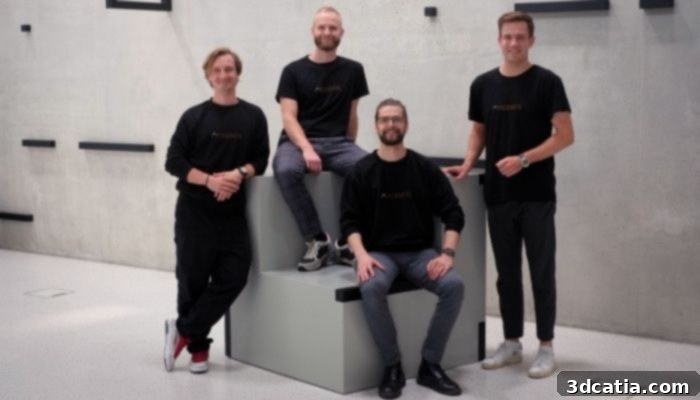
The FIDENTIS team. From left to right: Max Horn, Timo Schröder, Lukas Langer and Johannes Lauer.
Why Focus on Dental Prostheses? Addressing Critical Needs in Dentistry
Max Horn elaborated on the strategic decision to concentrate FIDENTIS’s innovative technology on the production of dental prostheses. He recounted how Josef Schweiger, one of Germany’s most distinguished dental technicians, discovered their advanced manufacturing technology several years ago. This technology, originally developed for highly demanding sectors like aeronautics and toolmaking due to its precision and material integrity, immediately struck Mr. Schweiger as having immense potential for the dental industry. This recognition sparked a collaboration that brought together FIDENTIS’s deep expertise in additive manufacturing with Mr. Schweiger’s unparalleled understanding of dental mechanics and patient needs. Since then, the teams have collaboratively refined and developed the technology further, making it compatible with precious metals and capable of meeting the exceptionally exacting standards required for high-quality dental prosthetics.
Horn highlighted a significant challenge within contemporary dental production: the persistent reliance on inferior solutions that often compromise patient comfort, fit, and aesthetics. A critical deficiency he pointed out is the frequent lack of friction telescopes in many dental solutions. Friction telescopes are specialized components in removable dental prostheses that ensure a precise, stable, and secure fit within the mouth, allowing for better function and a more natural appearance. Without them, prostheses can feel loose, cause discomfort, and fail to meet essential aesthetic and functional criteria. FIDENTIS’s core mission is unequivocally clear: to empower dental laboratories with the tools and technology needed to industrialize the production of consistently high-quality prostheses. By leveraging their advanced additive manufacturing technologies, FIDENTIS is not only elevating industry standards but also playing a crucial role in mitigating the growing shortage of qualified prosthetists. Their innovative approach provides a scalable and efficient method to produce complex, high-precision dental devices, addressing a pressing need in the healthcare sector.
Understanding FIDENTIS’s Multi-Material 3D Printing Process
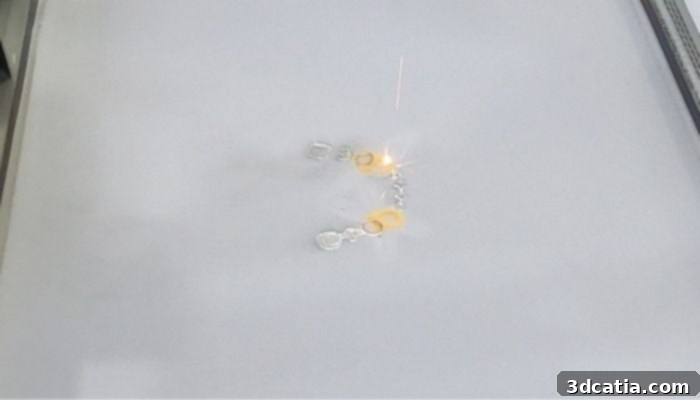
When asked to elaborate on their unique multi-material 3D printing process, Max Horn explained that the FIDENTIS® solution is ingeniously built upon the well-established laser powder bed fusion (L-PBF) process. However, FIDENTIS takes this technology a significant step further by enabling the precise combination of two or more distinct metal alloys within a single component. This is achieved through a highly sophisticated integration: a robotic arm intervenes with extraordinary precision to deposit additional powders into the build chamber, working in perfect synchronization with the ongoing L-PBF manufacturing process. This robotic intervention allows for the creation of intricate multi-material geometries and functional gradients that are simply unachievable with conventional single-material L-PBF systems. Furthermore, FIDENTIS dedicates considerable effort to developing tailor-made laser and scan path parameters for each material combination. This meticulous optimization is crucial to ensure optimal fusion between the disparate materials, guaranteeing fully dense parts with exceptional dimensional fidelity and superior mechanical properties at the interface. This advanced control over material deposition and fusion allows for the creation of dental prostheses that can feature, for example, a robust load-bearing core made from one alloy and a biocompatible, aesthetically pleasing surface from another, all within a single, integrated print.
Beyond the printing phase, FIDENTIS has established a fully integrated digital production chain. This end-to-end digital workflow enables the automated post-processing of functional surfaces, all seamlessly managed from a unified data model. This comprehensive approach ensures consistency, reduces manual errors, and significantly streamlines the entire manufacturing process, from design to final product. Max Horn emphasized that their technology represents a truly unique and significant advance in the field of multi-material additive manufacturing. While the immediate focus is on the dental sector, the team is eagerly looking forward to exploring the vast possibilities offered by their multi-material 3D printing solution in a myriad of other industries. Applications in aerospace, medical implants, and specialized toolmaking, where components require localized varying properties like hardness, wear resistance, or thermal conductivity, are just a few examples of sectors that could greatly benefit from FIDENTIS’s innovative approach.
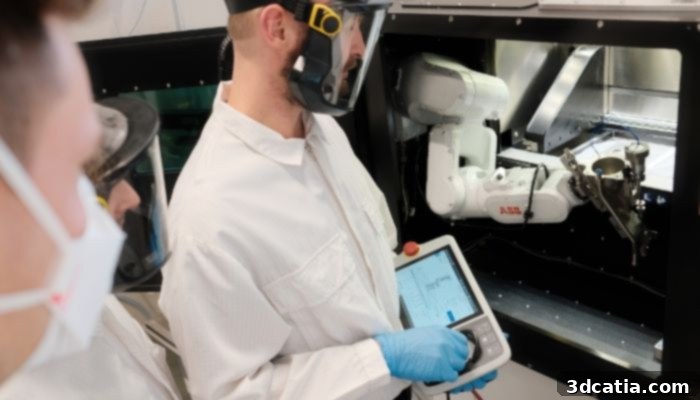
The process developed by FIDENTIS is 10 times faster than traditional methods.
Navigating the Complexities and Challenges of Multi-Metal 3D Printing
Max Horn candidly addressed the inherent challenges of simultaneous 3D printing with different metals, acknowledging its significant complexity. He stated that compared to single-material 3D printing, multi-material additive manufacturing is at least three times more intricate. The difficulty stems from the fact that it’s no longer sufficient to master the properties and behavior of just one material; instead, one must fully understand two (or more) materials and, crucially, their intricate interactions at the interface. This complexity manifests at every stage of the process, from the initial data preparation, where precise layering and material transitions must be carefully planned, to real-time monitoring during printing, which involves meticulous control over scanning strategies, laser power, and the accurate deposition of each powder type. Furthermore, the complexities extend into post-processing, including critical steps like heat treatment, machining, and even powder recycling, all of which must be adapted for multi-material parts to ensure optimal performance and material integrity.
FIDENTIS has been at the forefront of multi-material additive manufacturing research for over seven years. This extensive experience has allowed them to develop robust solutions that effectively structure and stabilize the entire process, thereby guaranteeing reliable, reproducible production of multi-material dental prostheses. Despite these advancements, Horn admitted that even analyzing single-layer scan paths can be incredibly complex at first glance, underscoring the depth of engineering and material science expertise required. The interaction between different metals, which can have varying melting points, thermal expansion coefficients, and chemical reactivities, necessitates precise parameter control to prevent issues like cracking, delamination, or the formation of brittle intermetallic phases at the material interfaces. FIDENTIS’s success lies in meticulously tuning these parameters and developing sophisticated software to manage these variables effectively.
On a broader scale, and particularly pertinent to their work in medical devices, Max Horn highlighted that the European regulatory framework represents a considerable challenge. While acknowledging the absolute necessity of rigorous regulations to ensure patient safety and well-being remain at the core of any technological advancement in healthcare, he pointed out that the current level of rigidity and the enforcement mechanisms of the legal framework can inadvertently stifle innovation. This imposes a significant burden, not only on agile start-ups like FIDENTIS but also on the entire ecosystem of medical device development. Horn advocated for a more flexible and pragmatic approach to innovation within society, especially when facing critical issues such as the growing shortage of qualified healthcare professionals and the escalating costs in the healthcare sector. He believes that a balanced regulatory environment, one that safeguards patient interests while simultaneously fostering the adoption of advanced, efficient solutions like multi-material 3D printing, is essential for the future of healthcare.
The Future Vision: FIDENTIS’s Next Steps
Looking ahead, Max Horn shared FIDENTIS’s exciting future plans. He expressed immense satisfaction that the enthusiastic response from industry experts has unequivocally confirmed that FIDENTIS is moving in the right direction. This positive reinforcement continually encourages the team to pursue their efforts with unwavering determination and passion. Their immediate and most significant milestone is to make their first patients smile – a deeply rewarding aspect of their work. As soon as these initial prostheses have been successfully delivered and their efficacy validated in a clinical setting, FIDENTIS plans to significantly ramp up its production capabilities. This will involve not only expanding their manufacturing facilities but also continuously optimizing their processes and further enhancing operational efficiency. The goal is to scale their unique multi-material 3D printing technology to meet growing demand, making high-quality, customized dental prosthetics accessible to a wider patient population and cementing their position as leaders in additive manufacturing for dentistry.
A Message of Gratitude and Engagement for Our Readers
Max Horn concluded the interview by extending his heartfelt gratitude to everyone who has supported FIDENTIS throughout their journey, acknowledging that their current success would not have been possible without the immense contributions of experts, mentors, and partners. Their collective support has been invaluable in transforming an innovative research concept into a tangible, impactful solution for dentistry.
If you’d like to delve deeper into the revolutionary FIDENTIS denture process and explore their cutting-edge multi-material 3D printing technology, we highly encourage you to visit their official page, HERE. We are keen to hear your thoughts: What do you think of FIDENTIS’s groundbreaking technology and its potential impact on the future of dental prosthetics? Please share your insights and comments below, or engage with us on our social media channels: LinkedIn, Facebook, and Twitter! Don’t forget to sign up for our free weekly Newsletter here to receive the latest 3D printing news directly in your inbox. For those specifically interested in more 3D printing news within the medical and dental sectors, click HERE to explore related articles and innovations.
*All Photo Credits: FIDENTIS