
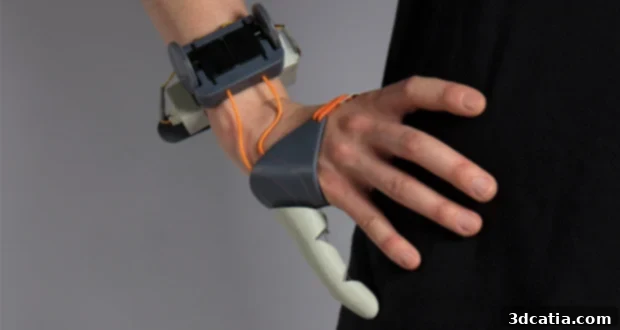
Beyond Replacement: How 3D Printing and Dani Clode’s Third Thumb are Pioneering Human Augmentation
In an era defined by rapid technological advancements, 3D printing has emerged as a transformative force, particularly within the medical and healthcare sectors. While its applications range from creating custom surgical guides to bioprinting tissues, one of its most profound impacts has been in the realm of prosthetics. Traditionally, prostheses have been viewed as essential medical devices designed to replace a missing or underdeveloped body part, primarily addressing physical disabilities. However, a new wave of innovation is challenging this conventional perception, aiming to redefine what a prosthetic can be. At the forefront of this groundbreaking shift is Dani Clode, a visionary graduate from the Royal College of Art in London, whose project, the ‘Third Thumb,’ seeks to dismantle the stigma associated with prosthetics and instead present them as powerful tools for human enhancement rather than mere compensation for a deficit.
The landscape of prosthetic design has been dramatically reshaped by the advent of additive manufacturing. For decades, the development and acquisition of functional prostheses were often hampered by exorbitant costs, lengthy production times, and a one-size-fits-all approach that rarely accounted for the nuanced needs of individual users. Traditional manufacturing processes involved intricate molding and casting, requiring significant manual labor and expensive materials, ultimately translating into a hefty price tag for the end-user. This financial barrier often limited access to essential mobility aids and made personalized solutions a luxury rather than a standard.
3D printing offers a compelling solution to these long-standing challenges. By enabling the direct fabrication of complex geometries from digital models, it drastically reduces material waste and streamlines the manufacturing process. This innovative approach significantly lowers production costs, making advanced prosthetics more accessible to a wider population. Furthermore, the inherent customization capabilities of 3D printing are unparalleled. Each prosthetic can be precisely tailored to the user’s unique anatomical measurements, ensuring an optimal fit, enhanced comfort, and superior functionality. This level of personalization was previously unimaginable without incurring prohibitive expenses. A notable example of this revolutionary impact can be seen in projects like the Fin, a specialized prosthetic developed for a veteran in the United States, demonstrating how 3D printing can provide bespoke solutions for specific, complex needs.
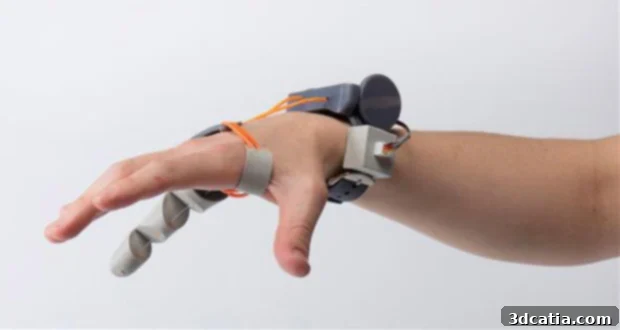
What truly sets Dani Clode’s Third Thumb apart from conventional prosthetics is its fundamental purpose. It is not designed to replace a missing digit or compensate for a physical impairment. Instead, it serves as an extension of the user’s natural abilities, offering an additional, functional digit that enhances dexterity and opens up new possibilities for interaction with the world. Imagine the ability to effortlessly catch multiple objects, execute more precise squeezing motions, or even perform intricate tasks like playing a complex piece on the guitar with enhanced ease. Clode’s overarching goal with this innovative device is to fundamentally alter the societal perception of prostheses. She advocates for a shift in perspective, viewing prosthetics not as indicators of a deficiency but as positive augmentations that expand human capabilities, pushing the boundaries of what the human body can achieve.
Clode elaborates on her vision by delving into the very etymology of the word “prosthesis.” As she explains, “The origin of the word ‘prosthesis’ meant ‘to add, put on to,’ so not to fix or replace, but to extend.” This historical context provides the philosophical bedrock for her project. The Third Thumb is deeply inspired by this original meaning, embarking on an exploration of human augmentation and striving to reframe prosthetics as dynamic, powerful extensions of the body, rather than static replacements. This perspective challenges centuries of medical and societal understanding, inviting us to imagine a future where additional limbs or sensory organs are not only possible but desirable, enabling humans to interact with their environment in novel and increasingly complex ways.

One of the most ingenious aspects of the Third Thumb’s design lies in its intuitive control mechanism. The prosthesis is precisely controlled by the user’s feet, utilizing subtle pressure sensors discreetly integrated into their shoes. This innovative interface allows for seamless and surprisingly natural manipulation of the extra digit. Clode highlights the inherent synergy between hands and feet, pointing out that humans already establish complex connections between these two extremities in various daily activities. For instance, when driving a car, our hands steer while our feet operate the pedals, or during piano playing, both hands and feet coordinate to produce harmonious music. This existing neural connection makes adapting to foot-controlled hand augmentation remarkably efficient, tapping into the brain’s incredible neuroplasticity and ability to integrate new sensory-motor inputs. The feet, often underutilized in terms of fine motor control in many daily tasks, become a powerful and accessible interface for extending manual dexterity.
The fabrication of the Third Thumb itself is a testament to the versatility and potential of modern 3D printing technologies. The core structure of the prosthesis was 3D printed using Ninjaflex filament, a type of Thermoplastic Polyurethane (TPU) known for its exceptional flexibility, durability, and rubber-like elasticity. This choice of material is crucial, as it allows the thumb to mimic the natural pliability and movement of a human digit, ensuring both comfort for the wearer and effective functionality. The flexible structure is then anchored and secured by a layer of resin, also precisely 3D printed, which provides the necessary rigidity and attachment points. The intricate mechanics of the thumb are powered by two small motors, which orchestrate the movement through the strategic folding and unfolding of three carefully designed hinges. This sophisticated articulation allows the thumb to move in multiple directions, enabling a wide range of gripping and manipulation tasks. Each Third Thumb is meticulously personalized, ensuring it is perfectly adapted to the individual contours of the user’s hand, optimizing both fit and performance. Looking ahead, Clode anticipates the availability of various designs and styles, further expanding the aesthetic and functional choices for future users.
The project not only showcases the technical prowess of 3D printing but also initiates a profound conversation about the future of human-machine interaction and the ethical implications of augmentation. As technology progresses, the lines between ‘healing’ and ‘enhancing’ blur, prompting discussions about accessibility, equity, and the very definition of human ability. The Third Thumb represents a significant leap towards a future where technology doesn’t just compensate for limitations but actively expands human potential, allowing individuals to transcend their natural biological constraints. It invites us to consider how such augmentations could revolutionize various industries, from manufacturing and surgery to art and sports, by offering an unprecedented level of control and dexterity. This concept moves beyond mere assistive devices to truly transformative tools that reshape human interaction with the physical world.
To delve deeper into Dani Clode’s innovative project and explore its implications, further details are available here.
Could groundbreaking innovations like the Third Thumb finally dismantle the long-standing stigmas against prostheses and usher in a new era of human augmentation? We invite you to share your thoughts and perspectives in the comments section below or engage with us on our Facebook and Twitter pages. Don’t miss out on the latest advancements in 3D printing technology; be sure to sign up for our free weekly Newsletter, delivering all the essential news and updates straight to your inbox!