
The Urban Dunes: Pioneering 3D Printed Sustainable Architecture to Combat Extreme Heat in Abu Dhabi
Additive manufacturing, more commonly known as 3D printing, has rapidly evolved from a niche technology into a cornerstone of innovation across numerous industries. In the realm of architecture and construction, it has firmly established itself as not just a viable alternative but often the preferred solution for a wide array of projects. Architects and designers are increasingly turning to 3D printing for compelling reasons that extend beyond mere novelty. The technology offers unparalleled capabilities for realizing intricate and complex geometries that would be prohibitively expensive or even impossible with traditional construction methods. Furthermore, it champions sustainability through efficient material use, reduced waste, and the potential for on-site fabrication with local resources. These benefits often translate into unique material properties and, surprisingly, lower overall project costs when factoring in customization and speed. We’ve previously explored groundbreaking applications, such as a 3D printed facade constructed from ceramic blocks, specifically engineered to provide an innovative natural ventilation system in sweltering climates.
The Growing Role of Additive Manufacturing in Architectural Innovation
The integration of additive manufacturing into architectural practices marks a significant paradigm shift. It empowers designers to transcend conventional limitations, fostering an era of unprecedented creativity and functional efficiency. The capacity to print intricate, organic shapes allows for biomorphic designs that can mimic natural forms, optimizing structural integrity while enhancing aesthetic appeal. Beyond aesthetics, 3D printing offers tangible benefits for sustainability. By utilizing digital models, material consumption can be precisely controlled, drastically minimizing waste compared to subtractive manufacturing or traditional cut-and-build methods. The ability to print with local or recycled materials further reduces the environmental footprint associated with transportation and resource extraction. This technological leap enables architects to envision and construct buildings that are not only visually striking but also perform exceptionally in terms of energy efficiency and environmental impact. The customizability inherent in 3D printing means that each component can be optimized for its specific function, leading to smarter, more resilient structures.
Addressing the Urban Heat Island Effect: Abu Dhabi’s Urgent Challenge
The latest architectural endeavor that has captured global attention is the “Urban Dunes” project, which directly confronts a pervasive and growing environmental challenge: the urban heat island (UHI) effect. This phenomenon, where urban areas experience significantly higher temperatures than surrounding rural areas due to human activities and modified land surfaces, is particularly pronounced in cities like Abu Dhabi, which already grapple with extreme desert climates. The UHI effect intensifies heatwaves, increases energy demands for cooling, degrades air quality, and negatively impacts human health and comfort. As urban populations continue to grow, sustainable solutions to mitigate this effect become not just desirable but absolutely critical for the livability and resilience of modern cities. The Urban Dunes project is a visionary response, aiming to provide a sustainable and innovative solution to reduce the heat island effect within Abu Dhabi’s challenging climate conditions.
The Urban Dunes: A Vision for Sustainable Cooling Through Architectural Design
Spearheaded by the renowned Italian design firm Barberio Colella Architects, in collaboration with architect Angelo Figliola, The Urban Dunes proposes a unique and ambitious design. Their vision cleverly integrates advanced manufacturing technologies with a profound respect for traditional architectural wisdom. The project seeks to create comfortable, naturally cooled urban microclimates, offering a sanctuary from the intense heat of Abu Dhabi. This fusion of ancient knowledge and modern capability is central to the project’s philosophy, promising not only an effective cooling solution but also a culturally resonant architectural statement.
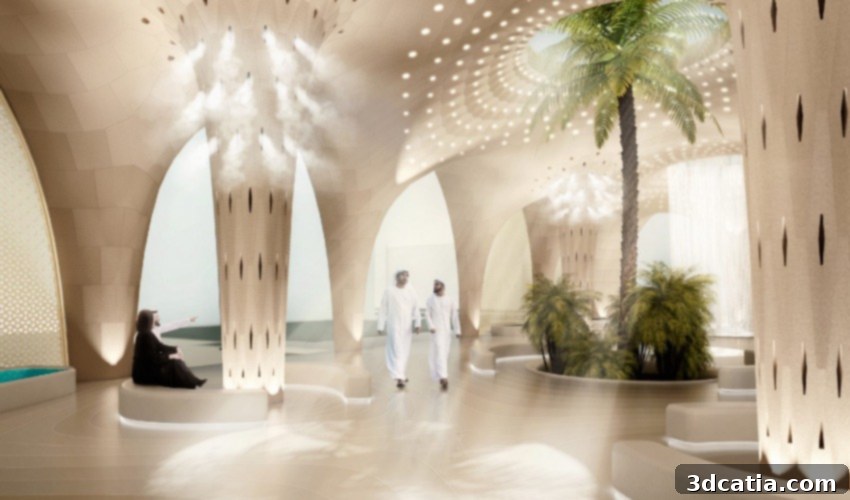
The core structural elements of The Urban Dunes are designed with elegance and functionality in mind. The structure will feature graceful vaulted spaces, a nod to time-honored architectural forms that inherently offer passive cooling benefits. These are complemented by vernacular shading devices, which have been refined over centuries in hot climates, and strategically placed cold-water basins, designed to enhance evaporative cooling. A pivotal aspect of this innovative design involves the use of 3D printing technologies for its realization. The Italian team’s approach is a testament to how cutting-edge technologies can be harmoniously blended with traditional concepts to forge sustainable, climate-responsive architecture.
Harnessing Local Materials and Advanced 3D Printing: The Sandstone Vaults
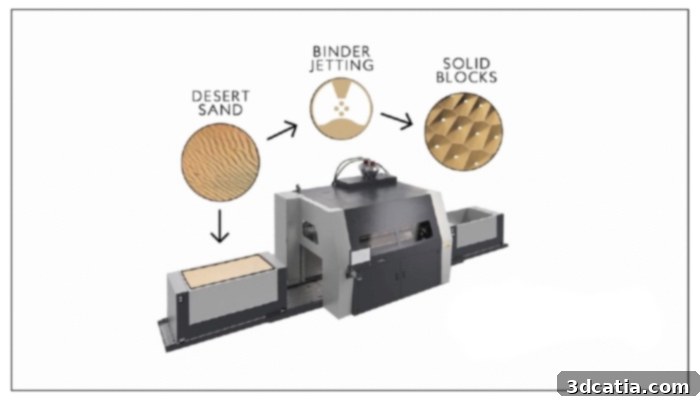
At the heart of The Urban Dunes’ design are its magnificent vaults, prominently featured in the article’s cover image. These structural masterpieces are composed of numerous blocks meticulously crafted from 3D printed sandstone. Crucially, the primary material for these blocks is local sand, a resource abundant in Abu Dhabi. This strategic choice not only champions sustainability by significantly reducing transportation costs and emissions but also imbues the structure with a unique connection to its environment. The sand is solidified through an advanced binder jetting process, a form of additive manufacturing highly suited for producing large-sized blocks with exceptional precision and material integrity.
The choice of a 55 cm thick 3D printed vault is no accident; it is a meticulously engineered element designed to combat the overheating of the urban space. This substantial thickness capitalizes on the high thermal mass properties of sandstone. Thermal mass allows the building material to absorb and store a significant amount of heat during the day, slowly releasing it during cooler periods. This natural thermal regulation prevents the rapid accumulation of heat inside the structure, effectively maintaining cooler internal temperatures even when external temperatures soar. Furthermore, the sand used in the printing process is ingeniously mixed with heat-reflective cool pigments. These pigments are specifically formulated to increase the surface reflectance of the sandstone, causing more solar radiation to be bounced back into the atmosphere rather than absorbed by the structure. This proactive measure significantly reduces surface heat build-up, thereby lowering the overall cooling requirements and subsequently decreasing energy consumption.
Binder Jetting: A Key Enabler for Large-Scale Construction
Binder jetting stands out as a particularly suitable 3D printing technology for architectural applications like The Urban Dunes. Unlike fusion-based methods, binder jetting involves selectively jetting a liquid binding agent onto a thin layer of powder material, such as sand, to create solid components layer by layer. This process is advantageous for several reasons. It allows for the rapid production of large-scale parts without the need for extensive support structures, which can be a limitation in other 3D printing techniques. The process is also highly material-efficient, as unbound powder can be recycled for subsequent builds. For projects utilizing local aggregates like desert sand, binder jetting offers a cost-effective and environmentally friendly way to transform readily available resources into high-performance building components. The precision offered by binder jetting ensures that complex geometries, such as those required for aesthetically pleasing and functionally optimized vaults and shading devices, can be manufactured with consistency and accuracy, bridging the gap between digital design and physical realization in a way that truly serves sustainable architecture.
Integrated Passive and Active Cooling Strategies for Optimal Comfort
The Urban Dunes project goes beyond a single cooling mechanism, employing a sophisticated, multi-layered approach that integrates both passive and active strategies. This holistic design ensures an optimal thermal comfort experience even in Abu Dhabi’s most extreme conditions, creating an urban oasis.
Vernacular Wisdom: The Mashrabiyya and Natural Ventilation
Beneath the imposing sandstone vault lies an urban microclimatic space, meticulously protected from the harsh sun. This protection is largely afforded by a traditional vernacular sun shading device known as the mashrabiyya. Historically prevalent in Islamic architecture, the mashrabiyya is an intricately latticed screen, typically made from wood, which serves multiple functions. Its finely perforated surface does more than just cast shade; it actively enhances the natural ventilation of the space. As wind encounters the complex, open pattern of the mashrabiyya, its speed is increased due to the Venturi effect, creating a refreshing incoming airflow. This design ingeniously filters direct sunlight while permitting air circulation, dramatically reducing the heat load and creating a cooler, more pleasant environment. Beyond its functional benefits, the mashrabiyya adds a layer of cultural richness and aesthetic beauty, linking the ultra-modern project with timeless architectural heritage.
The Refreshing Power of Water Features
The enhanced airflow from the mashrabiyya plays a crucial role in another passive cooling element: strategically placed cold-water basins. As the incoming, faster airflow touches the surface of these cold-water basins, it triggers an evaporative cooling process. This exchange efficiently cools the air, which then spreads throughout the public space, delivering a palpable sense of freshness and comfort. The design also incorporates the sensory benefits of water through the presence of two waterfall fountains. The sight and sound of flowing water provide a strong psychological reinforcement of coolness and tranquility, creating an inviting and serene atmosphere. These natural elements work in concert, contributing significantly to the overall microclimatic comfort within The Urban Dunes.
Biophilic Design: Integrating Greenery for Enhanced Cooling
Further augmenting the natural ventilation and cooling mechanisms is the thoughtful integration of vegetation, notably palm trees. These iconic desert plants provide crucial natural shading, reducing direct solar exposure on pathways and seating areas. Beyond shade, trees and plants contribute to cooling through evapotranspiration, a process where water vapor is released into the air, effectively lowering ambient temperatures. This biophilic design approach not only enhances the physical comfort but also contributes to psychological well-being, fostering a deeper connection with nature within the urban landscape. The presence of greenery creates a more inviting and visually appealing public space, reinforcing the oasis-like ambiance of The Urban Dunes.
Advanced Active Cooling Systems: Misting and Internal Shell Cooling
In addition to the extensive passive cooling measures, The Urban Dunes incorporates sophisticated active systems to achieve optimal thermal comfort. A high-pressure misting system will be deployed to significantly reduce the surrounding air temperature. This system operates by forcing water through a high-pressure pump, producing an ultra-fine mist that rapidly evaporates. This evaporative cooling process can effectively lower the ambient air temperature by as much as 20°C, creating a remarkably cool environment even on the hottest days. Complementing this, the entire shell of the structure will be actively cooled through an embedded network of tubing. A cooling fluid circulates through these tubes, drawing heat away from the sandstone vault and maintaining its cool thermal mass. By synergistically combining all these passive and active cooling systems, The Urban Dunes aims to achieve an unprecedented Universal Thermal Climate Index (UTCI) of 26°C for the month of August, typically the warmest month in Abu Dhabi. This target represents a comfortable thermal perception for an outdoor public space, demonstrating a groundbreaking achievement in climate-responsive urban design.
The Future of Urban Design: Sustainability and Innovation
The Urban Dunes project represents more than just a public space; it is a pioneering model for sustainable urban development in regions facing extreme climatic conditions. By seamlessly blending ancient architectural wisdom with cutting-edge 3D printing and advanced environmental engineering, Barberio Colella Architects and Angelo Figliola have offered a compelling blueprint for the future. This project demonstrates the immense potential of additive manufacturing to create resilient, energy-efficient, and aesthetically rich urban environments. It addresses critical issues of climate change adaptation, resource scarcity, and human comfort in a holistic manner. The success of The Urban Dunes could inspire similar adaptive strategies globally, pushing the boundaries of what is possible in architecture and urban planning. It underscores the responsibility of designers and technologists to innovate for a more sustainable and comfortable future, particularly as cities worldwide grapple with increasing temperatures and environmental pressures. The Urban Dunes stands as a beacon of innovation, showing how smart design, advanced technology, and a deep understanding of local context can coalesce to create truly transformative spaces for future generations.
Join the Conversation
We’d love to hear your thoughts on this groundbreaking project and its implications for sustainable architecture! What aspects of The Urban Dunes project do you find most compelling? Do you believe this innovative approach can be replicated in other hot climates around the world? Share your insights and comments below, or engage with us on our social media platforms. Join the discussion on our Facebook and Twitter pages. Don’t forget to sign up for our free weekly Newsletter to receive all the latest news on advancements, research, and insights from entrepreneurs in the dynamic world of 3D printing, delivered directly to your inbox!