
Revolutionizing Materials Science: How 3D Printing and AI Forge Ultra-Strong, Lightweight Nano-Architected Materials
In a groundbreaking advancement that promises to redefine the landscape of materials science, researchers at the University of Toronto have leveraged the synergistic power of machine learning and advanced 3D printing to develop a new class of nano-architected materials. These innovative materials boast an extraordinary combination of properties: the formidable strength of carbon steel married with the remarkable lightness of polystyrene foam. This achievement underscores the increasing importance of 3D printing as a versatile tool for engineering materials with advantageous characteristics, paving the way for applications across numerous fields.
This development is not merely an isolated incident but rather a testament to a burgeoning field where new breakthroughs are constantly emerging. The potential impact of such materials on various industries, from aerospace to automotive, is immense, signaling a future where performance is no longer constrained by conventional material limitations. Under the expert guidance of Professor Tobin Filleter, a dedicated team spearheaded the creation of these nanomaterials, which exhibit unparalleled robustness, extreme lightness, and remarkable adaptability. This pioneering process is poised to revolutionize numerous sectors, offering solutions that enhance efficiency, safety, and performance. But how exactly were these extraordinary materials conceived, and what are their precise properties that make them so revolutionary? Let’s delve deeper into the science and innovation behind this exciting discovery.

Unpacking Nano-Architected Materials: Strength at the Nanoscale
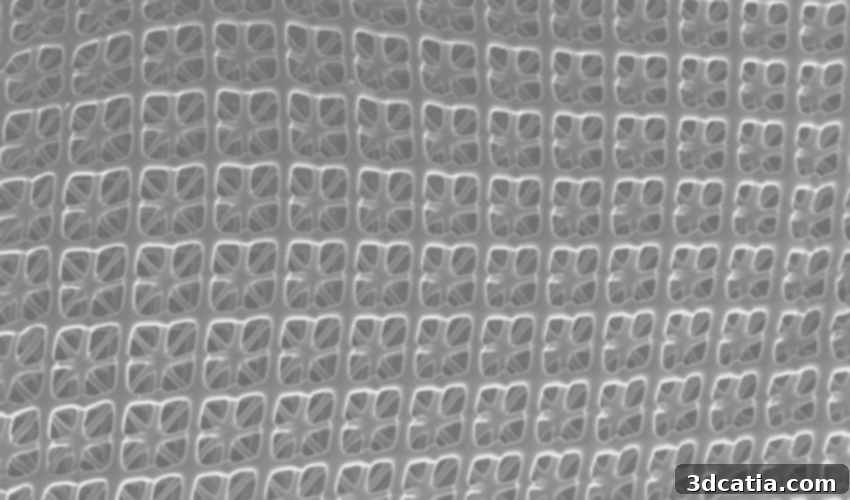
The core of this innovation lies in the meticulous design of nano-architected materials. These composites are structured from infinitesimally small, repetitive units, each measuring mere hundreds of nanometers. To put this into perspective, over a hundred of these units would need to be aligned side-by-side to equal the thickness of a single human hair. Primarily composed of carbon, these minute building blocks are meticulously arranged to form intricate three-dimensional structures known as nanolattices. The unique architecture at such a minuscule scale is crucial to their exceptional properties.
Traditional materials derive their strength from their chemical composition and bulk molecular structure. However, nano-architected materials tap into a different principle: the “smaller is stronger” effect. At the nanoscale, materials behave differently; defects that would compromise the integrity of larger structures become less critical, and the material’s inherent strength can be more fully realized. This phenomenon allows for the creation of structures that are not only incredibly strong but also astonishingly lightweight.
Peter Serles, one of the lead researchers on the project, eloquently explains the underlying principle: “Nano-architected materials combine high-performance shapes, like making a bridge out of triangles, at nanoscale sizes, which takes advantage of the ‘smaller is stronger’ effect, to achieve some of the highest strength-to-weight and stiffness-to-weight ratios of any material.” This statement perfectly encapsulates the elegance of using geometric principles combined with nanoscale engineering to achieve superior material performance. The precise arrangement of these carbon units into complex 3D nanolattices is what grants them their extraordinary capabilities, making them candidates for advanced applications where traditional materials fall short.
The Challenge: Overcoming Structural Weaknesses in Conventional Designs
While the concept of architected materials and nanolattices holds immense promise, a significant hurdle has traditionally limited their full potential: the issue of stress concentrations. Conventional lattice shapes and geometries, despite their seemingly robust design, often feature sharp intersections and corners. These acute angles, while structurally efficient in macroscopic designs, become points of extreme vulnerability at the nanoscale. When subjected to stress, these sharp corners act as localized stress concentrators, causing the material to experience significantly higher forces at these specific points than in the surrounding structure. This phenomenon inevitably leads to premature local failure and breakage of the material, severely restricting its overall performance and practical applicability.
Recognizing this critical limitation, Peter Serles saw an opportunity for a transformative approach. As he contemplated this persistent challenge in material design, a powerful solution emerged: “As I thought about this challenge, I realized that it is a perfect problem for machine learning to tackle.” This insight laid the foundation for an innovative research direction, leveraging computational intelligence to overcome a fundamental mechanical engineering problem.
The Solution: A Synergy of Machine Learning and Advanced 3D Printing
The breakthrough in overcoming the stress concentration problem came through a pioneering collaboration between Peter Serles and Tobin Filleter from the University of Toronto, and the Korea Advanced Institute of Science & Technology (KAIST) in South Korea. Their combined expertise fused advanced computational techniques with cutting-edge manufacturing processes to engineer superior materials.
Machine Learning: Predicting Optimal Geometries
At the heart of their innovation was the deployment of a sophisticated machine learning algorithm. Unlike traditional trial-and-error methods, which are time-consuming and often inefficient, this algorithm was trained to predict the ideal nanolattice shapes that would simultaneously enhance the material’s strength and maintain its remarkable lightness. The machine learning model didn’t simply mimic existing successful geometries from its training data; it possessed the intelligence to learn from various shape modifications—identifying what worked and what didn’t—to predict entirely novel and optimized lattice configurations.
Serles highlights the unprecedented nature and efficiency of this approach: “This is the first time machine learning has been applied to optimize nano-architected materials, and we were shocked by the improvements.” He further elaborated on the algorithm’s unique capabilities, stating, “It didn’t just replicate successful geometries from the training data; it learned from what changes to the shapes worked and what didn’t, enabling it to predict entirely new lattice geometries.” A particularly impressive aspect of this methodology was the choice of algorithm: multi-objective Bayesian optimization. This algorithm is renowned for its data efficiency, requiring only a modest 400 data points for training, a stark contrast to other machine learning algorithms that might demand 20,000 or more. “Machine learning is normally very data intensive, and it’s difficult to generate a lot of data when you’re using high-quality data from finite element analysis. But the multi-objective Bayesian optimization algorithm only needed 400 data points, whereas other algorithms might need 20,000 or more. So, we were able to work with a much smaller but an extremely high-quality data set,” Serles explained, underscoring how this allowed the team to work with an exceptionally high-quality, albeit compact, dataset.
Two-Photon Polymerization: Precision 3D Printing at the Nanoscale
Once the machine learning algorithm had identified the optimal nanolattice geometries, the next crucial step was to physically realize these complex designs. Serles utilized a highly specialized two-photon polymerization (TPP) 3D printer for this purpose. TPP is an additive manufacturing technique capable of fabricating structures with incredibly high resolution, down to the micro- and nanoscale. This precision printing method was indispensable for accurately replicating the intricate, optimized nanolattices predicted by the machine learning model. By precisely controlling the polymerization of a photosensitive resin with a focused laser, the TPP printer could create prototypes that faithfully embodied the computer-generated designs, allowing for the meticulous testing and validation of the machine learning’s predictions.
Unprecedented Performance: Properties and Advantages
The results of this innovative research were nothing short of spectacular. The machine-learning-optimized nanolattices demonstrated a significant leap in performance compared to previous models. Their strength was more than doubled, showcasing the profound impact of intelligent design. Specifically, these improved materials proved capable of withstanding an impressive stress of 2.03 megapascals per cubic meter per kilogram. To fully appreciate this achievement, consider that this strength-to-weight ratio is approximately five times greater than that of titanium, a metal celebrated for its high strength-to-weight properties and widely used in critical applications like aerospace and medical implants. This makes the newly developed materials extraordinarily efficient in terms of structural integrity relative to their mass.
The unique combination of ultra-lightness and high strength-to-weight and stiffness-to-weight ratios sets these nano-architected materials apart. They offer the potential to dramatically reduce the weight of components without compromising structural integrity or performance. This characteristic is a game-changer for industries where every gram saved can translate into significant operational advantages and cost efficiencies.
Transformative Applications: Beyond Aerospace
The primary aim of these novel designs is to create ultra-lightweight components for a myriad of aerospace applications. Imagine airplanes, helicopters, and spacecraft constructed with materials that are both incredibly strong and significantly lighter. For the aerospace sector, this translates directly into several critical benefits. Lighter aircraft consume less fuel, leading to substantial reductions in operational costs and environmental impact. Furthermore, reduced weight can enhance payload capacity, increase flight range, and improve overall vehicle performance, all while maintaining or even surpassing current safety and performance standards. These materials could enable radical new designs for aerospace vehicles, pushing the boundaries of what is currently possible.
However, the transformative potential of these nano-architected materials extends far beyond just aerospace. Their unique properties make them ideal candidates for a wide range of other high-performance sectors. In the automotive industry, lighter vehicles can achieve better fuel efficiency and electric vehicle range, contributing to a greener transportation future. For defense applications, these materials could lead to stronger, lighter body armor, protective equipment, and advanced vehicle components. The medical field could benefit from biocompatible, lightweight implants and prosthetics that offer superior durability. Even in consumer goods, the development of such materials could lead to more durable, lighter, and more efficient products, from sports equipment to electronic devices.
The Future of Material Innovation
This research marks a significant milestone in materials science, demonstrating a powerful paradigm shift in how new materials can be discovered and optimized. By seamlessly integrating machine learning with advanced manufacturing techniques like 3D printing, researchers can now explore an unprecedented design space, leading to materials with properties that were once thought impossible. The efficiency of the Bayesian optimization algorithm in handling high-quality data sets with minimal points further highlights the immense potential of AI in accelerating scientific discovery and engineering innovation. The ability to predict and then precisely fabricate novel geometries at the nanoscale opens doors to entirely new classes of materials tailored for specific, demanding applications.
As this field continues to evolve, we can anticipate further refinements in both the machine learning algorithms and the 3D printing technologies, leading to even more sophisticated and performant materials. This work by the University of Toronto team is not just a breakthrough; it’s a foundational step towards a future where materials are custom-designed for peak performance, enabling advancements across nearly every facet of technology and industry. For those interested in the full scientific details, the research paper is available HERE.

On the left, Professor Tobin Filleter, and on the right, Peter Serles, key researchers behind this groundbreaking discovery.
What are your thoughts on these revolutionary materials and their potential impact? We’d love to hear your insights! Share your comments below or connect with us on our LinkedIn, Facebook, and Twitter pages. Don’t miss out on the latest advancements in 3D printing; sign up for our free weekly Newsletter here to get news delivered straight to your inbox! You can also explore all our videos and interviews on our YouTube channel.
*All Photo Credits: University of Toronto