
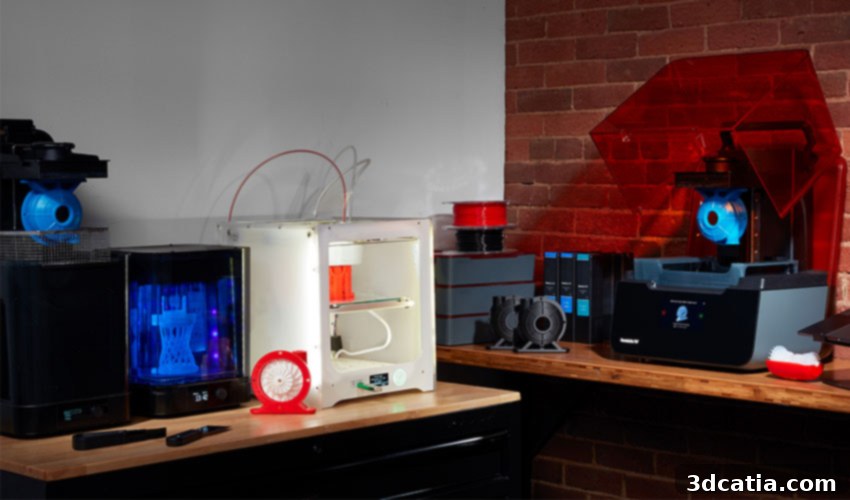
FDM vs. SLA 3D Printing: Unlocking Complementary Power for Advanced Manufacturing
In the rapidly evolving landscape of additive manufacturing, two technologies frequently stand out for their widespread adoption and diverse capabilities: Fused Deposition Modeling (FDM) and Stereolithography (SLA). While often viewed as competing processes, a deeper understanding reveals that FDM and SLA are, in fact, highly complementary, offering unique advantages that can be strategically leveraged to optimize various additive manufacturing projects. For businesses, engineers, and designers alike, grasping the fundamental differences in print quality, material properties, application suitability, workflow, speed, and cost is paramount for making informed decisions and maximizing project outcomes.
From intricate concept models and functional prototypes in product development to robust jigs, fixtures, and other tooling in manufacturing, these two 3D printing methods each have their distinct strengths. FDM typically excels with larger, simpler parts where mechanical strength and cost-effectiveness are primary concerns, while SLA is unparalleled for complex geometries, highly accurate tooling, and applications demanding superior surface finish and tight tolerances. This guide aims to explore these differences in detail and illustrate how integrating both technologies can lead to innovative solutions and enhanced project efficiency.
Comparing FDM and SLA 3D Printing: A Detailed Overview
At the heart of any 3D printing project lies the choice of technology, which significantly impacts the final part’s characteristics and the overall production process. While FDM technology has traditionally been the entry point for many, particularly at the consumer and hobbyist level due to its accessibility, SLA has established itself as a cornerstone in professional and industrial sectors, valued for its precision and versatility.
Working Principles and Material Properties
FDM 3D printers operate on an extrusion-based process, building parts layer by layer by melting and extruding thermoplastic filaments through a heated nozzle onto a build platform. As the molten plastic is deposited, it cools and solidifies, forming a mechanical bond with the previous layer. Common FDM materials include PLA, ABS, PETG, Nylon, and various composites, each offering a range of mechanical properties suitable for different applications. The resulting parts often exhibit visible layer lines and can have anisotropic properties, meaning their strength varies depending on the print orientation due to the nature of the layer-by-layer bonding.
In contrast, SLA 3D printing, a form of vat photopolymerization, uses a laser to selectively cure liquid photopolymer resin into hardened plastic. This process, known as photopolymerization, creates chemical bonds by cross-linking polymers across each successive layer. The fundamental difference in bonding mechanism results in fully dense, isotropic parts that are water and airtight, offering high degrees of lateral strength. SLA resins come in a vast array, from standard general-purpose resins to specialized engineering resins (tough, flexible, rigid), dental, medical, and castable resins, providing a wider range of functional properties critical for many engineering and manufacturing applications.
Precision, Accuracy, and Surface Finish
When it comes to fine detail and surface aesthetics, SLA technology generally outperforms FDM. FDM’s reliance on extruding molten filament means that very fine features, sharp edges, and intricate geometries can be challenging to achieve with high fidelity. The visible layer lines inherent to FDM parts often necessitate additional post-processing for a smooth finish. This makes FDM less ideal for highly detailed prototypes, molds with fine features, or end-use parts where aesthetics are paramount.
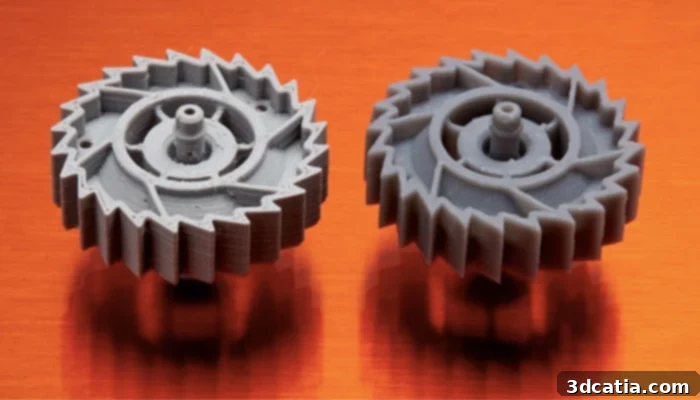
FDM 3D printed part (left) and SLA 3D printed part (right). In terms of geometric complexity, SLA technology is more precise and accurate | Credits: Formlabs
SLA, with its laser-curing process, can achieve exceptionally high resolution and accuracy, producing parts with incredibly smooth surfaces, intricate details, and tight tolerances. This capability makes SLA ideal for applications like investment casting patterns, dental models, jewelry prototypes, and highly functional prototypes that require precise fit and finish. The superior surface quality of SLA parts often requires minimal post-processing to achieve an injection-molded-like appearance.
Post-Processing Workflow
The post-processing steps differ significantly between the two technologies. FDM parts typically require the removal of support structures (if used), which can be done manually or by dissolving soluble supports. While cleaning is generally not required, some FDM parts may benefit from sanding, vapor smoothing, or other finishing techniques to improve surface quality. The process is usually straightforward and relatively clean.
SLA parts, however, always necessitate a rinsing step in isopropyl alcohol (IPA) or another compatible solvent to wash away any uncured liquid resin from their surfaces. This is a crucial step to ensure the final part’s integrity and appearance. Following the wash, many SLA parts, especially those made with engineering resins, benefit from or require a post-curing process using UV light. Post-curing further strengthens the part, increases its stiffness, and improves its mechanical properties and long-term stability. While this adds an extra step, automated washing and curing stations have streamlined this workflow significantly. Both FDM and SLA parts can subsequently be machined, primed, painted, and assembled for specific applications or aesthetic requirements.
Cost Considerations and Build Volume
From an initial investment perspective, FDM 3D printers typically offer a lower barrier to entry. Desktop FDM machines are available for a few hundred dollars, making them highly attractive to makers, hobbyists, and small businesses looking to experiment with additive manufacturing without a substantial upfront cost. Professional FDM printers, designed for industrial use, range significantly higher, often between 2,000 EUR and 8,000 EUR, offering larger build volumes, enclosed build chambers, and more advanced material capabilities.
In this professional price bracket, FDM machines directly compete with professional SLA 3D printers, which typically start around 3,000 EUR for smaller desktop units. Historically, one of SLA’s limitations was its smaller build volume compared to FDM, making it challenging to print large parts. However, recent advancements have addressed this. For example, Formlabs offers the Form 3L, a large-scale accessible SLA 3D printer, priced just below 10,000 EUR, boasting a significant build volume of 300 x 335 x 200 mm. This innovation demonstrates that large-part manufacturing is increasingly viable with SLA, expanding its application possibilities. When considering total cost of ownership, material costs (filament versus resin) and post-processing supplies (IPA, UV curing station) should also be factored in.
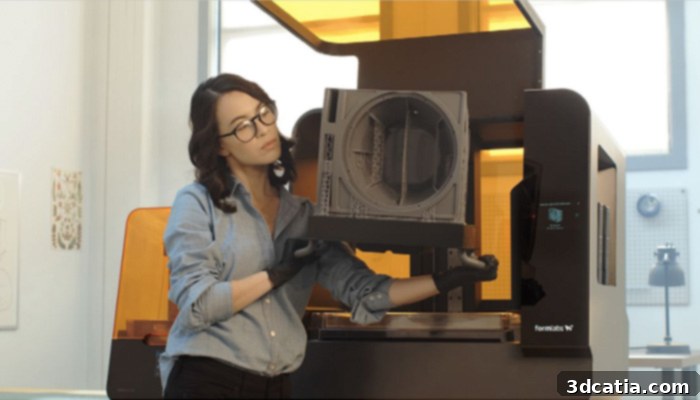
The Form 3L from Formlabs delivers large parts, it uses Low Force Stereolithography (LFS) to scale up to a larger print area built | Credits: Formlabs
Synergy in Practice: Combining FDM and SLA for Enhanced Projects
The true power of FDM and SLA often lies not in choosing one over the other, but in strategically employing both. Many forward-thinking companies are now investing in both technologies, recognizing their complementary nature rather than viewing them as perpetually competing. This integrated approach allows businesses to harness the specific strengths of each method, resulting in optimized workflows, reduced costs, and superior final products across a wide range of applications.
Why Combine Technologies?
By combining FDM and SLA, manufacturers and designers can achieve the “best of both worlds.” This means benefiting from low-cost, rapid prototyping capabilities for initial conceptual models and large, less-detailed parts (often handled by FDM) alongside the production of high-quality, intricate, and functional parts requiring excellent surface finish and precise tolerances (typically achieved with SLA). This dual approach can significantly accelerate product development cycles, enabling quicker iterations and more robust testing.
For instance, an engineering team might use FDM for large-scale mock-ups or robust jigs and fixtures where dimensional accuracy isn’t hyper-critical, saving on material costs and print time. Then, for intricate components, custom connectors, or highly detailed aesthetic prototypes requiring smooth finishes, they would turn to SLA. This optimization of resources ensures that the right tool is used for the right job, maximizing efficiency and quality throughout the entire product lifecycle.
Real-World Application: The Third Thumb Project
A compelling example of this synergistic approach is the “Third Thumb” project, conceptualized by Dani Clode in collaboration with The Plasticity Lab at the Institute of Cognitive Neuroscience at University College London (UCL). This innovative project explores prosthetic augmentation through a user-controlled extra thumb, aiming to enhance the usability and control of prosthetic devices.
The Third Thumb itself is a testament to the combined strengths of FDM and SLA. Dani Clode elaborated on the material choices: “The thumb itself is FDM printed flexible thermoplastic polyurethane, with a low print fill. FDM flex is hard to work with, but it is the best option for the thumb at the moment. It also makes it light and strong. The fingertips are Formlabs elastic, and that’s because I need a high-resolution flexible material that can be printed thin, hold its shape and grip nicely. I also love that it can be secured easily to my other materials, unlike silicone. SLA is the only printing method that can handle my intricate internal piping to control the thumb.”
This project perfectly illustrates how FDM was chosen for the main body of the thumb, leveraging its ability to produce lightweight, strong, and relatively large flexible parts cost-effectively. Concurrently, SLA was indispensable for the fingertips, where the critical need for high-resolution flexibility, fine detail for internal pneumatic or control channels, and superior tactile properties could only be met by specialized SLA elastic resins. The intricate internal piping, crucial for the device’s functionality, further highlighted SLA’s unparalleled precision.
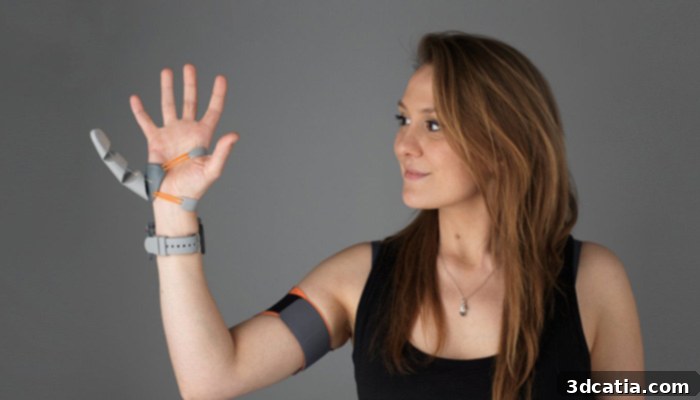
Dani Clode wearing the third thumb | Credits: Dani Clode / The Plasticity Lab
Conclusion: Expanding Horizons in 3D Printing
As demonstrated, combining multiple 3D printing technologies, specifically by playing to the unique strengths of FDM and SLA, can dramatically expand the possibilities of additive manufacturing. This strategic integration allows for the creation of complex, multi-material, and highly functional parts that might be impossible or cost-prohibitive to produce using a single technology. For individuals and businesses looking to push the boundaries of design and engineering, understanding and embracing this complementary relationship is key.
If you are primarily an FDM user, considering the addition of SLA technology can significantly grow your capabilities, enabling you to tackle projects requiring higher precision, finer details, and a broader range of specialized material properties. Explore how you can enhance your additive manufacturing toolkit and receive an exclusive discount on Formlabs SLA technology by learning more HERE.
We’d love to hear your thoughts on combining FDM and SLA 3D printing! Share your experiences and insights in a comment below or connect with us on our Facebook and Twitter pages. For all the latest news and innovations in the world of 3D printing, remember to sign up for our free weekly Newsletter, delivered straight to your inbox!