
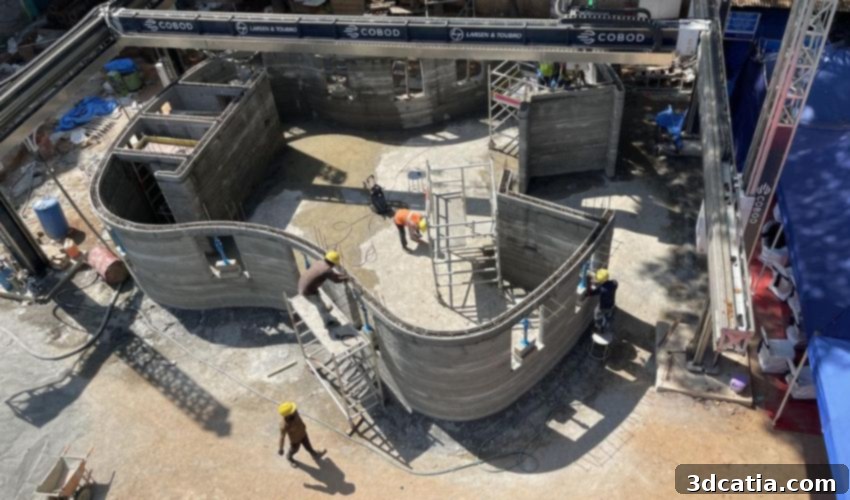
Pioneering the Future: India Unveils the World’s First 3D Printed Post Office in Bengaluru
The landscape of global construction is undergoing a profound transformation, driven by innovative technologies like 3D printing. From houses and pavilions to bridges and even entire communities, additive manufacturing is redefining what’s possible in building. This technological revolution has recently reached a new milestone in India, capturing significant attention across social media and the engineering world. In Bengaluru, a bustling hub of innovation, Larsen & Toubro (L&T) Construction is diligently working on a groundbreaking project: the world’s first 3D printed post office. This pioneering endeavor marks a significant leap for India in adopting advanced construction methods, coming just two years after the country inaugurated its first 3D printed house, showcasing a rapidly accelerating interest in this transformative technology.
The Ascendancy of 3D Printing in Modern Construction
The synergy between 3D printing and construction has become increasingly evident over the past few years, with projects multiplying at an astonishing rate. This advanced method has been applied to a diverse array of structures, demonstrating its versatility and potential. We’ve seen the advent of the first 3D printed hotel, innovative 3D printed schools, and even entirely 3D printed communities designed to address housing shortages efficiently. Beyond terrestrial applications, the technology has even ventured into space exploration with projects like the 3D printed Mars Dune Alpha, a Mars Surface Habitat simulator created by ICON for NASA. The driving forces behind this global surge in interest are crystal clear: 3D printing offers a compelling solution for more affordable, sustainable, and rapid construction. Its capacity to significantly reduce construction time, minimize material waste, and decrease labor costs over the long term positions it as a vital tool for meeting the growing demands for infrastructure worldwide, particularly in developing economies.
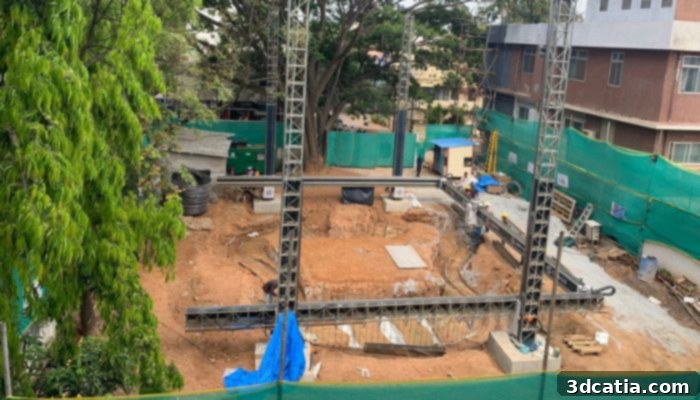
The beginning stages of construction of the 3D printed post office in Bengaluru (photo credits: Marisha Thakur via Twitter)
L&T Construction: Driving Innovation in India’s Building Sector
Larsen & Toubro (L&T) Construction, the prominent force behind this pioneering post office project, unequivocally recognizes the transformative potential of additive manufacturing. M. V. Satish, the esteemed Whole-Time Director and Senior Executive Vice-President of L&T, articulated the company’s strategic focus, stating, “L&T Construction’s primary focus for 3D printing technology includes affordable housing up to G+3 floors, villas, military barracks, and single-floor schools, post offices, and factories. We are actively seeking to expand our portfolio of 3D printed structures in various sectors and are positioned well to capitalize on the benefits of this innovative technology.” This statement underscores L&T’s commitment to integrating advanced techniques into mainstream construction practices. Indeed, their engagement with 3D printing is not new; they have already successfully executed several 3D printing construction projects in India, including a single-story building in Tamil Nadu and an innovative show apartment in Chennai. These prior successes have not only honed their expertise but also cemented their role as a trailblazer in bringing sustainable and efficient construction solutions to India.
Constructing the Future: Details of the First 3D Printed Post Office
The ambitious 3D printed post office project in Bengaluru is being realized with the advanced BOD2 3D printer from COBOD International. This Danish company stands as a global leader in construction 3D printing, having contributed to numerous significant projects worldwide. Notably, COBOD previously collaborated with L&T Construction on India’s first two-story 3D printed building, a testament to their strong partnership and shared vision for innovation. For the Halasuru Post Office, 3D printing was chosen once again, primarily for its unparalleled speed and efficiency. The BOD2 printer, known for its gantry system and ability to print large-scale structures with precision, extrudes a specialized concrete mixture layer by layer, rapidly forming the walls of the building. This automated process significantly reduces the need for extensive manual labor and conventional formwork, accelerating the construction timeline dramatically.
L&T estimates that the construction of the entire 1000 sq-ft Halasuru Post Office will take a mere 45 days. This rapid completion includes not just the structural shell but also the integration of essential mechanical, electrical, and plumbing (MEP) systems, along with high-quality finishes. In traditional construction, a project of this scale would typically require several months, highlighting the profound advantage of additive manufacturing. Furthermore, the project is projected to cost approximately Rs 23 lakh (equivalent to about $28,042 USD), representing a remarkable cost reduction of about 30-40% compared to conventional building methods for similar structures. This significant saving is achieved through optimized material usage, reduced labor hours, and quicker project turnaround, making 3D printing an economically attractive solution for public infrastructure development. The integration of MEP and finishes within this tight schedule further underscores the comprehensive capabilities of modern construction 3D printing, delivering a fully functional building in record time.
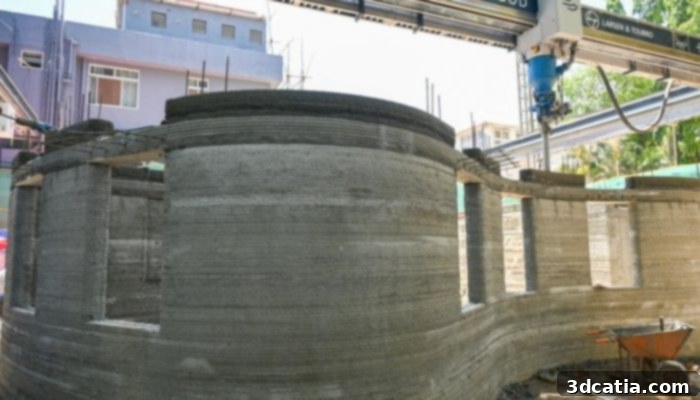
Progress on the 3D printed walls of the post office, showcasing the layered construction (photo credits: DH Photo/BH Shivakumar)
Government and Academic Support: Paving the Way for Innovation
The successful implementation of this project is significantly bolstered by the proactive support from both the Indian government and academia. This collaborative approach has been instrumental in creating an environment conducive to adopting advanced construction technologies. In a public statement, L&T proudly declared, “While the technology has been approved by the Building Materials and Technology Promotion Council (BMTPC), the structural design of the post office has been validated by IIT Madras.” The endorsement from BMTPC, a government body dedicated to promoting sustainable building materials and construction technologies, signifies official recognition and acceptance of 3D printed construction. Concurrently, the validation of the structural design by the Indian Institute of Technology Madras, one of the nation’s premier academic institutions, provides crucial technical assurance and reinforces public confidence in the safety and integrity of these innovative structures. This dual approval is vital for mainstreaming 3D printing in construction, establishing robust standards, and encouraging broader adoption across various infrastructure projects in India.
India’s Vision for a Sustainable and Efficient Future
The 3D printed post office in Bengaluru is more than just a building; it represents a significant milestone in India’s journey towards sustainable and efficient infrastructure development. By embracing 3D printing, India is positioning itself as a leader in leveraging cutting-edge construction technology to address its growing infrastructure needs, including affordable housing, rapid urban development, and accessible public services in both urban and remote areas. This project serves as a powerful demonstration of how digital construction methods can provide quick, cost-effective, and environmentally friendly solutions, setting a precedent for future innovations within the country and inspiring other nations. It underscores a forward-thinking approach that prioritizes technological advancement for the betterment of society and the economy.
Though the Halasuru Post Office project is not yet fully complete, its progress has already generated immense excitement and anticipation within the industry and among the general public. As construction continues at an impressive pace, we will ensure to keep our readers updated on its journey towards becoming a fully operational landmark. This venture not only highlights the remarkable capabilities of 3D printing but also reinforces India’s commitment to embracing innovative solutions for a brighter, more efficient future in construction.
What are your thoughts on India’s first 3D printed post office and its implications for future construction? Let us know your insights in a comment below or join the conversation on ourLinkedIn,Facebook, andTwitter pages! Don’t forget to sign up for our free weeklyNewsletter here to receive the latest 3D printing news straight to your inbox! You can also find all our videos and comprehensive reports on ourYouTube channel.
*Cover Photo Credits: K. Murali Kumar