
Aeditive: Driving the Future of Construction with Advanced Robotic 3D Concrete Printing Technology
Additive manufacturing technologies are rapidly transforming industries worldwide, offering a compelling blend of reduced manufacturing costs, significantly faster production times, and superior resource efficiency. The construction sector, a traditionally conservative industry, is now actively embracing these advancements, particularly through the use of concrete as an additive material. This integration allows the industry to unlock unprecedented benefits, most notably an unparalleled freedom of design. From structurally optimized components to entire 3D printed houses and even specialized hospital capacities, the possibilities are vast and transformative. This burgeoning potential is clearly reflected in market statistics: the global concrete 3D printing market, valued at a substantial $310 million in 2019, is projected to skyrocket to an astonishing $40 billion by 2027. This phenomenal growth represents a compound annual growth rate (CAGR) of 106.5% from 2020 to 2027, as reported by Research & Markets. It’s no surprise, then, that an increasing number of innovative players are entering this dynamic market, with Germany-based startup Aeditive at the forefront of this exciting revolution.
Aeditive’s distinctive name itself is a testament to its core mission, ingeniously crafted from a blend of “additive manufacturing” and “Aedificium,” the Latin word for building. This powerful combination perfectly encapsulates the company’s ambitious goal: to fundamentally digitize and modernize the construction industry through cutting-edge robotic printing solutions. The company recently unveiled its groundbreaking 3D printer, the Aeditive Concrete, a system capable of producing concrete parts with impressive maximum dimensions of 11 x 4 x 4 meters on robust steel pallets. Intrigued by this innovative technology and its potential impact, we had the privilege of meeting with Alexander Türk, one of Aeditive’s visionary founders, for an exclusive interview to delve deeper into their work and aspirations.
3DN: Can you introduce yourself and elaborate on Aeditive’s connection to additive manufacturing?
Aeditive is a high-technology startup that officially launched in 2019, strategically headquartered in Norderstedt, a vibrant town near Hamburg. Our fundamental mission is to spearhead the digitization of the construction industry, achieving this through our proprietary robotic 3D printing solutions. We are dedicated to fostering higher levels of productivity and enhancing sustainability within construction processes. Our ultimate goal is to create a future where people can live in well-built, accessible structures, where the environment is actively protected through more efficient material use, and where the working conditions in concrete construction are significantly safer and cleaner for all involved. By leveraging the precision and efficiency of additive manufacturing, we are not just building structures; we are building a better future for the industry and society at large.
3DN: How did the foundational idea for Aeditive come to fruition?
The inception of Aeditive traces back to a pivotal moment when three of our co-founders—Niklas Nolte, Hendrik Lindemann, and Roman Gerbers—converged during an intensive research project at a distinguished technical university. During this period, their collaborative efforts were focused on pioneering digital production processes specifically tailored for concrete construction. This wasn’t merely theoretical exploration; it involved rigorous experimentation and problem-solving to overcome the inherent complexities of integrating digital technologies with traditional construction materials. After four years of dedicated and meticulous research, the technology they had developed reached a significant milestone, demonstrating clear market readiness and commercial viability. It was at this crucial juncture that the profound potential of their innovation became undeniable, sparking the idea and ultimately leading to the birth of Aeditive. They recognized that their breakthroughs had the power to revolutionize an entire industry, moving from academic discovery to real-world application.
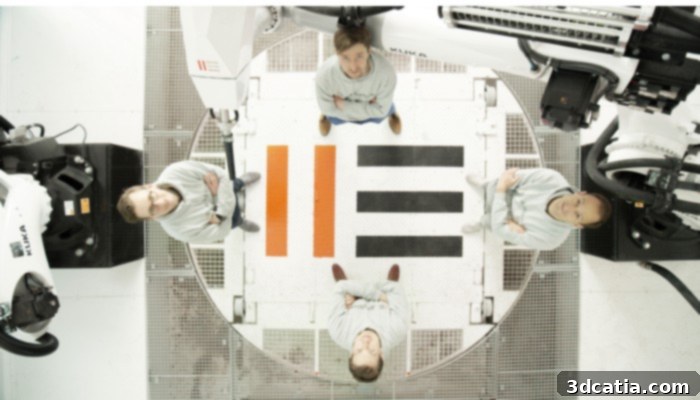
The founders of Aeditive (from left clockwise): Niklas Nolte, Hendrik Lindemann, Alexander Türk and Roman Gerbers | Picture Credits: Aeditive
3DN: Can you explain the operational mechanics of your 3D printer, the Concrete Aeditor?
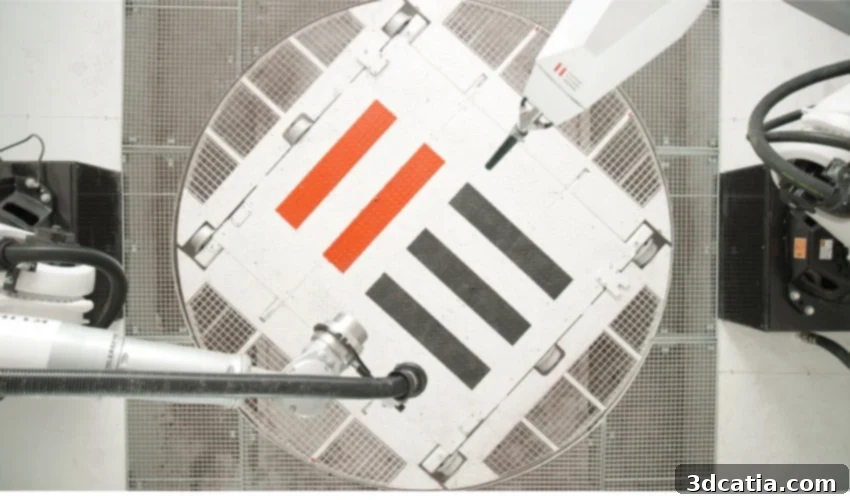
The Concrete Aeditor employs a sophisticated and highly efficient shotcrete process to create concrete components. This method is a distinct advantage compared to other concrete printing techniques, as it enables the seamless integration of critical elements such as steel reinforcement directly into the structure during the printing process. This is vital for ensuring the structural integrity and load-bearing capacity of the finished components. Our system operates with two synchronized robotic arms. The first robot is meticulously tasked with applying the concrete in precise layers, building up the desired geometry. Simultaneously, the second robot performs essential reworking of surfaces, ensuring a smooth, high-quality finish, or even adding texture and specific functional features as required. This dual-robot approach allows us to offer our customers an exceptionally high degree of automation in the production of concrete components. Furthermore, this precise and controlled application of material leads to significant material savings, thereby producing more sustainable products with reduced waste. The ability to integrate reinforcement and refine surfaces in-process truly sets the Concrete Aeditor apart, offering both structural robustness and aesthetic quality.
3DN: What significant opportunities does 3D printing present for the construction industry, and what are its primary challenges?
3D printing stands at the cusp of a revolutionary transformation within the construction industry. While recent years have seen impressive showcases and prototypes, the market is now undeniably shifting towards integrating 3D printing as a regular, indispensable production method. This technology opens up a myriad of opportunities that were previously unattainable. These include unprecedented design freedom, allowing for complex, organic geometries and custom architectural elements that are difficult or impossible to achieve with traditional methods. It promises accelerated construction timelines, reduced material waste through optimized designs, and the potential for on-demand, localized production, which can significantly lower transportation costs and environmental impact. The ability to quickly produce bespoke components can also address urgent housing needs or rapidly rebuild infrastructure after disasters.
However, for 3D printing to achieve widespread adoption, it must confront two formidable challenges unique to the construction sector. Firstly, building is inherently characterized by multi-materiality. A modern structure is not merely composed of concrete; it is a complex assembly of steel reinforcement, intricate piping systems, electrical conduits, insulation, windows, doors, and a multitude of other components. Therefore, our production processes must extend far beyond simply extruding concrete. We must develop comprehensive solutions for seamlessly integrating diverse materials and systems, ensuring functional and regulatory compliance. Secondly, the construction industry has painstakingly refined and perfected its conventional manufacturing processes over many decades, creating an incredibly robust and efficient system of craftsmanship and established practices. Consequently, 3D printing faces stiff competition not only on a technical front, needing to prove its superiority or unique value proposition but also economically, requiring demonstration of clear cost-effectiveness and scalability when pitted against deeply entrenched, highly optimized traditional methods. Overcoming these challenges will define the next era of innovation in construction.
3DN: Could you elaborate on Aeditive’s future projects and your current client base?
Currently, we are in an incredibly exciting phase, working hand-in-hand with our selected pilot customers to develop an increasing number of component prototypes. This collaborative process is invaluable, as it allows us to rigorously test and continuously expand the application spectrum and capabilities of our Concrete Aeditor. These prototypes range from specialized architectural elements and structurally optimized beams to intricate façade components, demonstrating the versatility of our technology. Looking ahead to 2021, we are scheduled to install the very first Concrete Aeditor systems directly at our customers’ sites, specifically within precast plants. This marks a pivotal transition from demonstration to full-scale production, integrating our robotic systems seamlessly into existing manufacturing workflows. Our diverse client roster includes highly innovative precast manufacturers, such as Glatthaar Technology from the picturesque Black Forest region, renowned for their forward-thinking approach. Beyond these pioneers, we also collaborate with a wide range of other companies of varying sizes and across different segments of the construction industry, including residential, commercial, and infrastructure projects. These collaborations enable us to tailor our solutions to specific industry needs and continue refining our technology for broader market adoption.
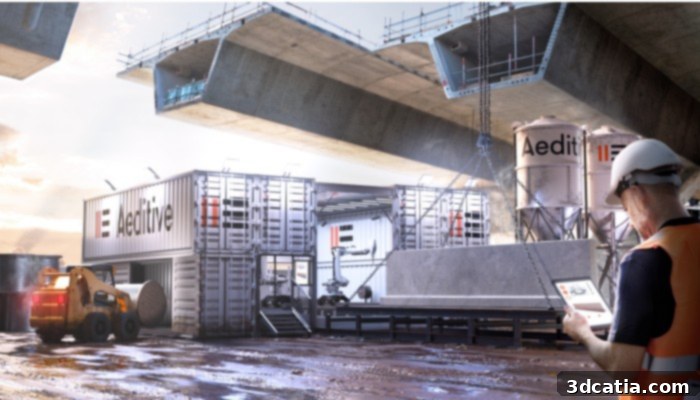
Aeditive is currently producing prototypes with selected pilot customers on their demonstration plant. The Aeditive Concrete will then be used for production on site by the pilot customers in 2021 | Credits: Aeditive
3DN: Where do you envision Aeditive being in the next five years?
In five years, I foresee Aeditive firmly established as a leading technology company, distinguished by a large base of highly satisfied customers and an exceptional product that is not only robust and precise but also incredibly intuitive and easy to use and operate. Our success will be measured by the tangible improvements we bring to the quality of our users’ workplaces, actively contributing to making concrete construction jobs significantly safer, cleaner, and less physically demanding. With our advanced technology, we aim to systematically reduce critical bottlenecks prevalent in construction projects, ensuring that vital infrastructure developments proceed without costly delays and that urgently needed living spaces can be created efficiently and in a timely manner to meet growing demands. This goes beyond mere speed; it’s about optimizing the entire construction pipeline. Furthermore, a cornerstone of our long-term vision is sustainability. Our technology makes it possible to precisely optimize material use, inherently reducing the overall consumption of cement. This reduction is a direct and substantial contribution to mitigating the environmental impact of construction, particularly concerning CO2 emissions associated with cement production. Ultimately, we envision Aeditive as a catalyst for a more efficient, safer, and ecologically responsible construction industry globally.
3DN: Do you have any final thoughts or a message for our readers?
Indeed, there is an palpable sense of optimism and excitement permeating the construction industry worldwide. We are witnessing a monumental shift, where technology is not just being introduced but is actively being embraced and integrated across the entire value chain. This transformation promises to redefine the industry in ways that were unimaginable just a few years ago. The scope of innovation is incredibly broad, encompassing everything from sophisticated software solutions that streamline design and project management, to advanced robotics that enhance efficiency and safety, and, of course, the transformative potential of 3D printing. However, despite the rapid advancements, there are still numerous exciting challenges that await innovative solutions. Many groundbreaking ideas are yet to be conceived, and a strong demand remains for visionary “doers” – individuals and teams who are ready to roll up their sleeves, push boundaries, and bring these future-shaping technologies to life. It’s an open invitation to be part of an unprecedented era of change and growth in construction.
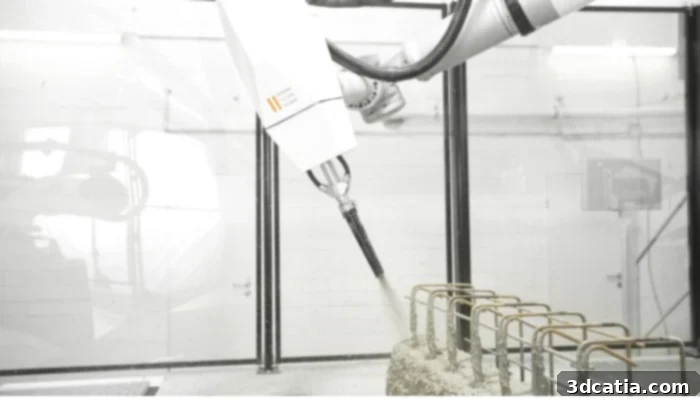
The Aeditive Concrete is based on the RSP (Robotic Shotcrete Printing) process, which the team developed in four years of academic research. It is based on the shotcrete process | Credits: Aeditive
For those interested in delving deeper into Aeditive’s innovative projects and groundbreaking technology, more comprehensive information can be found HERE. We are keen to hear your perspectives on this pioneering startup’s endeavors. Please share your thoughts and insights by leaving a comment below or by engaging with us on our Facebook and Twitter pages! Don’t forget to sign up for our free weekly Newsletter to stay updated on the latest in additive manufacturing.