
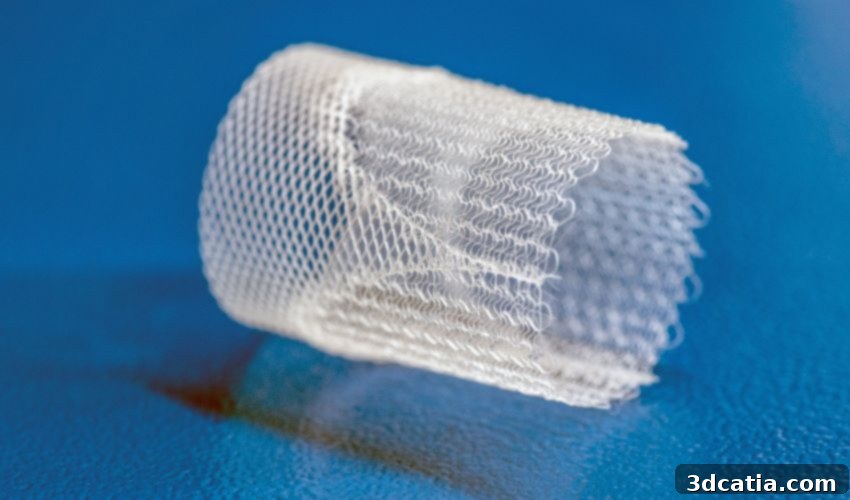
Revolutionizing Cardiac Care: 3D Printed Heart Valves Designed to Grow with Patients
A groundbreaking development in medical science promises to transform the lives of countless patients suffering from heart valve diseases. Researchers have successfully developed a novel form of 3D printed heart valves, engineered with a remarkable capability: they allow the patient’s own cells to integrate, form new tissue, and grow dynamically with the body. This innovative approach holds immense potential to significantly reduce the complex array of complications typically associated with traditional organ transplants and existing valve replacement procedures, offering a more natural and long-lasting solution.
The rapid evolution of additive manufacturing within the medical sector has been nothing short of exponential. This advanced technology has empowered scientists and doctors to explore previously unimaginable possibilities, pushing the boundaries of what is medically achievable. While 3D printing has already seen considerable success in areas such as the creation of custom prosthetics, its application in more intricate fields like internal medicine, particularly the cutting-edge concept of bioprinting, is still under active exploration. This recent research, however, represents a monumental leap forward, demonstrating the profound impact that personalized 3D printed implants can have on regenerative medicine and future cardiac interventions.
The innovative project bringing these bio-integrative heart valves to fruition is the result of a collaborative effort by a dedicated team of researchers. Key contributors include Professor Petra Mela, an expert in medical materials and implants at the Technical University of Munich (TUM), and Professor Elena De-Juan Pardo from the University of Western Australia. Their combined expertise has been instrumental in advancing the concept of creating 3D printed heart valves that can serve as life-lasting implants. The core innovation lies in the valves’ ability to foster the formation of new, functional tissue within the patient’s body. By leveraging advanced additive manufacturing technologies in conjunction with specially developed, biodegradable materials, these professionals have been able to craft implants that astonishingly mimic the intricate complexities and functionalities of natural human heart valves. Considering the staggering statistic of approximately 182,000 heart valve replacements performed annually in the United States alone, this research, once viable for clinical application, could genuinely save countless lives and dramatically improve patient outcomes globally.
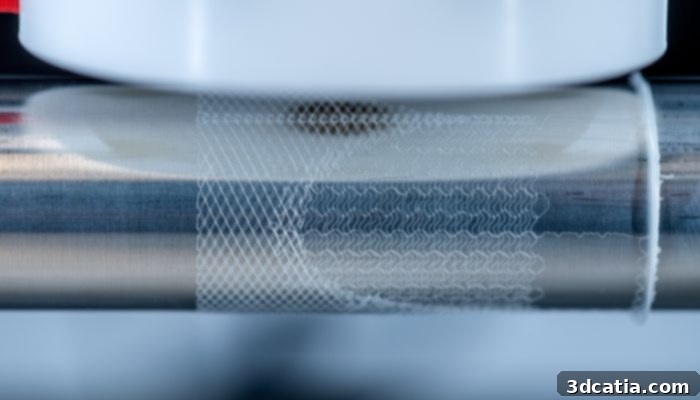
The fine structural details achieved on the 3D printed heart valve highlight the precision of the manufacturing process.
While various types of heart valve implants currently exist, their use is invariably accompanied by significant challenges and potential complications. Mechanical heart valves, for instance, are manufactured from durable materials but carry a substantial risk of blood clot formation on their metallic surfaces. These clots can lead to severe, life-threatening events such as strokes or heart attacks. Consequently, patients receiving mechanical valves are subjected to the lifelong necessity of taking blood-thinning medication, which itself introduces risks like increased bleeding. Moreover, these patients often face limitations in their physical activities, impacting their quality of life. Another major drawback of both mechanical and bioprosthetic (animal tissue-derived) valves is their inability to grow or adapt within the patient’s body. They are essentially static implants that eventually degenerate or become outgrown, especially in pediatric patients, necessitating repeated, invasive surgical replacements over the years.
Professor Petra Mela eloquently explains the critical need for a new paradigm: “Our overarching goal is to engineer bioinspired heart valves that actively support the formation of new, functional tissue directly within the patient. Children stand to benefit most profoundly from such an innovative solution. Current heart valves, unfortunately, do not possess the capacity to grow in tandem with the patient’s developing body, meaning that young patients must endure multiple complex surgeries throughout their childhood and adolescence to replace outgrown valves. In stark contrast, our novel 3D printed heart valves are meticulously designed to mimic the intricate structural and functional complexity of native heart valves. Crucially, they are engineered to enable a patient’s own cells to infiltrate the scaffold, colonize it, and ultimately develop into a living, functioning part of the heart. This ability to integrate and grow naturally would eliminate the need for repeated surgeries, drastically improving the long-term prognosis and quality of life for pediatric cardiac patients.”
Utilizing Advanced Melt Electrowriting for Precision 3D Printed Heart Valves
To achieve the unprecedented level of detail and structural integrity required to accurately imitate the delicate biological structures of a human heart valve, the research team employed a highly specialized additive manufacturing technology known as melt electrowriting. This sophisticated process builds upon conventional extrusion 3D printing but introduces a crucial element of refinement. In melt electrowriting, a medical-grade polymer material is first heated to its melting point, then precisely extruded as a fine liquid jet from a printing head. What truly distinguishes this technology and makes it ideal for such intricate biological applications is the application of a high-voltage electric field to this molten jet. This electric field precisely controls and stretches the polymer, allowing for the creation of incredibly fine fibers, ranging in thickness from an astonishing five to fifty micrometers. This unparalleled precision enables the machine to print with extreme detail, producing highly accurate and consistent patterns that closely replicate the extracellular matrix of natural tissue. For the implant material, the team judiciously selected medical-grade polycaprolactone (PCL), a synthetic polymer renowned for its excellent biocompatibility—meaning it is well-tolerated by living cells—and its biodegradable properties, ensuring that the scaffold can naturally resorb as new tissue forms.
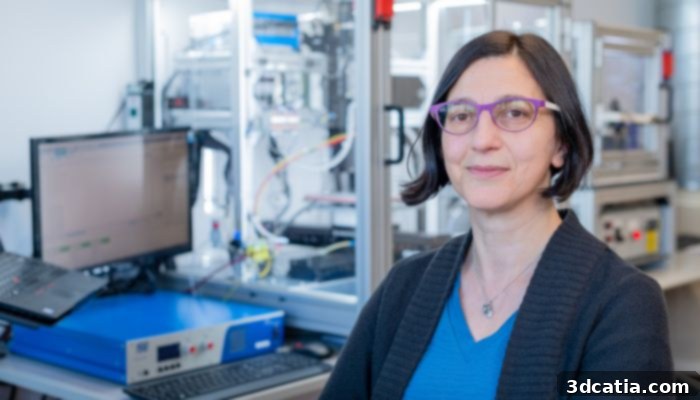
Professor Petra Mela of the Technical University of Munich (TUM), a lead researcher in the heart valve project.
As highlighted earlier, the overarching long-term objective of this pioneering research is to develop heart valve implants specifically tailored for children. These implants are envisioned to not only remain safely within the body but also to actively grow and adapt with the patient as they mature, completely circumventing the need for multiple, traumatic replacement surgeries. The scientific premise behind this regenerative capacity is that, over time, the patient’s own endothelial and mesenchymal stem cells will naturally settle and proliferate within the meticulously designed micro-pores of the PCL scaffold. These pores are strategically engineered to be smaller than the pores of a typical PCL structure, optimizing cell infiltration and tissue regeneration. Although the journey from laboratory development to widespread clinical application is often extensive and challenging, the research team expresses strong confidence in the transformative potential of their work for individuals suffering from debilitating heart valve diseases. The next critical phase involves moving onto rigorous animal testing, a crucial step to validate the safety, efficacy, and long-term performance of these innovative 3D printed heart valves in a living system. Further details on this remarkable project can be explored HERE.
The development of these self-growing 3D printed heart valves signifies a paradigm shift in cardiovascular medicine, offering a beacon of hope for regenerative therapies. This breakthrough showcases the incredible synergy between advanced additive manufacturing, sophisticated biomaterials, and deep biological understanding. It sets a new standard for medical implants, moving beyond inert replacements to fully integrated, living components that can heal and adapt with the human body, especially benefiting the most vulnerable patient populations.
What are your thoughts on these revolutionary 3D printed heart valves and their potential impact on future cardiac care? We encourage you to share your insights and comments below, or engage with us on our social media platforms: LinkedIn, Facebook, and Twitter! Don’t miss out on the latest advancements in additive manufacturing—subscribe to our free weekly Newsletter here to receive top 3D printing news directly in your inbox. You can also discover more captivating content by visiting our YouTube channel for a wide range of videos.
*All Photo Credits: Andreas Heddergott / TUM