
AI-Powered Quality Assurance: Revolutionizing Industrial 3D Printing with Real-time Monitoring and Digital Twins
The landscape of industrial 3D printing is undergoing a transformative shift, driven significantly by the imperative for enhanced automation across every stage of the manufacturing workflow. While additive manufacturing holds immense promise for producing complex parts with unparalleled design freedom, its widespread adoption in high-volume industrial applications has historically been hampered by challenges related to repeatability and consistent quality. When parts are produced at scale, the ability to replicate identical characteristics and performance properties consistently becomes paramount. Traditional 3D printing systems, however, often struggle to deliver this level of unwavering consistency, leading to variations that can impact the structural integrity and functionality of the final product.
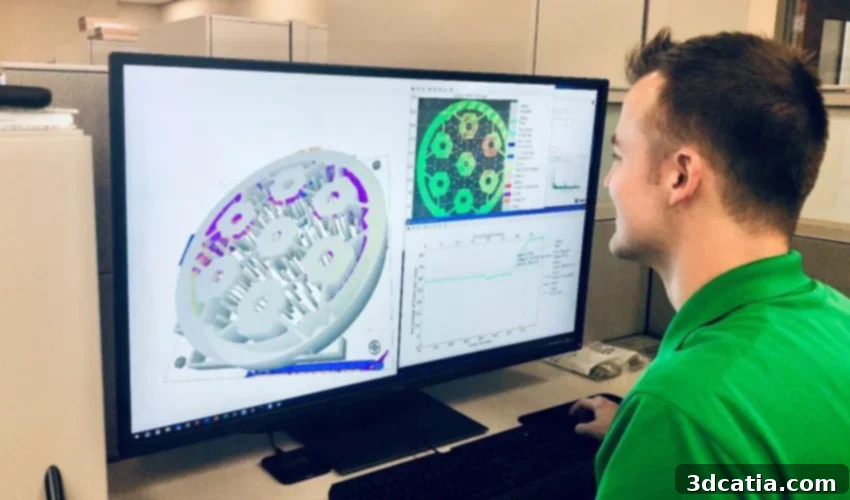
This critical need for reliability has spurred a focus on integrating advanced automation techniques, particularly in the realm of quality assessment. Ensuring the quality of 3D printed parts in real-time is not merely an improvement; it’s a foundational requirement for industrial scalability. Addressing this vital need, researchers at the prestigious Oak Ridge National Laboratory (ORNL) have spearheaded the development of an innovative artificial intelligence (AI) program designed to conduct real-time quality assessment. This sophisticated software is engineered to meticulously collect and analyze vast amounts of data throughout every single step of the additive manufacturing process. From the initial design phase and the crucial selection of feedstock materials, through the intricate print build process, and finally to rigorous material testing, the AI system maintains an uninterrupted watch, gathering vital intelligence that underpins true quality assurance.
One of the most groundbreaking features of this AI-driven approach is its capability to capture comprehensive information as a part is being 3D printed, layer by layer, voxel by voxel. This continuous data capture allows the artificial intelligence to construct an incredibly detailed “digital clone” for each manufactured part. Far more than just a simple virtual representation, this digital clone evolves into a dynamic repository, housing a wealth of data points that span the entire lifecycle of the component. It meticulously tracks everything from the precise specifications of the raw material used to the nuanced operational conditions during printing, and ultimately, the observed characteristics of the finished component. This exhaustive dataset provides unprecedented insights into the part’s genesis and its inherent quality attributes.
Vincent Paquit, one of the lead researchers at ORNL, eloquently explains the profound implications of this technology: “We then use that data to qualify the part and to inform future builds across multiple part geometries and with multiple materials, achieving new levels of automation and manufacturing quality assurance.” This statement highlights the dual benefits: immediate qualification of individual parts and, more importantly, a feedback loop that continually refines and optimizes future manufacturing processes. The ultimate vision for this cutting-edge technology is even more ambitious: to empower 3D printers with the ability to be truly self-correcting in real-time. Imagine a printer that can detect a subtle anomaly in its current layer, analyze the root cause instantly, and adjust its parameters on the fly to prevent the defect from escalating – a true paradigm shift in manufacturing control.
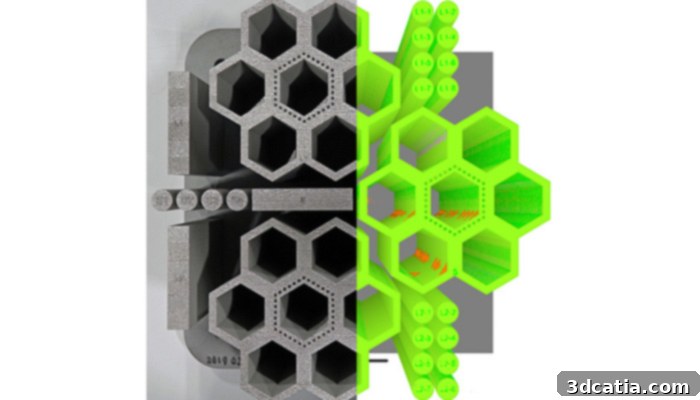
AI-driven defect detection in real-time during the additive manufacturing process. | Credits: Luke Scime/ORNL
Enhancing Part Reliability with Computer Vision and Automated Defect Detection
For 3D printed parts destined for mission-critical applications – such as structural components in automobiles, aerospace parts for aircraft, or vital elements within energy generation facilities – the need for an infallible control method at the end of the manufacturing process is non-negotiable. These applications demand zero-defect tolerance, making precise and rapid quality verification absolutely essential. ORNL’s innovative software addresses this by employing a sophisticated computer vision technique that offers swift and accurate analysis. This technique leverages images captured from high-resolution cameras strategically installed directly on the 3D printers, providing an immediate visual inspection of the print bed and the developing part.
The computer vision algorithms are specifically trained to scrutinize these images for any surface-visible defects, deviations, or anomalies that might indicate a flaw in the manufacturing process. These could range from minor surface roughness and discoloration to more significant issues like delamination or incomplete fusion. When the software identifies any such inconsistencies or deviations from the expected build parameters, it immediately triggers an alert. This automatic notification system promptly informs human operators, allowing them to intervene and make necessary adjustments to the printing process, potentially preventing further material waste and saving valuable production time. This proactive approach significantly minimizes the risk of producing defective parts and enhances the overall reliability of the additive manufacturing workflow.
Addressing the Complexities of Powder Bed Fusion Defects
The AI software, initially developed and rigorously tested for powder bed fusion (PBF) systems, targets a manufacturing process notorious for its susceptibility to a myriad of potential defects. Researchers have identified that virtually anything during the PBF process can contribute to a flaw in the final part. These include, but are not limited to, inconsistent or uneven distribution of the powder or binding agent, the occurrence of tiny molten material spatters, insufficient heat input during the laser or electron beam melting process, and the formation of various porosities within the material structure. Each of these imperfections, if undetected, can compromise the mechanical properties, dimensional accuracy, and overall performance of the printed component.
Luke Scime, the principal investigator for the Peregrine project at ORNL, articulates the fundamental challenge inherent in additive manufacturing: “One of the fundamental challenges for additive manufacturing is that you’re caring about things that occur on length-scales of tens of microns and happening in microseconds, and caring about that for days or even weeks of build time.” This statement encapsulates the immense complexity. The process involves dynamic phenomena occurring at incredibly small scales (tens of microns, the size of powder particles or individual melt pools) and at extremely rapid speeds (microseconds for laser-material interaction). Yet, these micro-scale events accumulate over extended build times, sometimes spanning days or weeks, to determine the final macroscopic quality of the part. Because a critical flaw can emerge at any point during this protracted and intricate process, understanding the underlying mechanisms and subsequently qualifying a part becomes an extraordinary challenge for traditional quality control methods.
Scalable Implementation and Broad Impact of the AI Software
A key aspect of this research is the development of an AI software solution that is not only powerful but also highly adaptable and easily deployable. The scientists are engineering the software to be installable on virtually any powder bed fusion system, a critical step towards broad industry adoption. This universality is achieved through its unique design: it produces a common image database that can be readily transferred to each new machine. This transferable database is crucial for rapidly training new neural networks, significantly reducing the setup and calibration time traditionally associated with machine learning deployments. Furthermore, the software boasts impressive computational efficiency, capable of running effectively on a single high-powered laptop or desktop computer, eliminating the need for complex and costly dedicated server infrastructure.
The research at ORNL has utilized standard, commercially available cameras for image acquisition, typically ranging from 4 to 20 megapixels in resolution. These cameras are meticulously installed to provide clear, consistent images of the print bed at each successive layer during the build process, feeding the continuous data stream required by the AI. The software’s robustness and versatility have been thoroughly validated through successful testing on seven different powder bed printers at ORNL. This diverse testing environment included various PBF technologies, such as electron beam melting (EBM), laser powder bed fusion (L-PBF), and binder jetting (BJ), demonstrating its efficacy across a spectrum of additive manufacturing processes. This widespread applicability makes the ORNL AI software a pivotal tool for advancing quality control in additive manufacturing.
More detailed information regarding this groundbreaking research can be found in the esteemed journal *Additive Manufacturing*. The published work provides in-depth insights into the methodologies, experimental results, and future implications of this AI-driven quality assurance system. You can access the full article and explore the scientific findings HERE.
The Future of Industrial 3D Printing: Towards Self-Correction and Unmatched Reliability
The implications of ORNL’s AI software extend far beyond mere defect detection; it represents a significant leap towards truly automated and reliable industrial 3D printing. By providing a continuous, intelligent feedback loop from the manufacturing process, this technology paves the way for a future where 3D printers are not just machines that execute instructions, but smart systems that can learn, adapt, and self-correct. This level of autonomy will dramatically reduce human intervention, minimize material waste, lower production costs, and most importantly, elevate the consistency and integrity of 3D printed parts to unprecedented levels. The digital twin concept, empowered by this AI, will become a standard for complete traceability and certification, especially vital for highly regulated industries. As these systems continue to evolve, we can anticipate a future where the quality assurance process for additive manufacturing becomes seamlessly integrated, predictive, and ultimately, a core enabler for the widespread adoption of 3D printing in every sector of high-value manufacturing.
What are your thoughts on this revolutionary AI software designed to assess 3D printing quality in real-time? How do you envision its impact on the future of industrial manufacturing? We invite you to share your insights and comments below, or engage with us on our Facebook and Twitter pages! Don’t miss out on the latest advancements and news in the world of 3D printing; sign up for our free weekly Newsletter and have all the crucial updates delivered straight to your inbox!