
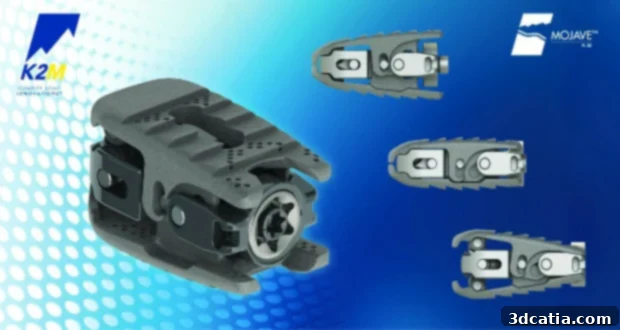
K2M’s FDA-Approved 3D-Printed Mojave Spinal Implant: Revolutionizing Lumbar Fusion Surgery
In a year marked by groundbreaking advancements in medical 3D printing, from the creation of 3D printed ovaries to innovative skin applications, the healthcare industry continues to witness transformative breakthroughs. The latest significant development comes from K2M, a global leader in complex spine and minimally invasive solutions. Headquartered in Leesburg, Virginia, K2M has proudly announced the U.S. Food and Drug Administration (FDA) 510(k) clearance for their groundbreaking 3D-printed Mojave Spinal Support Implant. This FDA approval marks a pivotal moment, ushering in a new era for advanced spinal fusion procedures and reinforcing the immense potential of additive manufacturing in improving patient care.
The FDA’s clearance is not merely a regulatory milestone; it is a profound validation of K2M’s innovative approach and the safety and efficacy of 3D printing technology in critical medical applications. For patients suffering from degenerative disc disease, spinal stenosis, or other conditions requiring lumbar fusion, this approval signifies access to a new generation of spinal implants designed for superior outcomes. It underscores the rigorous testing and meticulous design process that K2M has undertaken to meet the highest standards of medical device manufacturing, paving the way for wider adoption of 3D-printed solutions in complex surgical fields.
At the heart of this innovation is the Mojave PL 3D, an interbody fusion system meticulously engineered to offer unprecedented control and stability within the lumbar spine. Its sophisticated design provides independent control over both the anterior and posterior parts of the lumbar spine, a feature that distinguishes it from conventional implants. This independent adjustability allows surgeons to fine-tune the implant’s position and expansion, addressing the unique anatomical needs of each patient with greater precision. Such flexibility is crucial for achieving optimal sagittal balance and restoring natural spinal alignment, which are critical factors for successful fusion and long-term patient mobility.
The proprietary “Lamellar 3D Titanium Technology” developed by K2M is the cornerstone of the Mojave PL 3D’s unique capabilities. This advanced additive manufacturing process enables the creation of complex, porous structures that mimic the natural architecture of bone. Unlike solid implants, the Lamellar technology facilitates the production of implants with optimized mechanical properties, including elasticity similar to cancellous bone, which can reduce stress shielding and promote more natural load distribution. This biomimetic approach is instrumental in fostering a more conducive environment for bone integration and fusion.
One of the most remarkable features made possible by this technology is the implant’s infinite adjustability in terms of its expansion range. The Mojave PL 3D can be precisely expanded to any desired height, providing surgeons with unparalleled flexibility during the surgical procedure. This adaptability ensures a snug, custom fit for each patient’s specific spinal anatomy, optimizing construct stability and maximizing the potential for successful arthrodesis. The ability to lock the implant at any chosen height further guarantees secure placement and prevents post-operative subsidence, which is a common concern with traditional interbody devices.
Photo// lowbackpainprogram.com
To fabricate the Mojave PL 3D, K2M utilizes high-grade titanium powder combined with selective laser sintering (SLS), a sophisticated additive manufacturing process. SLS employs a high-power laser to selectively fuse small particles of titanium powder into a desired three-dimensional shape. This layer-by-layer manufacturing method allows for the creation of intricate internal geometries that would be impossible to achieve with traditional machining techniques. The precision and control offered by SLS are paramount in producing medical devices that meet the stringent requirements for safety, biocompatibility, and functional performance.
The complex internal geometries and the rough surface architecture are not merely aesthetic choices; they are functional elements critical for promoting robust bone ingrowth and ongrowth. The rough surface enhances the initial stability of the implant by increasing the friction between the device and the vertebral endplates, preventing migration. More importantly, this specific surface topography provides an ideal scaffold for osteoblasts—the cells responsible for bone formation—to adhere and proliferate. This biological integration is fundamental to achieving a strong, lasting spinal fusion, directly translating to better long-term outcomes for patients.
Thanks to their pioneering Lamellar technology, K2M has engineered a porous structure within the Mojave PL 3D that goes beyond surface roughness. This interconnected porous network throughout the implant acts as a conduit for cellular activity and vascularization, encouraging true bony integration through the end plates and into the core of the implant. Such comprehensive integration minimizes the risk of subsidence and enhances the overall stability of the spinal construct, leading to a more reliable and durable fusion. The ability to mimic the natural trabecular bone structure through advanced 3D printing is a testament to K2M’s commitment to biologically inspired design.
Eric Major, President and CEO of K2M, articulated the company’s vision and leadership, stating, “We are proud to be the global leader in 3D printing of spinal applications. We have developed internal 3D expertise that is allowing us to accelerate the rate of spinal innovation.” This statement reflects K2M’s strategic investment in additive manufacturing capabilities, fostering a team of experts dedicated to pushing the boundaries of what’s possible in spinal surgery. Their deep understanding of both clinical needs and advanced manufacturing processes places them at the forefront of developing next-generation solutions for complex spinal pathologies.
Major further emphasized the significance of the Mojave PL 3D: “As the first-ever, FDA-cleared, 3D-printed expandable interbody technology, MOJAVE PL 3D exemplifies our leadership in this space and provides surgeons the ability to expand the implant in-situ.” This distinction as the first FDA-cleared device of its kind highlights a paradigm shift in spinal surgery. The “in-situ” expansion capability means that surgeons can precisely adjust the implant’s height and lordosis after it has been inserted into the disc space. This minimizes the need for multiple implant sizes, streamlines the surgical workflow, and potentially reduces the invasiveness of the procedure, leading to improved surgical efficiency and patient safety.
The implications for surgeons are profound. The Mojave PL 3D offers enhanced control and adaptability, allowing for more tailored and precise surgical reconstructions. This level of customization can lead to better anatomical fit, optimized load sharing across the fusion segment, and a reduced risk of complications. For patients, these advantages translate into potentially faster recovery times, decreased post-operative pain, and a higher likelihood of achieving solid, long-lasting spinal fusion. This innovation signifies a major step forward in addressing the complex challenges associated with lumbar interbody fusion.
The approval of the Mojave PL 3D reinforces the growing trend of patient-specific medical solutions made possible by 3D printing. This technology allows for the creation of devices that are not just standard sizes, but truly optimized for individual patient anatomies and pathologies. Such personalization can lead to more effective treatments, better surgical outcomes, and an overall improvement in the quality of life for individuals suffering from chronic spinal conditions. K2M’s success with the Mojave PL 3D serves as a powerful example of how additive manufacturing is driving the future of personalized medicine.
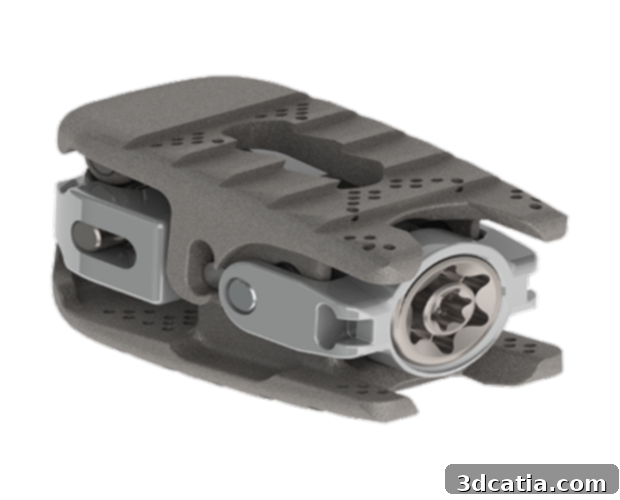
The MOJAVE PL 3D printed spinal lumbar photo// K2M
What does this FDA approval signify for the broader future of 3D printing in medicine? It signals a strong regulatory acceptance and confidence in the technology for even the most critical applications. This precedent is likely to accelerate research, development, and commercialization of other complex 3D-printed medical devices, from custom prosthetics and orthotics to bioreactor-grown tissues and organs. The ability to create intricate, patient-specific implants with advanced biological integration properties opens up new frontiers in surgical planning, regenerative medicine, and drug delivery systems, promising a future where healthcare is even more tailored, effective, and accessible.
In conclusion, K2M’s FDA approval of the 3D-printed Mojave Spinal Support Implant is a landmark achievement, solidifying its position as an innovator in the spinal surgery market. By leveraging their distinctive Lamellar 3D Titanium Technology and selective laser sintering, K2M has delivered an expandable interbody device that addresses critical clinical needs through precision, adaptability, and enhanced bone integration. This innovation not only elevates the standard of care for lumbar fusion surgery but also serves as a beacon for the ongoing revolution of additive manufacturing in transforming the landscape of medical science and patient treatment globally.
For more detailed information, you can find K2M’s official press release here.
What do you think their FDA approval means for the future of 3D printing in medicine? Share your thoughts in a comment below, or join the discussion on our Facebook and Twitter pages. Don’t forget to sign up for our free weekly Newsletter to receive all the latest news and advancements in 3D printing delivered straight to your inbox!