
Unlocking Metrology-Grade Precision: A Comprehensive Guide to the Shining 3D FreeScan UE Pro 3D Scanner
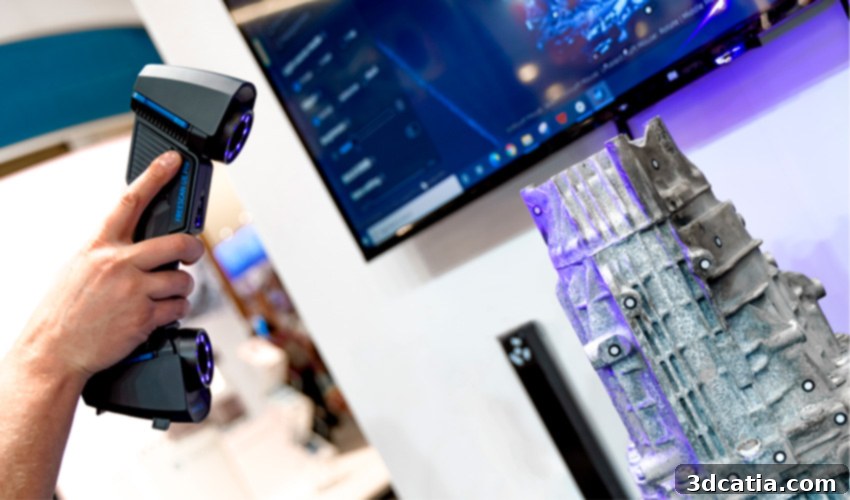
In the rapidly evolving landscape of industrial metrology and 3D scanning, the demand for high-precision, versatile, and user-friendly solutions is ever-increasing. Responding to this need, Shining 3D has introduced a groundbreaking addition to its FreeScan series: the FreeScan UE Pro. This state-of-the-art portable 3D scanner represents a significant leap forward from its predecessor, the FreeScan UE, by integrating a suite of advanced features designed to meet the most stringent professional requirements. As a multifunctional 3D metrology solution, the FreeScan UE Pro is engineered to tackle an extensive array of applications across diverse industries, from quality inspection and reverse engineering to product development and additive manufacturing. Its exceptional capability lies in its flexibility to handle objects of varying sizes, coupled with its ability to deliver metrology-grade precision inspections.
One of the most distinguishing features of the FreeScan UE Pro is its innovative integrated photogrammetry function. This powerful technology plays a crucial role in enhancing overall measurement accuracy, particularly when scanning large objects. By precisely aligning data points within the scanning space, it significantly reduces cumulative errors, ensuring consistent and reliable results even across vast surfaces. This article aims to delve deeper into the capabilities of this remarkable 3D scanner and its advanced photogrammetry technology. We will address common questions users might have, provide insights into its operation, and offer practical tips to help you maximize the benefits of this cutting-edge metrology tool.
Distinguishing Features: FreeScan UE Pro Versus Other 3D Scanners
When a leading manufacturer like Shining 3D launches a new product, the immediate question that arises for many is: how does it stand apart from existing solutions, both within its own portfolio and from competitors? Shining 3D’s range of advanced handheld 3D scanners includes formidable devices such as the EinScan HX and the FreeScan UE. The FreeScan UE Pro, however, carves out a unique niche as a multifunctional, portable, and exceptionally precise solution, specifically optimized for metrology-grade inspection and high-accuracy applications. Its design philosophy centers around delivering unparalleled accuracy and efficiency across a broad spectrum of industrial use cases.
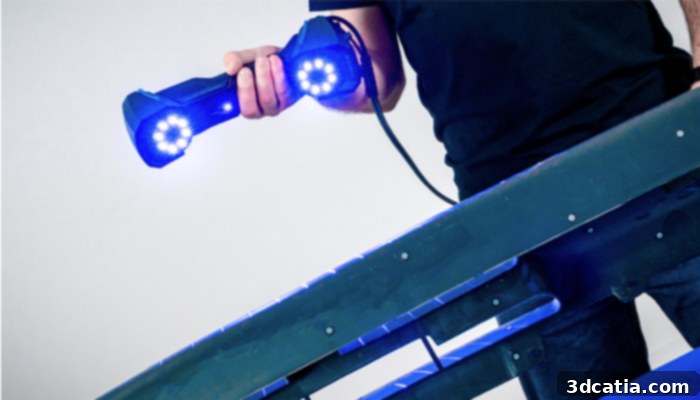
A core differentiator of the FreeScan UE Pro is the seamless integration of photogrammetry technology. As a technique that provides highly accurate spatial data from a series of photographs, its integration into a handheld 3D scanner significantly enhances overall measurement integrity, especially for large-scale projects. Beyond photogrammetry, the FreeScan UE Pro boasts a highly advanced and adaptable 3D scanning mode architecture. It features 13 cross laser lines for rapid scanning of large objects, allowing users to capture extensive areas quickly and efficiently. For intricate details, five parallel laser lines are employed, ensuring fine features are captured with exceptional resolution. Furthermore, a single laser line mode is available for deep hole and pocket area scanning, addressing geometries that are often challenging for other scanners. This comprehensive suite of scanning modes empowers the FreeScan UE Pro to effectively capture data from all types of objects, regardless of their size or geometric complexity, making it an incredibly versatile tool for diverse industrial challenges.
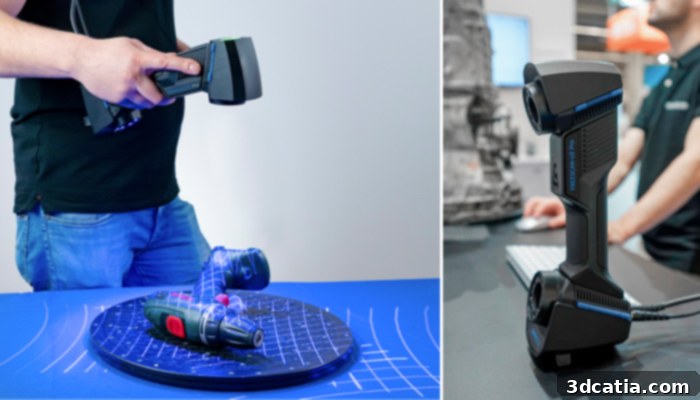
Comparing the FreeScan UE Pro with other Shining 3D solutions reveals a clear progression in technological capability. The FreeScan UE, for instance, is a highly capable multifunctional manual laser 3D scanner offering two scanning modes based on 7 or 11 cross lines and a single line. While excellent for many applications, the UE Pro expands upon this by offering more laser lines (13 cross lines) for faster, more comprehensive coverage and improved performance on larger objects, as well as the integrated photogrammetry. The EinScan HX, on the other hand, stands out for its hybrid blue laser and LED light source, excelling at scanning textures and aligning object reference points. While the EinScan HX is remarkable for its color and texture capture, the FreeScan UE Pro prioritizes metrology-grade accuracy and efficiency, especially for large-scale industrial inspection and measurement where ultimate precision is paramount.
The Power of Integrated Photogrammetry: Enhancing Accuracy for Large-Scale Scanning
The integrated photogrammetry technology is undoubtedly one of the most compelling features of the FreeScan UE Pro, setting it apart as a true industrial metrology instrument. In conventional 3D scanning workflows, particularly when dealing with extensive or irregularly shaped objects, cumulative alignment deviation can become a significant challenge. As data is captured and aligned incrementally, minor errors can compound, leading to inaccuracies over larger distances. The FreeScan UE Pro’s integrated photogrammetry effectively addresses this critical issue by establishing a precise spatial frame that serves as an unwavering reference for data alignment *before* the point cloud scanning even begins.
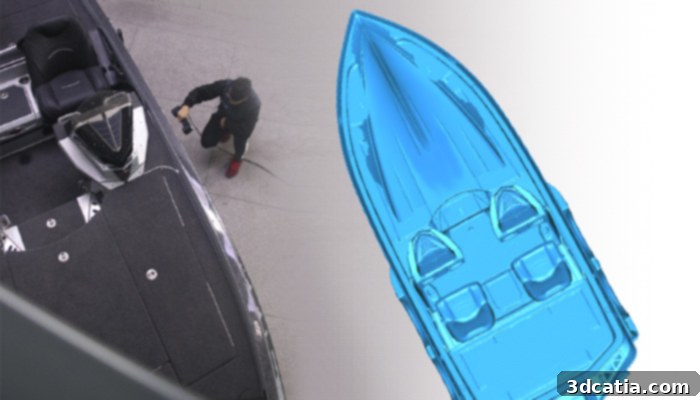
This process works by initially capturing a series of photographs of the object. These images are then processed to create a highly accurate “spatial frame” or global coordinate system. This frame acts as a fixed, stable reference for the subsequent 3D scan data. When scale bars are used in conjunction with the photogrammetry system, their reference information further optimizes this spatial frame, ensuring even higher quality and accurate results. This preliminary step dramatically reduces the likelihood of alignment errors that typically plague large object scanning. The result is an impressive scanning accuracy of 0.02mm + 0.015mm/m in its built-in photogrammetry mode. To put this into perspective, for parts extending over 8 meters in length, the maximum deviation accuracy remains remarkably low, approximately 0.14 millimeters (calculated as 0.02 + 0.015 × 8 = 0.14 mm). Such precision is indispensable for applications requiring tight tolerances, such as quality control of large castings, automotive bodies, or aerospace components.
Furthermore, the FreeScan UE Pro distinguishes itself by employing a binocular photogrammetry system. In many other systems, especially those using monocular photogrammetry, users would typically need to apply coded targets (small, adhesive markers) to the object’s surface to help the software establish reference points. These targets require careful placement and can add time and effort to the setup process. However, with its advanced binocular photogrammetry, the FreeScan UE Pro eliminates the need for coded targets. The dual camera system can more easily and accurately determine the three-dimensional space and establish the necessary spatial frame without additional markers. This not only streamlines the workflow but also allows for the capture of more complete photos and angles, leading to more robust overall precision control during data calculation. As Shining 3D experts explain, “While coded targets are often used in photogrammetry systems, the FreeScan UE Pro’s binocular photogrammetry system can more easily and accurately determine three-dimensional space without them.” This innovation significantly enhances user convenience and accelerates the scanning process, particularly for large-scale industrial applications where efficiency is key.
FreeScan UE Pro: Technical Specifications and Optimized Workflow
Understanding the technical specifications and operational nuances of any 3D scanner is crucial for maximizing its utility. The FreeScan UE Pro offers several features that significantly enhance its performance and user experience. For instance, scanning challenging surfaces such as dark or translucent parts typically requires the application of matting sprays to reduce reflectivity and ensure accurate data capture. However, with the FreeScan UE Pro, this step is often unnecessary. Users can simply configure the surface type within the scanner’s intuitive software, and the device intelligently adjusts its parameters to effectively scan these difficult materials, saving valuable time and consumables. It’s important to note, however, that while it excels in geometric accuracy, the FreeScan UE Pro is not designed for full-color part scanning, focusing instead on precise spatial data.
The scanner achieves a remarkable maximum resolution, boasting a spot distance of 0.01mm in its fine scan mode, as recommended by Shining 3D for capturing the most intricate details. This level of resolution is critical for applications that demand meticulous data, such as reverse engineering delicate components, inspecting complex molds, or analyzing small mechanical parts with tight tolerances. Beyond precision, the FreeScan UE Pro also features a unique fast speed option. This mode allows users to significantly increase the frame rate (up to 180 frames per second), which is ideal when speed is prioritized over ultimate detail, for instance, during preliminary scans of large objects or when working with less geometrically complex components. This flexibility allows operators to tailor the scanning process to the specific requirements of each task, optimizing both speed and accuracy.
Another standout feature is the HD partial scan functionality. This intelligent capability allows users to selectively focus on specific areas of an object that require a higher level of detail, without needing to rescan the entire part at maximum resolution. The workflow is streamlined: users can first employ the faster cross-line scanning mode to quickly capture the overall geometry of the object. Once this initial scan is complete, they can then select a specific area of interest and switch to parallel lines, increasing the resolution to obtain high-definition data only where it’s most needed. This dual-mode approach offers unparalleled efficiency, combining rapid global scanning with targeted, high-resolution detail capture.
Once the physical models have been digitized, the FreeScan UE Pro integrates seamlessly into a broader digital workflow. The captured data can be easily exported and subjected to a comprehensive range of post-processing operations using appropriate software. These essential post-processing tools include mesh simplification to reduce file size while maintaining critical geometry, mesh optimization for improved rendering and analysis, smoothing to refine surface quality, removal of small floating parts to clean up unwanted data, automatic and manual hole filling to create watertight models suitable for 3D printing or CAE analysis, and cutting plane tools for precise sectioning and measurement. This robust post-processing capability ensures that the raw scan data is transformed into a clean, optimized, and ready-to-use digital model for any subsequent engineering, manufacturing, or inspection application.
In essence, the Shining 3D FreeScan UE Pro is more than just a 3D scanner; it’s a comprehensive metrology solution. Its fusion of portability, advanced multi-line laser scanning, and integrated binocular photogrammetry makes it an indispensable tool for professionals seeking uncompromising precision and efficiency in their industrial workflows. With its ability to effortlessly digitize a vast array of surfaces and objects, from minute details to sprawling structures, the FreeScan UE Pro empowers users to achieve superior results in quality control, reverse engineering, product design, and more. To explore its full potential and detailed specifications, we encourage you to visit the official Shining 3D website HERE.
What are your thoughts on the innovative FreeScan UE Pro? We would love to hear your insights! Share your comments below or connect with us on our Facebook, Twitter, and LinkedIn pages. Don’t miss out on the latest advancements in 3D printing and scanning technology; sign up for our free weekly Newsletter here to receive direct updates to your inbox!
*Cover Photo Credits: Shining3D