
Revolutionizing Sound: The Impact of 3D Printing on Music and Instruments
The world of music is constantly evolving, embracing new technologies to enhance creativity, performance, and accessibility. As we approach global celebrations like the Fête de la Musique (also known as World Music Day), it’s a perfect time to explore how additive manufacturing, commonly known as 3D printing, is transforming this vibrant industry. 3D printing has emerged as a groundbreaking force, offering significant advantages to both companies and individual artists looking to innovate their musical projects. From custom-designed instruments and unique accessories to advanced speakers and headphones, 3D printing is rapidly becoming indispensable in the music sector, enabling unprecedented levels of customization, rapid prototyping, and material innovation. This article delves into some of the most exciting applications of 3D printing across various facets of music, showcasing its profound influence at every level of creation and performance.
The Travel Sax: Portable Musical Innovation
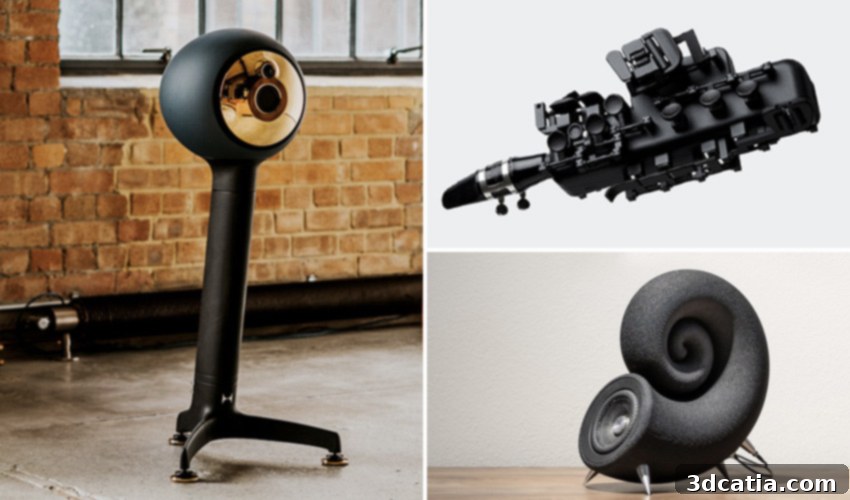
For musicians who desire to carry their passion wherever they go, the concept of a truly portable instrument is a dream come true. The Travel Sax, an innovative 3D printed electric saxophone developed by the Spanish company Odisei Music, perfectly embodies this ideal. Designed for ultimate portability, this compact instrument measures a mere 8.7 x 5 x 3.1 inches (22 x 12.8 x 8 cm) and weighs approximately 0.5 lbs (225g), making it incredibly easy to transport without compromise. The complete package extends beyond the instrument itself, including a protective case, an accessory bag, a cleaning cloth, a charging cable, and three mouthpiece adapters suitable for soprano, tenor, and baritone styles. Odisei Music leverages HP’s Multi Jet Fusion technology for the Travel Sax’s production, utilizing PA12 as the primary material. This choice of material and manufacturing process ensures not only a lightweight yet durable instrument but also delivers a uniform and elegant final finish, reflecting both aesthetic appeal and robust functionality. The Travel Sax represents a significant leap in instrument design, offering musicians unprecedented freedom to practice and perform on the go, showcasing the power of 3D printing in creating highly specialized and user-centric musical devices.
Songbird Vinyl: The DIY 3D Printed Turntable Kit
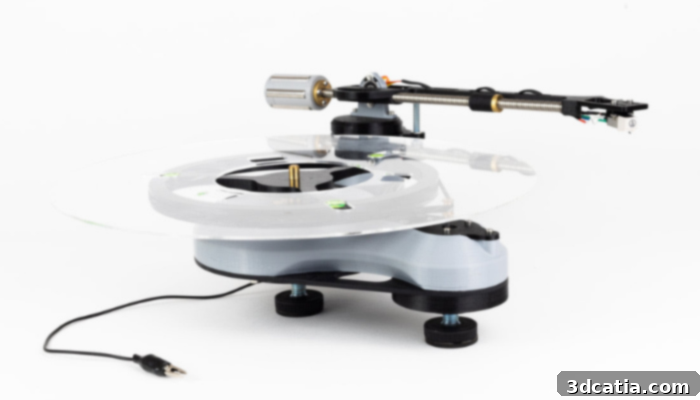
Reinventing how enthusiasts engage with vinyl records, the SongBird is a pioneering 3D printable turntable kit introduced by British startup Frame Theory 3D. Originally scheduled for release in October, this project gained significant traction through a highly successful Kickstarter campaign, raising over £25,442 (approximately $35,952) from 167 passionate backers. This initiative democratizes access to turntable technology, allowing users to choose between two convenient options: a fully printed kit, which arrives with all necessary parts pre-manufactured, or a “maker” kit, specifically designed for individuals who prefer to 3D print the components themselves using an FDM machine. Irrespective of the chosen kit, the assembly process is remarkably straightforward, requiring less than two hours. Once assembled, users can immediately enjoy playing their full-length records. The SongBird project highlights how 3D printing can empower consumers to build sophisticated electronics at home, fostering a deeper connection with their music and the technology that brings it to life. This innovative approach not only reduces manufacturing costs but also offers a unique hands-on experience for audiophiles and DIY enthusiasts alike.
Nik Huber Guitars: Precision 3D Printed Components
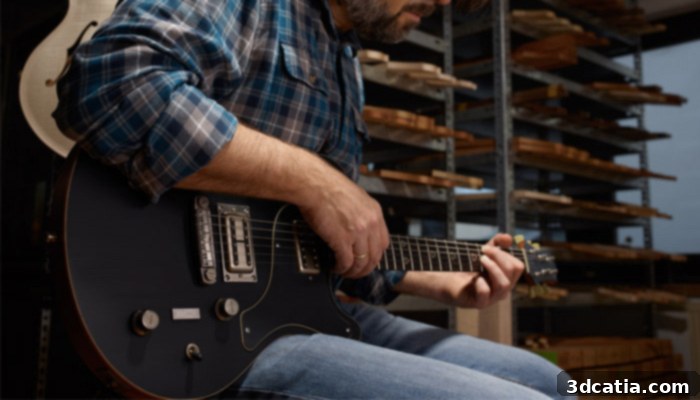
Established in 1996, Nik Huber Guitars has built a reputation for crafting exquisite, high-quality handcrafted guitars. In a recent innovative collaboration with Heraeus, the company ventured into the realm of additive manufacturing to 3D print an electric guitar’s bridge. The bridge is a crucial component that allows for precise adjustment of string height and plays a significant role in the instrument’s resonance and sustain. For this project, an amorphous metal was specifically chosen to fabricate the bridge. This material choice was pivotal in achieving significantly lower vibration absorption during playing compared to traditional manufacturing methods and materials. The result is a richer, purer tone with enhanced sustain. Furthermore, Nik Huber Guitars emphasizes that this advanced material provides superior strength and durability when juxtaposed with conventionally used materials such as steel, brass, aluminum, or other similar alloys. The integration of 3D printing and advanced materials in crafting such critical components undoubtedly demonstrates how modern technologies are elevating the performance and longevity of meticulously crafted instruments, providing a competitive edge for companies like NHG in the high-end guitar market.
The 3DVarius Violin: A New Era of Electric Violins
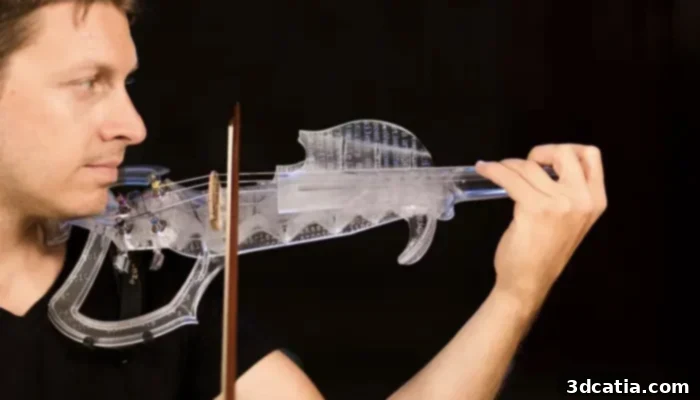
In 2015, French engineer and musician Laurent Bernadac founded 3Dvarius, a company whose name cleverly plays on the legendary Stradivarius instruments. 3Dvarius is dedicated to revolutionizing electric violin design and production through one-piece additive manufacturing. The initial spark for this ambitious venture came to life through a successful Kickstarter campaign, which impressively raised over $59,000 (€50,000). Since then, 3Dvarius has established its own distinctive line of 3D printed violins, characterized by exceptionally original and futuristic designs. The company currently offers four different models, with the flagship instrument bearing the company’s and founder’s name, the 3Dvarius, being the most recognized. Other unique models include the Line, Prism, and Equinox violins, each showcasing distinct aesthetic and ergonomic qualities. Laurent Bernadac has actively demonstrated the diverse musical capabilities of these 3D printed violins through his captivating YouTube channel, inspiring musicians worldwide. His pioneering work has opened up exciting possibilities for enthusiasts and professionals alike to own a high-performance, custom-designed 3D printed violin, blending traditional artistry with cutting-edge manufacturing technology.
The Wave: Visually Stunning 3D Printed Speakers
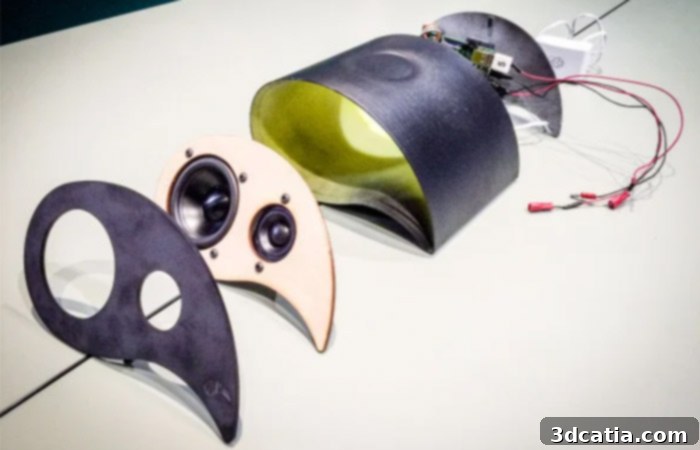
For any true audiophile, the quality of sound produced by speakers can profoundly impact the listening experience. While speakers come in a myriad of shapes, colors, and sizes, “The Wave” stands out by transforming sound waves into a tangible visual symbol through its distinctive 3D-printed design. This unique loudspeaker concept originated from an engineering and design course at the Technical University of Denmark, where students were tasked with constructing a loudspeaker using additive manufacturing in a mechatronics curriculum. The innovative design of “The Wave” allows for complex geometries that would be difficult or impossible to achieve with traditional manufacturing methods, symbolizing the very essence of sound in its physical form. Functionally, this 3D-printed speaker is powered by a Raspberry Pi and features a WIFI connection, enabling users to stream music directly from their mobile phones. For those interested in delving into additive manufacturing themselves and recreating this remarkable speaker, comprehensive design files and instructions are readily available on the Thingiverse platform, fostering a community of DIY audio enthusiasts. “The Wave” not only delivers exceptional sound but also serves as a piece of sculptural art, merging high-fidelity audio with avant-garde design made possible by 3D printing.
Specdrums: Blending Music and Colors Through 3D Printing
Specdrums offer a fascinating fusion of colors, 3D printing, and musical expression. These ingenious small rings, created through additive manufacturing, are designed to be worn on the fingers, allowing users to transform any color they touch into music. The innovative technology embedded within Specdrums features sensors located on their underside, capable of accurately identifying the color beneath them. This color information is then wirelessly transmitted to a smartphone or tablet, where a dedicated app converts it into a musical note or sound, enabling users to create melodies simply by tapping different colored surfaces. Specdrums boast an extensive database of sounds, providing a wide array of options ranging from classic piano tones to various animal sounds, offering immense creative freedom. This allows musicians, educators, and hobbyists to explore new ways of composing and interacting with music, making learning and experimentation both intuitive and fun. Specdrums exemplify how 3D printing can be utilized to produce sophisticated, miniaturized electronic devices that offer novel interactive experiences, bridging sensory input with artistic output.
Open e-drums by Ryo Kosaka: Accessible Electronic Drum Kits
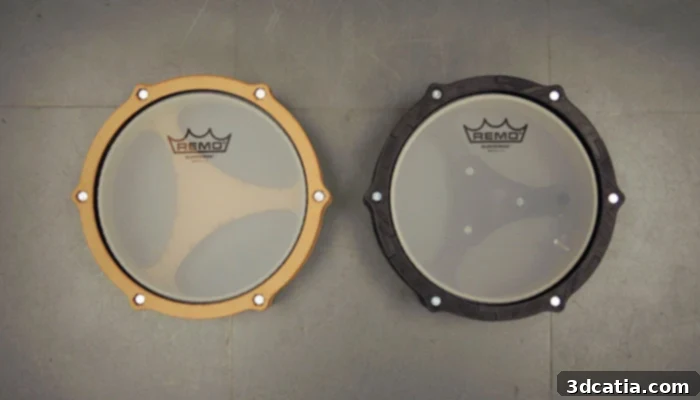
Ryo Kosaka’s open-source e-drums project is a testament to the power of passion and accessible technology. This innovative endeavor began when Kosaka, a design student from Kyoto, stumbled upon a Drum Mania controller in a second-hand store. Inspired by his find, he dedicated his spare time to developing an electronic drum kit that is now freely available to the public. Remarkably, Kosaka, without extensive prior expertise, successfully engineered a functional electronic drum kit by combining Arduino microcontrollers with 3D printing technology. He notes that a standard 3D printer with a modest print bed size of 150 x 150 mm is sufficient for manufacturing the crucial mesh pads of the drum kit. For those without a 3D printer, an alternative method involving a laser cutter and MDF can be used to create 12-inch mesh pads. This project not only showcases the versatility of 3D printing in creating complex musical instruments but also emphasizes the growing open-source movement in hardware development. Ryo Kosaka’s e-drums empower aspiring drummers and makers worldwide to build their own customizable electronic percussion setups, proving that high-tech music instruments can be created affordably and accessibly.
Olaf Diegel’s ODD Guitars: Pioneering 3D Printed Electric Guitars
Olaf Diegel has long been recognized as a trailblazer in the field of 3D printed musical instruments. Several years ago, he captured widespread attention with his innovative 3D printed aluminum electric guitar. This groundbreaking instrument leveraged the unique capabilities of 3D printing and advanced materials to achieve a lightweight, highly customizable design that posed a significant challenge to traditional electric guitar manufacturing. Since his initial success, Diegel has substantially expanded his pioneering work. His brand, ODD Guitars, now employs Selective Laser Sintering (SLS) technology, primarily utilizing durable nylon instead of aluminum for the outer shells. To ensure optimal sound quality and structural integrity, each guitar incorporates a wooden core. ODD Guitars offers a diverse range of striking designs, including the iconic “Xenomorph” (inspired by the film Alien) and the “American Graffiti,” alongside other distinctive 3D printed instruments such as bass guitars, drum kits, and even a fully 3D printed saxophone. Diegel’s creations exemplify how additive manufacturing allows for intricate, avant-garde aesthetics combined with professional-grade musical performance, pushing the boundaries of instrument design and personalization.
Monad Studio: Futuristic 3D Printed Music Instruments as Art
Monad Studio, an architectural firm known for its avant-garde designs, has transcended traditional boundaries by developing an extraordinary collection of five futuristic 3D printed music instruments. This remarkable ensemble includes a piezoelectric violin, a didgeridoo, a unique “monobarisbasitar” (a form of small bass instrument), a cello, and a “hornucopia” — a visually striking instrument resembling a cornucopia or horn of plenty. The design process for each instrument was meticulously detailed and time-intensive, requiring between three to six months of dedicated work to perfect the intricate geometries and functional elements. In stark contrast, the actual 3D printing phase for all five instruments was incredibly rapid, taking only ten days to complete. The designers acknowledge that post-processing, including finishing and retouching, is often necessary once the parts emerge from the printer. However, they confidently assert that certain instrument types, particularly wind instruments, could potentially be manufactured entirely through advanced 3D printing technologies without significant post-processing. Monad Studio’s collection blurs the lines between sculpture, architecture, and musical instrumentation, showcasing the immense potential of additive manufacturing to create truly unique, playable art pieces that challenge conventional perceptions of musical instruments.

The Heartbeats Project: Printing Your Heartbeat into Music
In 2016, Polish DJ Piotr Bejnar embarked on a profoundly unique and interactive musical endeavor known as the “Heartbeats Project.” His vision was to deepen the audience’s involvement in his performances by integrating their collective heartbeats directly into the music. Bejnar conceptually viewed the human heart as a natural drum, whose rhythm offers a perfect, organic foundation for musical production. To bring this innovative concept to fruition, he ingeniously turned to 3D printing. Utilizing the Zortrax M200 3D printer, Bejnar was able to cost-effectively produce an array of specialized wristbands. These wristbands were then distributed among the audience, designed to wirelessly transmit each individual’s heart pulse to the DJ booth. This real-time biometric data was subsequently incorporated into the live music, creating a truly synchronized and communal experience between the DJ and the crowd. The Heartbeats Project stands as a compelling example of 3D printing’s capacity to facilitate novel interactive experiences, demonstrating its exciting application in blending technology, music, and human physiology to create unforgettable live performances.

SYOS: Custom 3D Printed Mouthpieces for Saxophones and Clarinets
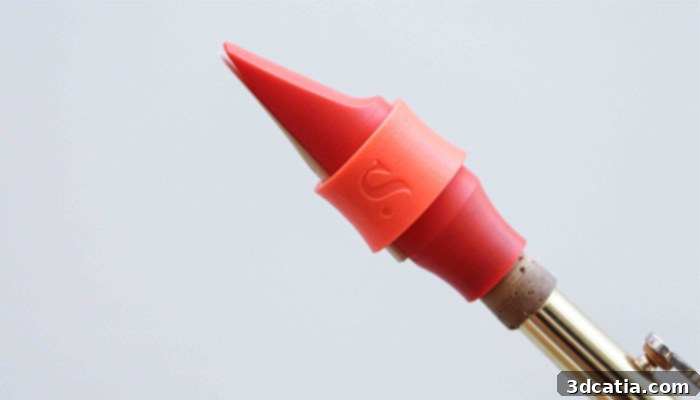
SYOS (Shape Your Own Sound), a pioneering French startup, is dedicated to elevating the musical experience for wind instrument players by developing custom 3D printed saxophone and clarinet mouthpieces. Their core mission is to provide musicians with unparalleled sound quality and personalized comfort. Each mouthpiece is meticulously custom-made, with its design precisely tailored based on comprehensive advice from acoustic experts and the specific preferences of the musician. This bespoke approach ensures that every player receives a mouthpiece perfectly suited to their embouchure, playing style, and desired tonal characteristics. Fabricated from durable and resonant ABS material, the mouthpieces are available in a vibrant array of colors, allowing for both aesthetic customization and personalized performance. SYOS offers a unique 30-day trial period, enabling musicians to thoroughly test their custom mouthpiece and ensure it meets their exacting standards. Today, SYOS proudly collaborates with over 500 musicians each month, a testament to their success in combining advanced additive manufacturing with acoustic expertise to truly shape the sound of professional and aspiring wind instrumentalists.
LEET Synthesizer: An Open-Source, 3D Printable Synth
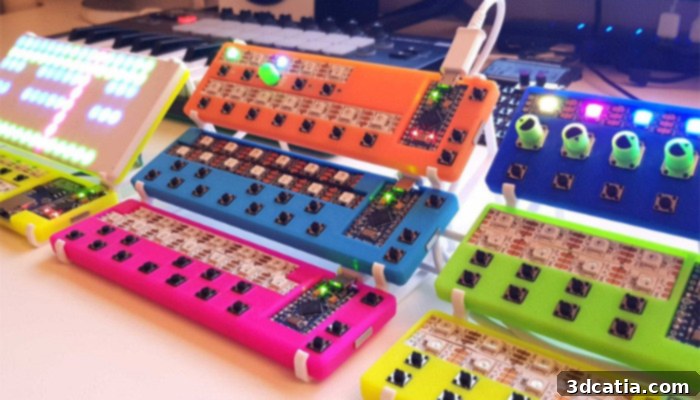
The LEET Synthesizer, an ingenious open-source project by Swedish engineer Johan Von Konow, offers music enthusiasts the exciting opportunity to construct their own synthesizer at home. This compact electronic instrument is remarkably affordable to build, with total material costs amounting to just around $6. However, prospective builders should possess some foundational skills in soldering and programming embedded electronics to successfully complete the project. The synthesizer itself is encased in a vibrant, customizable 3D printed shell, drawing aesthetic inspiration from the classic computers of the 1970s, giving it a distinct retro-futuristic charm. This shell elegantly houses a custom-designed printed circuit board (PCB), forming the core of its electronic functionality. Von Konow intentionally designed the LEET Synthesizer to be simplistic, engaging, and enjoyable to assemble and use. The 3D printing of the shell can be completed in approximately four hours, followed by an additional two hours for the soldering process. This project exemplifies how 3D printing can facilitate the creation of accessible, educational, and fun electronic musical instruments, fostering a community of DIY makers and musicians.
Node Audio: Acoustically Optimized 3D Printed Speakers
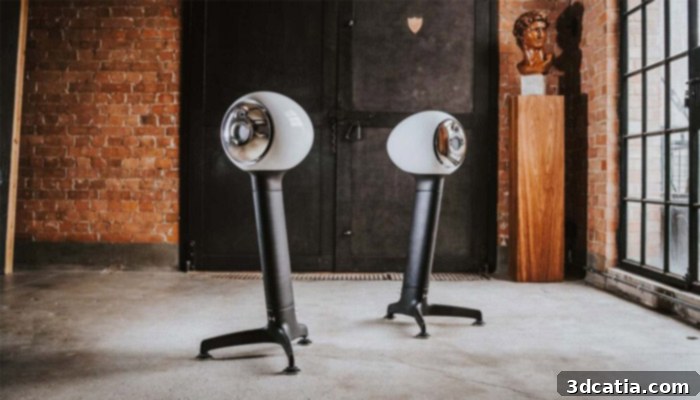
Node Audio, a UK-based company, is rapidly gaining recognition for its commitment to delivering superior quality speakers and an unparalleled audio experience. Their flagship product, the Hylixa speaker, is a groundbreaking achievement in audio engineering, largely made possible through the strategic integration of additive manufacturing, specifically utilizing SLS (Selective Laser Sintering) and MJF (Multi Jet Fusion) processes. The Hylixa speaker boasts an astonishing and unconventional shape: instead of adhering to the traditional flat panels and square edges, its design features an intricate helix-like structure that gives it a distinct rounded, organic form. This complex geometry is virtually impossible to achieve through conventional manufacturing techniques, underscoring the critical role of 3D printing in its creation. The speaker’s head component is 3D printed using glass-fiber filled nylon, a material chosen for its exceptional acoustic properties, which contribute to the speaker’s pristine sound reproduction. Furthermore, the feet and neck of the Hylixa speaker are precisely manufactured using an HP Multi Jet Fusion machine, ensuring structural integrity and aesthetic consistency. Node Audio’s Hylixa speaker is a prime example of how 3D printing enables the design and production of acoustically optimized, geometrically complex, and visually striking audio equipment that sets new industry standards.
Amanda Ghassaei and Her 3D Printed Vinyl Records
Engineer and artist Amanda Ghassaei pioneered a fascinating technique to bridge the gap between digital audio and physical media through 3D printing. She developed a method for converting digital audio recordings into playable 3D printable LPs, which can then be played on standard turntables. This audacious project required not only a sophisticated 3D printer, specifically a Stratasys Objet Connex 500, but also Ghassaei’s exceptional programming skills, as she authored her own software for the intricate 3D modeling part of the process. The resulting 3D printed vinyl records, while a remarkable feat of engineering, do come with a caveat: Ghassaei openly acknowledges that the sound quality is inherently lo-fidelity compared to conventionally pressed vinyl. Despite this, the project is unequivocally a success from an innovative and conceptual standpoint. It demonstrates the incredible versatility of 3D printing to materialize abstract data into tangible, functional objects, challenging our perceptions of how music can be stored, distributed, and experienced. Ghassaei’s work is a testament to the creative freedom and experimental possibilities that additive manufacturing offers to artists and engineers alike.
DEEPTIME: 3D Printed Speakers Made Out of Sand
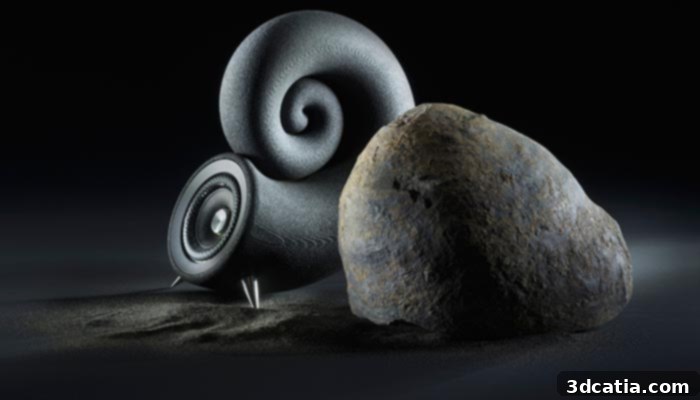
For discerning audiophiles seeking an alternative to conventional speaker designs, DEEPTIME, a Polish startup combining design and engineering expertise, presents a uniquely stylish and innovative option: 3D-printed speakers crafted entirely from sand. These speakers boast a distinctive shell-shaped design, pushing the boundaries of aesthetic and acoustic engineering. DEEPTIME’s journey into sand-based additive manufacturing was a result of persistent innovation. After initial attempts to additively manufacture speakers using wood proved challenging, the company pivoted its research towards the possibilities of sand 3D printing. This change in material and process unlocked new design freedoms and acoustic properties. In a detailed joint interview, DEEPTIME founders Ondrej Chotovinsky and Martin Hreben shared profound insights into their creative process, the challenges they faced, and the pioneering techniques they developed. Their work underscores how additive manufacturing, even with unconventional materials like sand, can be leveraged to produce high-fidelity audio equipment that is both visually stunning and acoustically superior, redefining the aesthetics and performance benchmarks for modern loudspeakers.
Sandvik’s Indestructible 3D Printed Guitar
While many 3D printed music instruments incorporate additive manufacturing for specific parts or limited editions, Swedish company Sandvik pushed the boundaries even further in 2019 by designing and producing the world’s first virtually indestructible 3D printed guitar. This engineering marvel was famously put to the ultimate test by renowned Swedish guitarist Yngwie Malmsteen during a live performance, who, despite his best efforts, was unable to demolish it. The secret to its resilience lies in Sandvik’s meticulous design and material selection. During the development process, particular attention was paid to the guitar neck and fingerboard, traditionally the most vulnerable areas of a guitar. These critical components were precision-milled from solid bars of recycled stainless steel, ensuring unparalleled strength and stability. For the guitar body, Sandvik employed titanium powder in a specialized metal 3D printing process. This choice of material and manufacturing technique allowed for the creation of a body that is exceptionally stable, durable, and surprisingly lightweight, offering a perfect balance of robustness and playability. Sandvik’s indestructible guitar not only showcases the extreme capabilities of industrial 3D printing in metal but also offers a glimpse into a future where instruments can withstand the most rigorous demands of touring and performance, combining cutting-edge technology with practical application for musicians.
The integration of 3D printing into the music industry has moved far beyond novelties, becoming a powerful tool for innovation, customization, and artistic expression. From portable instruments to custom accessories, high-fidelity speakers, and even interactive musical experiences, additive manufacturing is consistently demonstrating its potential to redefine how music is made, played, and enjoyed. The examples highlighted here underscore a significant shift: 3D printing is not just for prototyping anymore; it’s a viable and often superior method for producing final, high-performance musical products. As technology continues to advance, we can anticipate even more groundbreaking applications that will further empower musicians, designers, and enthusiasts alike. The future of music is undoubtedly being shaped, note by note, through the limitless possibilities of 3D printing.