
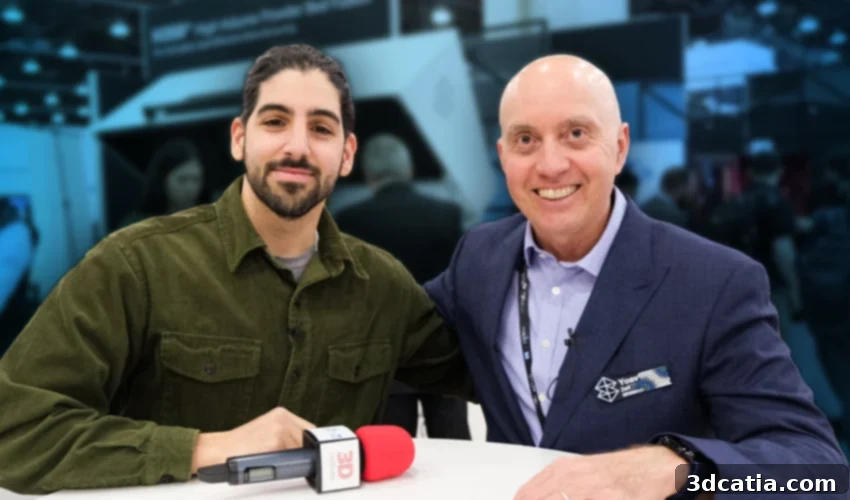
Unlocking the Future of Additive Manufacturing: Stratasys’ Yoav Zeif on 2025 Trends and the Revolutionary Neo®800+ SLA 3D Printer
The year 2025 is poised to be a pivotal period for the additive manufacturing industry. Faced with a complex global landscape characterized by evolving geopolitical dynamics, rapid technological advancements, and shifting market equilibria, the 3D printing sector is bracing for significant transformation. To gain deeper insights into these emerging trends and understand the strategic direction the industry is likely to take, 3Dnatives recently had the exclusive opportunity to connect with Yoav Zeif, the esteemed CEO of Stratasys, during his attendance at RAPID + TCT 2025. This insightful discussion shed light on how industry leaders are preparing to navigate both the challenges and opportunities that lie ahead.
In an exclusive, in-depth interview, Filippos Voulpiotis, Managing Director of 3Dnatives, engaged with Yoav Zeif on a range of pressing topics shaping the additive manufacturing landscape. Key discussion points included the potential ramifications of U.S. tariffs on global supply chains, the burgeoning and rapid expansion of the Asian market, and the increasingly indispensable role of additive manufacturing (AM) within the broader advanced manufacturing ecosystem. Zeif articulated a clear vision, emphasizing areas where the industry can find renewed hope and, critically, how to strategically convert these challenging times into concrete opportunities for growth and innovation. Stratasys, under Zeif’s leadership, is actively demonstrating this forward-thinking approach by channeling its efforts into developing cutting-edge industrial solutions. These solutions are meticulously designed to simplify the professional workflow, enhance operational efficiency, and consistently deliver superior quality and performance across diverse applications.
A highlight of Stratasys’ presence at RAPID + TCT 2025 was the much-anticipated launch of its new Neo®800+ machine. This innovative system promises to be a groundbreaking development in the realm of large-format resin 3D printing. This article will delve into what this significant launch means not only for Stratasys but also for the wider additive manufacturing market, examining its features, capabilities, and the strategic rationale behind its introduction.
Key Insights from Yoav Zeif: Navigating Industry Challenges and Global Shifts
Yoav Zeif provided a comprehensive perspective on the current state and future trajectory of additive manufacturing. He highlighted the significant impact of macroeconomic factors and geopolitical shifts on the industry. The ongoing discussion around U.S. tariffs, for example, is not merely a political talking point but a critical element influencing global manufacturing strategies and supply chain resilience. Zeif suggested that these tariffs, while creating immediate challenges, also accelerate a re-evaluation of manufacturing locations and capabilities, potentially boosting domestic or regional additive manufacturing investments. This shift could lead to a new phase for the AM market, one focused on localized, agile production.
Furthermore, Zeif underscored the exponential growth of the Asian market, particularly China, as a dominant force in additive manufacturing. This expansion presents both immense opportunities and competitive pressures for Western companies. Stratasys, like many global players, recognizes the necessity of a robust strategy to engage with and benefit from this dynamic market. The emphasis on advanced manufacturing, where AM plays a central role, is globally consistent, pushing industries towards greater efficiency, customization, and sustainable production methods. Zeif’s optimism for the industry stems from its inherent ability to adapt and innovate, transforming obstacles into stepping stones for technological and market advancement.
Stratasys’ Strategic Focus: The Three Pillars of Industrial AM
During the interview, Yoav Zeif elaborated on Stratasys’ long-term strategic vision, intricately linking it to the company’s most recent product launch: the Neo®800+ SLA machine. This advanced system represents a significant evolution of its predecessor, the Neo®800. The introduction of the Neo®800+ is not an isolated event but a carefully calculated move within Stratasys’ overarching strategy to precisely meet current industrial market demands. These demands primarily revolve around achieving superior production quality while simultaneously driving down operational costs, critical factors for widespread adoption of additive manufacturing in industrial settings.
Zeif articulated that industry professionals today are under increasing pressure to demonstrate tangible value and address immediate, concrete needs within their manufacturing processes. From his perspective, the entire additive manufacturing market is firmly supported by three fundamental pillars: rapid prototyping, robust tooling, and efficient end-use part manufacturing. For each of these critical applications, industrial companies consistently demand uncompromising quality, unwavering reliability, and substantial cost reduction. Stratasys aims to achieve these objectives through continuous material innovation and significant process improvements, ultimately enabling users to successfully execute their diverse projects, regardless of complexity or scale. The pertinent question then becomes: how effectively does Stratasys’ new Neo®800+ 3D printer embody and deliver on these crucial requirements for industrial success?
Prototyping: Accelerating Innovation Cycles
Rapid prototyping remains a cornerstone of product development across nearly every industry. The ability to quickly and accurately produce physical models allows designers and engineers to validate concepts, perform functional testing, and iterate designs with unprecedented speed. The Neo®800+ significantly enhances this capability by offering large-format printing with exceptional accuracy and speed. This means complex prototypes, even large ones, can be produced in less time, reducing development cycles and getting products to market faster. Industries from automotive to consumer electronics benefit immensely from this accelerated design validation process, saving both time and financial resources in the early stages of production.
Tooling: Enhancing Manufacturing Efficiency
Additive manufacturing for tooling applications has proven to be a transformative force. From jigs and fixtures to molds and patterns, 3D printed tools offer unparalleled design freedom, customization, and lead-time reduction compared to traditional manufacturing methods. The Neo®800+ plays a crucial role here by producing high-precision, durable tools that can withstand the rigors of industrial production. Its large build volume enables the creation of larger tools or multiple smaller tools in a single build, optimizing production schedules. The improved accuracy and surface finish of parts produced by the Neo®800+ also translate directly into higher quality and more reliable tools, which in turn leads to more efficient and less error-prone manufacturing processes.
End-Use Part Manufacturing: Driving Production Adoption
The ultimate goal for much of the additive manufacturing industry is the widespread adoption of 3D printing for actual end-use parts. This requires machines that can produce parts with industrial-grade quality, consistency, and cost-effectiveness. The Neo®800+ moves Stratasys further into this domain by addressing the needs for high-fidelity, large-format parts suitable for direct application. Whether it’s custom components for specialized machinery, lightweight parts for aerospace, or intricate designs for medical devices, the Neo®800+ provides the capabilities to meet stringent performance requirements. Its reliability and improved yield contribute directly to making additive manufacturing a viable and attractive option for series production, pushing AM beyond its traditional prototyping role into full-scale manufacturing.
Introducing the Stratasys Neo®800+ Large-Format SLA 3D Printer
The development of the new Neo®800+ SLA 3D printer by Stratasys is a direct response to a critical observation within the industry: users of stereolithography (SLA) 3D printers frequently encounter significant difficulties in consistently producing high-quality, precision 3D printed parts for both prototyping and tooling applications. Many existing or legacy SLA 3D printers, particularly non-industrial models, often yield inaccurate parts. This inaccuracy invariably necessitates extensive, time-consuming, and costly post-processing steps, directly increasing both the time-to-part and overall production expenses. Stratasys recognized this pervasive pain point and engineered the Neo®800+ as a robust solution to these longstanding challenges.
Addressing Core Industry Pain Points
The Neo®800+ is positioned by Stratasys as a primary solution to these prevalent challenges in industrial SLA. Its advanced capabilities are a result of a holistic approach, integrating cutting-edge hardware, sophisticated updated software, and a state-of-the-art scanning system. This synergy enables the machine to overcome the limitations of older systems, offering a significant leap in performance and reliability. The core problems of inaccuracy, extensive post-processing, and high operational costs are directly targeted and mitigated by the Neo®800+’s innovative design.
Unpacking the Neo®800+’s Advanced Features
The Neo®800+ boasts impressive specifications designed to meet the demands of industrial production. It features a substantial build volume of 800 x 800 x 600 mm, allowing for the creation of large single parts or numerous smaller components in a single build. Equipped with a powerful 4W laser, the machine achieves scanning speeds up to an astounding 20 m/s (790 in/s), significantly reducing build times without compromising detail. Its layer resolution ranges from 50 to 200 µm, providing flexibility for various application needs, from highly detailed models to robust functional parts. These parameters collectively empower users to dramatically increase productivity and achieve higher yields, all while maintaining an exceptionally high standard of part fidelity and dimensional accuracy.
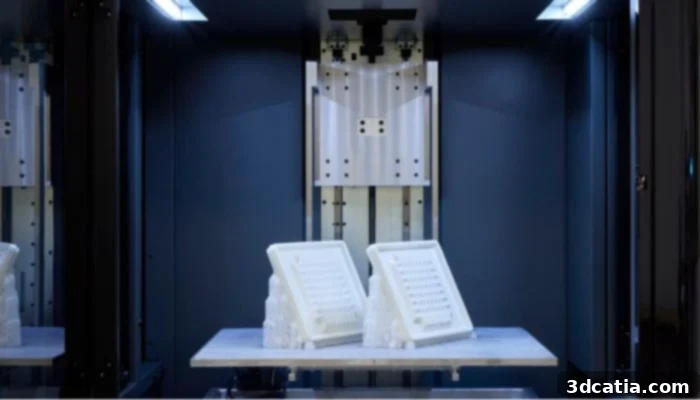
Neo®800+’s build chamber (photo credits: Stratasys)
A cornerstone of the Neo®800+’s enhanced performance is its proprietary ScanControl+ technology, coupled with a dedicated High Detail (HD) mode. This intelligent system grants users granular control over critical laser parameters, including power, motion, and focus. This precise control allows the Neo®800+ to achieve average scanning speeds that are up to 50% faster than its predecessor, the Neo®800, without any compromise in the intricate detail or overall quality of the printed parts. This means faster throughput for complex geometries and fine features, directly translating to increased efficiency for users.
In terms of material compatibility, the Neo®800+ is fully optimized for use with a range of Somos resins, including the widely acclaimed Somos WaterShed XC+, which is specifically certified for ScanControl+ technology. This ensures optimal performance and consistency. Beyond proprietary materials, the system maintains an open material ecosystem, being compatible with other commercially-available 355 nm resins, providing users with flexibility and choice in their material selection to suit diverse application requirements and budget considerations.
The user experience is further streamlined by the Stratasys Neo Titanium software. This intuitive platform offers fast, efficient SLA build control through a user-friendly interface. It also incorporates powerful reporting tools that provide detailed insights into print jobs, critical for process optimization and quality control. Stratasys emphasizes that this software is continuously improved and updated based on invaluable customer feedback, ensuring it remains responsive to the evolving needs of industrial users. Operational reliability, a paramount concern in manufacturing, is guaranteed through advanced features such as Z-Stage Collision Detection, a robust Vacuum System Protection, and real-time monitoring of critical environmental factors like temperature and humidity. These integrated optimizations are projected to yield a significant average increase in production compared to the previous Neo®800 model, with an impressive 39% more parts produced and a remarkable 44% improvement in tooling mold yield. These compelling figures undoubtedly present an attractive investment proposition for organizations looking to leverage cutting-edge stereolithography technology to enhance their manufacturing capabilities.
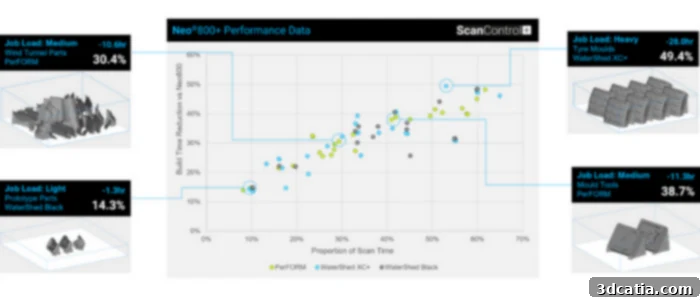
Build time study comparing the Neo800 and Neo800+ (photo credits: Stratasys)
All these advancements collectively mean that the Neo®800+ machine is far more than just another new product entering the market. Instead, it is confidently positioned by Stratasys as the new benchmark for high-speed, large-format stereolithography tailored specifically for rigorous industrial applications. Its guaranteed reliability and superior repeatability are key attributes that solidify its standing as a groundbreaking solution for advanced manufacturing.
Stratasys’ Vision for the Future of Additive Manufacturing
Beyond the impressive technical specifications of the Neo®800+, Yoav Zeif articulated a broader vision for Stratasys and the additive manufacturing industry. He stressed the importance of a customer-centric approach, where technological innovation is directly tied to solving real-world manufacturing problems. The company’s focus on industrial-grade solutions is a testament to this commitment, aiming to transition AM from a niche technology to a mainstream manufacturing process for an ever-expanding array of applications. This vision involves continuous investment in R&D, strategic partnerships, and fostering a robust ecosystem of materials, software, and services that support the entire additive manufacturing workflow.
The Broader Market Perspective: Growth and Innovation
The interview with Yoav Zeif also touched upon broader market dynamics that will define additive manufacturing in the coming years. The industry is currently experiencing unprecedented growth, driven by demand for customized products, shorter supply chains, and more sustainable manufacturing practices. Innovations in materials science are unlocking new possibilities, while advancements in software and automation are making 3D printing more accessible and efficient. The competitive landscape is intensifying, pushing companies to differentiate through specialization, performance, and comprehensive solutions. Stratasys, with its history of innovation and strategic launches like the Neo®800+, aims to maintain its leadership position by addressing these evolving market needs head-on, delivering solutions that provide clear economic and operational advantages to its customers worldwide.
In the video recording of the interview, Yoav Zeif further elaborates on the growing influence of the Chinese market and offers his detailed perspective on the implications of tariffs imposed by President Trump, explaining how he believes these factors will usher the additive manufacturing market into a new, transformative phase. We encourage you not to miss the full interview below to gain access to all his invaluable insights and expert analysis:
If you are keen to learn even more about the groundbreaking Neo®800+ machine from Stratasys, we invite you to register for free for our exclusive webinar HERE. What were your thoughts on our insightful interview with Yoav Zeif and the new Neo®800+ machine from Stratasys? We would love to hear your feedback! Please share your comments below or engage with us on our social media platforms: LinkedIn, Facebook, and Twitter pages! Don’t forget to sign up for our free weekly Newsletter here to receive the latest 3D printing news directly to your inbox! You can also explore all our compelling videos and further content on our dedicated YouTube channel.
*Cover Photo Credits: 3Dnatives