

AI-Driven Optimization for Additive Manufacturing: Unlocking the Full Potential of 3D Printing Productivity
Additive manufacturing, often referred to as 3D printing, has emerged as a groundbreaking digital production method, firmly establishing itself across an impressive spectrum of industries. From critical applications in the medical field to rapid prototyping in the automotive sector and innovative product development in consumer goods, the unique capabilities of 3D printing offer unparalleled advantages. This transformative technology is redefining production paradigms, enabling the creation of components with unprecedented design flexibility and enhanced sustainability. Despite its widespread adoption and proven benefits, additive manufacturing has not yet reached its peak potential concerning overall productivity and efficiency. This raises a crucial question for the future of manufacturing: Could artificial intelligence (AI) be the pivotal element to unlock this untapped potential? A proactive German-Canadian consortium is now at the forefront of addressing this very challenge. Their collaborative endeavor involves the development of pioneering new process control software specifically designed for laser material deposition (LMD), with the overarching goal of significantly optimizing production workflows and dramatically boosting productivity in additive manufacturing.
The digital age has ushered in Industry 4.0, an era characterized by the profound integration of advanced digital technologies and artificial intelligence across all facets of industrial operations. Within this landscape, 3D printing stands out as a leading technology, intrinsically linked to the principles and advancements of Industry 4.0. It is therefore unsurprising that additive manufacturing methods stand to gain immensely from increased automation and intelligent systems, particularly when it comes to refining and optimizing complex production processes. Recognizing this synergy, the “Artificial Intelligence Enhancement of Process Sensing for Adaptive Laser Additive Manufacturing (AI-SLAM)” project was initiated, bringing together a distinguished German-Canadian consortium. On the German side, key partners include the renowned Fraunhofer Institute for Laser Technology ILT, located in Aachen, and BCT, a specialist software developer based in Dortmund. The Canadian contingent is spearheaded by the National Research Council (NRC), which coordinates the project, and is further bolstered by the expertise of a research team from McGill University in Montreal. Additionally, Apollo Machine and Welding Ltd, an industrial partner from Alberta, actively participates in this innovative project. The collective objective is to engineer sophisticated software solutions for equipment manufacturers, thereby enabling LMD processes to operate with full automation and minimal human intervention.
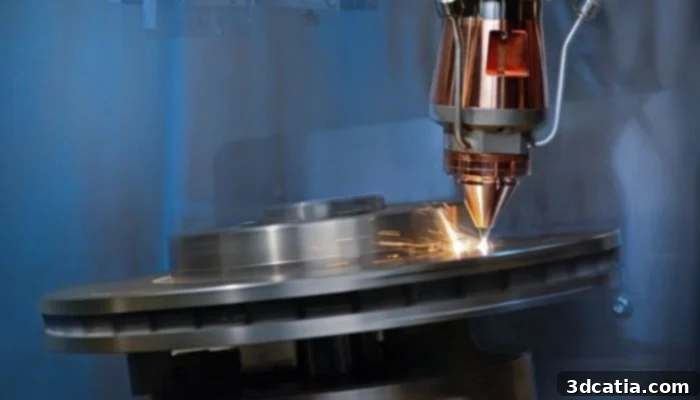
Photo Credits: Fraunhofer ILT, Aachen
AI to Make the LMD Process More Efficient and Autonomous
Laser Material Deposition (LMD) is a sophisticated hybrid manufacturing technique that combines the precision of laser technology with material additive processes. This method allows for the rapid and highly precise application of material layers, ranging from a mere 0.01 mm to 2 mm in thickness, onto virtually any metallic base material. LMD is particularly valued for its ability to build, repair, or add features to existing components with exceptional accuracy. However, users familiar with laser buildup welding understand that ensuring impeccable component quality currently demands rigorous manual oversight. Traditionally, the thickness of each deposited layer, or at least every 10th layer, must be meticulously measured, and the process control parameters manually adjusted to compensate for any deviations. This manual, iterative adjustment is time-consuming and prone to human error, forming a significant bottleneck in achieving maximum productivity.
This is precisely where artificial intelligence promises a transformative leap forward. In the near future, thanks to advanced AI integration, LMD systems will possess the capability to autonomously detect and recognize the necessity for such adjustments. The groundbreaking software developed by the AI-SLAM consortium is designed to identify deviations from the pre-defined component contour in real-time. More importantly, it will then automatically control and fine-tune critical process parameters, such as the feed rate, laser power, and gas flow, to maintain optimal deposition conditions. Beyond merely reacting to current deviations, this intelligent software is engineered to learn independently. By continuously analyzing a vast database of process data, including successful builds, deviations, and corresponding adjustments, it will iteratively optimize the LMD process. This iterative learning mechanism ensures that the system becomes progressively smarter and more efficient with each successive operation, leading to unparalleled levels of precision, consistency, and material utilization.
Developing such a sophisticated system is an inherently complex undertaking, heavily reliant on the collection, processing, and analysis of massive amounts of high-fidelity process data. This data-driven approach is fundamental to enabling the AI to learn, adapt, and make informed decisions during the LMD process. The AI-SLAM project has already achieved significant milestones, including the successful commissioning of software functionality for automated component scanning and intelligent path planning at the Fraunhofer ILT facility. These initial successes demonstrate the viability and potential of integrating AI into complex additive manufacturing workflows. The AI-SLAM project is scheduled to run until March 2024, operating under the auspices of the 3+2 funding program which fosters collaborative research between Germany and Canada. The software is being developed with specific industrial users in mind, notably Apollo Machine and Welding Ltd.
Apollo, a Canadian company, leverages LMD technology extensively for the repair of critical wear parts, such as robust stone crusher teeth used in heavy machinery. For such industrial applications, the primary expectation from automated process control is a substantial gain in efficiency. This translates into the ability to produce more parts with less effort, reduced material waste, faster turnaround times, and ultimately, significant cost savings. The integration of AI promises to transform LMD from a skilled operator-dependent process into a highly automated, self-optimizing system. This automation will not only reduce the need for constant manual intervention but also minimize human error, leading to more consistent part quality and fewer rejections. The project’s success is anticipated to set new benchmarks for productivity and reliability in advanced manufacturing, particularly within the realm of metal additive processes. The full scope and ongoing advancements of this pivotal research can be explored further HERE.
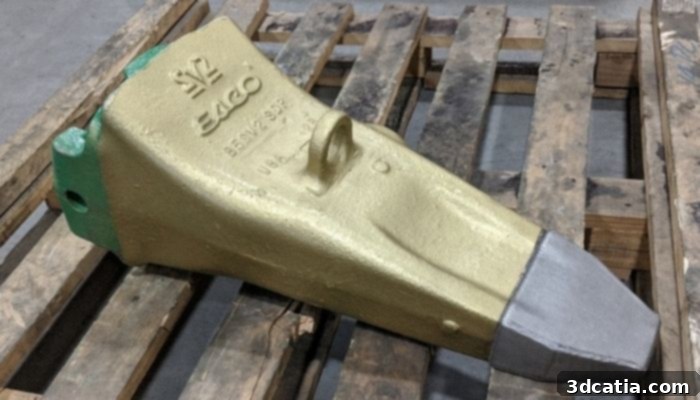
For complex geometries, AI-based process optimization will enable significant efficiency gains (photo credits: Apollo Machine and Welding Ltd, Canada)
The convergence of additive manufacturing and artificial intelligence represents a powerful paradigm shift, offering far-reaching implications beyond just process control. This symbiotic relationship holds the potential to revolutionize various stages of the AM workflow, from generative design and material informatics to predictive maintenance and supply chain optimization. AI can analyze vast datasets of material properties and printing parameters to suggest optimal designs for specific applications, reducing trial-and-error iterations. It can also monitor printer performance in real-time, anticipate potential failures, and schedule maintenance proactively, thereby minimizing downtime and maximizing machine utilization. The intelligent automation facilitated by AI integration will propel 3D printing into an era of unprecedented productivity, enabling the creation of custom, high-performance parts with greater speed and cost-effectiveness than ever before. This collaboration between German and Canadian innovators is a testament to the global effort to harness advanced technologies for the betterment of industrial processes, driving forward the vision of truly smart factories where production is not just automated, but intelligently optimized.
What potential do you envision in the powerful combination of additive manufacturing and artificial intelligence? Do you believe this technological synergy is the definitive catalyst needed to propel productivity in 3D printing to its next transformative level? We invite you to share your insights and opinions by leaving a comment below or engaging with us on our LinkedIn, Facebook, and Twitter pages! To ensure you stay at the forefront of the latest developments and breaking news in the dynamic world of 3D printing, don’t forget to sign up for our complimentary weekly Newsletter here, delivered directly to your inbox. You can also explore our extensive library of innovative content and discussions by visiting our YouTube channel.