

Sandvik’s Unbreakable 3D Printed Guitar: A Revolution in Musical Instrument Durability
The act of guitar smashing has long been an iconic and dramatic element of rock & roll performances, symbolizing rebellion, raw emotion, and artistic catharsis. Originating in the 1960s, this destructive yet powerful ritual has cemented its place in music history, with legendary musicians like Pete Townshend and Jimi Hendrix turning their instruments into explosive extensions of their art. The moment a guitar shatters against the stage or a speaker stack evokes a primal energy, leaving a lasting impression on audiences. But what if the instrument, designed for such a spectacle, simply refused to break? This intriguing paradox became the ambitious goal for Sandvik, a global leader in metal additive manufacturing. Their groundbreaking project aimed to engineer an unsmashable guitar using advanced 3D printing and music technologies, challenging the very notion of instrument fragility and pushing the boundaries of what’s possible in both engineering and artistic expression. The idea of a guitar that withstands even the most forceful attempts at destruction is, to say the least, surprising on stage and a testament to modern material science and manufacturing innovation.
The convergence of new technologies, particularly 3D printing, with the world of music is rapidly transforming how instruments are designed, manufactured, and experienced. Beyond crafting novel and aesthetically unique instruments, additive manufacturing pushes the limits in terms of acoustic properties, playability, and sheer durability. From creating more powerful speakers with intricate internal structures to customizing all types of musical accessories, 3D printing offers unparalleled design freedom and efficiency. Sandvik’s initiative to develop an unbreakable guitar stands as a prime example of this innovative synergy, showcasing how industrial expertise can intersect with artistic demands to create something truly revolutionary.
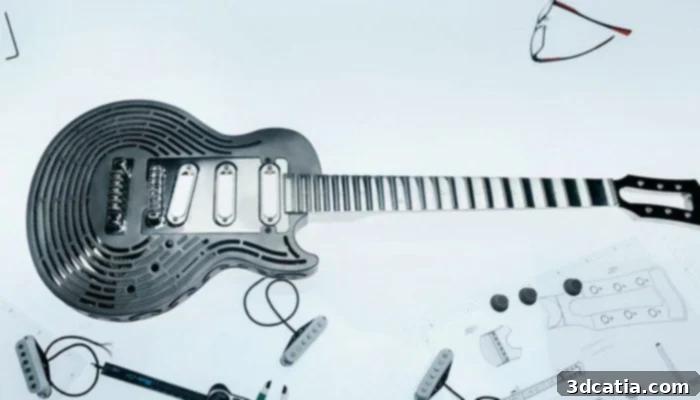
Credits: Sandvik
Engineering the Unbreakable: Design Challenges and Innovative Solutions
The concept of an unbreakable 3D printed guitar was born from a collaboration with legendary Swedish guitar virtuoso, Yngwie Malmsteen, renowned for his neoclassical shredding and, occasionally, his stage theatrics involving guitar smashing. The formidable task of bringing this vision to life was spearheaded by Henrik Loikkanen, a machining process developer at Sandvik Coromant and a keen guitarist himself. Loikkanen and his team faced a monumental engineering challenge: “We had to design a guitar that is unsmashable in all the different ways you can smash a guitar. The engineering challenge was that critical joint between the neck and the body that usually cracks on a guitar.” This particular area is a notorious weak point in conventional guitar construction, making it the primary focus for Sandvik’s innovative approach.
To overcome this inherent structural vulnerability, Sandvik’s engineers conceived a radical design departure. Instead of a traditional glued or bolted joint, they completely eliminated the conventional neck-body interface. The solution involved an ingenious integration: the neck and fretboard of the guitar were meticulously milled together as a single, continuous piece from solid bars of recycled stainless steel. This not only ensured exceptional structural integrity but also highlighted Sandvik’s commitment to sustainable manufacturing practices by utilizing recycled materials. The stainless steel, known for its robustness and resistance to deformation, provided an ideal foundation for the guitar’s core strength.
Further reinforcing this design, the unified neck and fretboard extended deeply into the guitar’s main body, forming a unique “rectangular knot” that essentially locked the two primary components together without any weak points. This innovative interlocking mechanism distributed stress more effectively across the entire structure, rendering the infamous neck-body joint virtually indestructible. The design process for such a complex and high-performance instrument demanded rigorous validation. Engineers performed numerous checks, meticulously ensuring that even the most slender components, such as the neck and frets, would not succumb to distortion or breakage upon severe impact. They leveraged advanced simulation software to digitally model and understand every aspect of the manufacturing process, from material stress under extreme conditions to potential structural vulnerabilities. This digital foresight significantly streamlined development, reduced the need for physical prototypes, and guaranteed the success of their ambitious engineering feat.
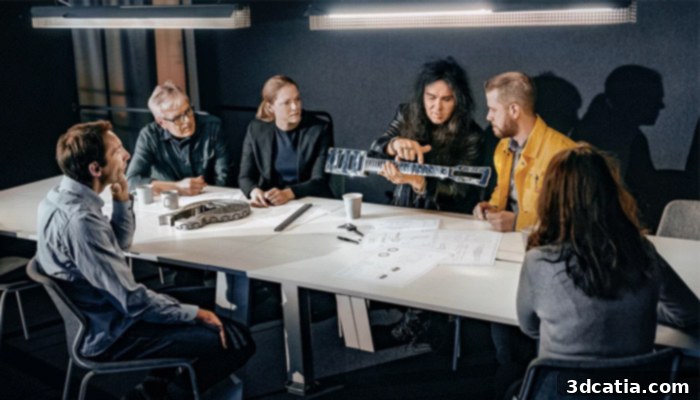
Yngwie Malmsteen and the Sandvik team | Credits: Sandvik
The Power of Metal Additive Manufacturing: Crafting the Guitar Body
While the neck and fretboard provided the skeletal strength, the second significant engineering challenge was to create a guitar body that was both incredibly solid and remarkably lightweight. This is where metal additive manufacturing, specifically powder bed fusion technology, became indispensable. Sandvik opted to design the guitar’s body using high-quality titanium powder. Titanium is an exceptional material choice due to its outstanding strength-to-weight ratio, superior corrosion resistance, and excellent fatigue properties, making it ideal for high-performance applications where durability and low mass are critical. These attributes ensure the guitar can withstand intense physical abuse without compromising its structural integrity or becoming overly cumbersome for the musician.
Amélie Norrby, an additive manufacturing engineer at Sandvik, eloquently explains the core advantage of this technology: “Additive manufacturing lets us create lighter, stronger and more flexible components with internal structures that would be impossible to mill traditionally.” This capability is crucial for the guitar body. Through powder bed fusion, Sandvik engineers could incorporate intricate lattice structures and optimized internal geometries within the titanium body. These complex internal designs significantly reduce the overall weight of the guitar while simultaneously increasing its rigidity and ability to absorb impact energy, far beyond what traditional manufacturing methods could achieve. Such advanced internal architecture is key to balancing the requirement for extreme durability with the need for a playable instrument that isn’t excessively heavy.
Furthermore, Norrby highlights the environmental benefits of additive manufacturing: “And it’s more sustainable because you only use the material you need for the component, minimising waste.” Unlike subtractive manufacturing processes, which cut away material from a larger block, often generating significant waste, additive manufacturing builds components layer by layer. This ‘near-net-shape’ production minimizes material consumption, making the process highly efficient and environmentally conscious. For the unsmashable guitar, this meant optimizing both material usage and structural performance, resulting in an instrument that is not only incredibly robust but also produced with a reduced environmental footprint. This commitment to sustainability, combined with cutting-edge engineering, underscores Sandvik’s holistic approach to innovation.

Credits: Sandvik
The Ultimate Test: Yngwie Malmsteen vs. The Unbreakable Guitar
With the critical components meticulously manufactured and assembled, the moment of truth arrived. Guitarist Yngwie Malmsteen, the inspiration and collaborator behind this ambitious project, was ready to put the “unsmashable” guitar to the ultimate test during a live concert in Florida. The stage was set for a dramatic showdown between artistic expression and engineering prowess. Known for his powerful performances and occasional instrument destruction, Malmsteen unleashed his full force upon the specially designed guitar. Audiences watched in anticipation as he slammed, threw, and violently thrashed the instrument, replicating the very acts that would typically reduce a conventional guitar to splinters.
However, after numerous intense attempts, the musician could not break the guitar. It remained completely intact, a defiant testament to Sandvik’s innovative design and manufacturing capabilities. Malmsteen’s reaction was one of genuine astonishment and admiration. He exclaimed: “This guitar is a beast! The result is amazing. I gave everything I had, but it was impossible to smash.” His words perfectly captured the groundbreaking nature of this achievement. The unsmashable guitar represents a paradigm shift for performers, offering unprecedented durability without compromising playability or aesthetic appeal. It proves that extreme engineering can not only meet but exceed the demands of live performance, providing artists with tools that can withstand the most rigorous conditions. This project not only solved a unique problem for a specific artist but also pushed the boundaries of what is conceivable in musical instrument design and manufacturing.
Beyond Durability: The Broader Impact of 3D Printing in Music
The Sandvik unsmashable guitar is more than just a novelty; it highlights the transformative potential of metal additive manufacturing and 3D printing across the entire music industry. This technology empowers designers and instrument makers to explore geometries and structures previously unattainable with traditional methods. From creating custom-fit ergonomic instruments that enhance player comfort and performance to designing unique acoustic properties through intricate internal chambers, the possibilities are vast. Musicians can now access highly personalized instruments tailored precisely to their physical needs and desired sound characteristics.
Beyond full instruments, 3D printing is revolutionizing various aspects of music. It enables the rapid prototyping and production of custom parts for existing instruments, such as bridges, nuts, and pickguards, allowing for fine-tuning of sound and aesthetics. Speaker manufacturers are leveraging 3D printing to create optimized enclosures and internal baffling systems that improve sound clarity and projection, pushing the limits of audio fidelity. Even simple accessories like guitar picks, capo designs, and instrument stands are benefiting from the design freedom and material innovation offered by additive manufacturing, leading to more durable, ergonomic, and specialized products. The ability to produce complex components with minimal waste also positions 3D printing as a sustainable choice for future music industry manufacturing.
Sandvik’s project with Yngwie Malmsteen serves as a powerful demonstration of how industrial innovation can directly impact creative fields. It underscores the company’s leading expertise in metal AM, showcasing its capacity to apply advanced engineering solutions to highly specialized and seemingly unconventional challenges. This collaboration not only yielded an extraordinary guitar but also inspired a new vision for the future of musical instrument design, where durability, sustainability, and artistic expression can coexist seamlessly thanks to cutting-edge manufacturing technologies. It’s a testament to how intelligent design, advanced materials, and precise manufacturing can create products that truly stand the test of time – and, in this case, the test of rock & roll.
You can find more information about this incredible engineering feat HERE and witness part of Yngwie’s unforgettable concert performance with the unsmashable guitar in the video above.
What do you think of this unsmashable guitar? How do you foresee 3D printing continuing to shape the future of music? Let us know your thoughts in a comment below or join the conversation on our Facebook and Twitter pages. Don’t forget to sign up for our free weekly Newsletter, with all the latest news in 3D printing delivered straight to your inbox!