
3D Printing a Lifeline: Custom Tracheal Splints Revolutionize Pediatric Airway Treatment in Georgia
The landscape of modern medicine is continuously evolving, driven by remarkable technological advancements. Among these, 3D printing technology, also known as additive manufacturing, stands out as a transformative force in the healthcare sector. Its applications range from creating highly customized prosthetics and surgical guides to facilitating groundbreaking work in bio-printing, which holds the promise of significantly reducing organ transplant waiting lists. This innovation is also paving the way for personalized medical devices tailored to individual patient needs. A compelling example of this progress comes from Georgia, where biomedical engineers from Georgia Tech have partnered with Children’s Healthcare of Atlanta to pioneer a life-saving procedure for pediatric patients involving advanced 3D printed tracheal splints.
A Landmark Medical Achievement in Georgia
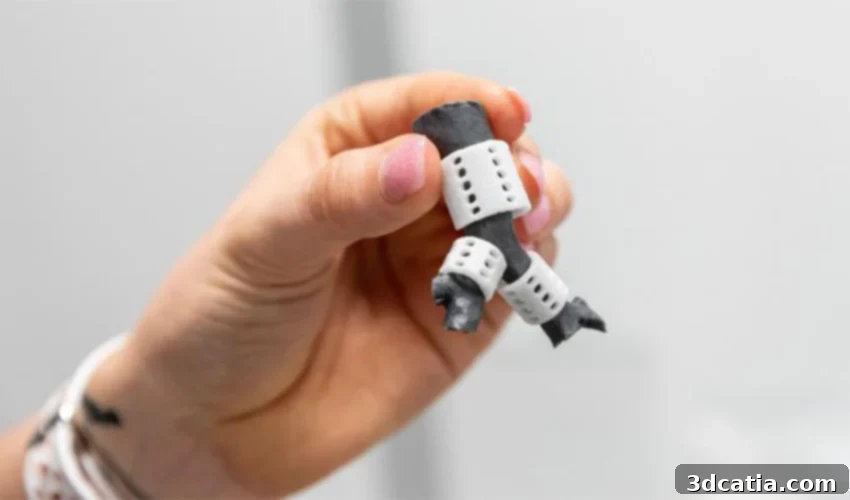
Children’s Healthcare of Atlanta has achieved a significant milestone, becoming the first institution in Georgia to successfully implant custom 3D printed tracheal splints in a pediatric patient. This groundbreaking procedure was performed on Amir, a 7-month-old infant who had endured severe, life-threatening airway obstructions for a substantial portion of his young life. The dedicated medical team meticulously designed and produced three individualized 3D printed splints, engineered to stabilize Amir’s compromised airways and significantly improve his breathing. This innovative approach offers hope for children suffering from complex respiratory conditions that are often resistant to conventional treatments.
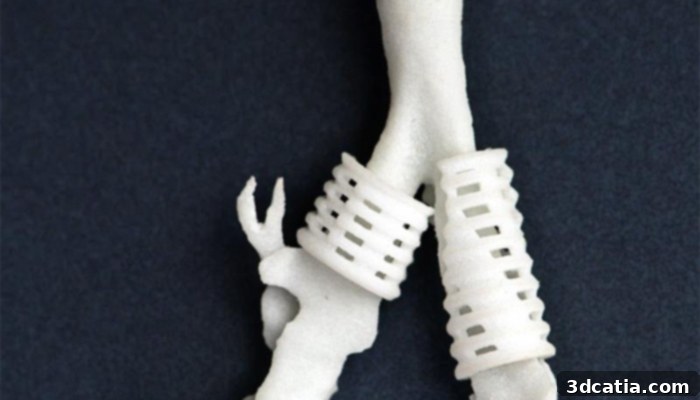
Amir’s struggle began with a dual diagnosis of congenital heart disease and severe tracheobronchomalacia. Tracheobronchomalacia is a condition characterized by the weakness of the tracheal and bronchial walls, causing them to collapse, especially during exhalation. In infants, this can lead to severe and recurrent airway obstruction, making breathing incredibly difficult and often life-threatening. Amir spent six challenging months as an inpatient in the Pediatric Intensive Care Unit (PICU) at Children’s Healthcare of Atlanta, experiencing frequent episodes of airway collapse that traditional surgical interventions could not effectively correct. Faced with this dire situation, the clinical team proposed an innovative solution: the surgical implantation of an experimental 3D printed tracheal splint. The primary goal was to structurally support his airways, allowing the trachea and bronchus to expand and function properly.
The Collaborative Vision: Georgia Tech and Children’s Healthcare of Atlanta
The revolutionary tracheal splint is a novel device currently undergoing development, spearheaded by Scott Hollister, who holds the prestigious Patsy and Alan Dorris Endowed Chair in Pediatric Technology. This pioneering work is a testament to the powerful collaboration between Georgia Tech, where Hollister directs the cutting-edge Center for 3D Medical Fabrication, and Children’s Healthcare of Atlanta. Dr. Hollister emphasizes the driving force behind their research, stating, “The possibility of using 3D printing technology to save the life of a child is our motivation in the lab every day.” He further elaborated on their commitment, affirming, “We’re determined to develop innovative solutions that meet the needs of Georgia’s most complex pediatric patients.” This partnership exemplifies how interdisciplinary expertise can push the boundaries of medical science and directly impact patient outcomes.
Understanding Polycaprolactone (PCL): The Material Behind the Splint
The material used for these advanced tracheal splints is polycaprolactone (PCL), a biocompatible and biodegradable polyester. PCL is an excellent choice for medical implants due to its unique properties. It is a semi-crystalline polymer that is gradually absorbed by the body over time, typically within 3 to 4 years, which is crucial for pediatric applications where the child’s anatomy is still growing and developing. Its biocompatibility ensures minimal adverse reactions within the patient’s body, making it a safe option for long-term implantation. Furthermore, PCL possesses suitable mechanical properties to provide the necessary structural support for the trachea while being flexible enough to adapt to the body’s natural movements. This careful material selection is fundamental to the success and long-term efficacy of the 3D printed tracheal splint.
A Complex Surgical Intervention Powered by 3D Printing
The procedure itself is a highly intricate process that begins with detailed pre-operative planning. A high-resolution CT scan of the patient’s airways is performed to capture precise anatomical data. This data is then used by Dr. Hollister and his team at the Center for 3D Medical Fabrication at Georgia Tech to create an accurate three-dimensional digital model of the patient’s trachea and bronchi. Utilizing advanced Computer-Aided Design (CAD) software, the team meticulously designs multiple versions of the splint in various sizes and configurations. This iterative design process is critical to ensure a perfect, customized fit that can be optimally placed around the patient’s airways during the demanding surgical procedure.
The Precision of Additive Manufacturing: Producing the Splint
The actual production of the tracheal splint utilizes sophisticated 3D printing technology, specifically Selective Laser Sintering (SLS). In this process, fine polycaprolactone (PCL) powder is spread in thin layers across a build platform. A powerful laser then precisely traces the pattern of the splint onto the powder bed, selectively fusing the PCL particles together at designated points. This process is repeated layer by layer, building the splint from the ground up with exceptional accuracy and intricate detail. The SLS method is ideal for creating complex geometries and porous structures, which can be beneficial for tissue integration and minimizing material usage. This level of customization and precision is unattainable with traditional manufacturing methods, underscoring the revolutionary potential of 3D printing in personalized medicine.
The Marathon Surgery and Recovery
The surgical implantation of the 3D printed tracheal splints was a testament to the skill and endurance of the medical team. The complex procedure spanned approximately 10 hours, involving a cross-functional team of highly specialized surgeons, anesthesiologists, and support staff. On August 17th of this year, this dedicated team successfully placed the three custom-designed 3D printed tracheal splints precisely around Amir’s trachea, providing immediate structural support. Following the tracheal procedure, Amir was then transitioned onto a heart-lung machine for the concurrent surgical repair of his congenital cardiac defect, highlighting the multifaceted challenges of his condition and the comprehensive care required. Post-operatively, the unique properties of the PCL material come into play; over a period of 3-4 years, the splint material will gradually be absorbed by the patient’s body, allowing his trachea and bronchus to naturally expand and strengthen as he grows, without the need for additional surgical removal.
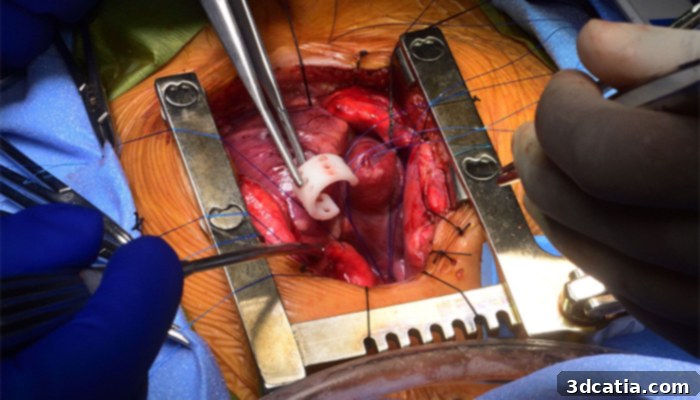
Implanting 3D-printed tracheal splints. Photo via Children’s Healthcare of Atlanta.
Regulatory Pathways and the Future of 3D Printed Medical Devices
It is important to note that this specific procedure and the 3D printed splint itself are still under active development and are considered investigational devices. As such, the device has not yet received full regulatory approval from the Food and Drug Administration (FDA) for widespread clinical use, meaning its safety and effectiveness are still being rigorously evaluated. To proceed with Amir’s life-saving surgery, the medical team had to apply for and secure emergency clearance from the FDA under what are known as “expanded access guidelines.” These guidelines allow for the use of unapproved medical products in patients with serious or immediately life-threatening conditions when no comparable or satisfactory alternative therapy exists. This particular procedure in Georgia represents the 15th time a patient worldwide has received treatment involving a 3D printed tracheal splint, with the first such implantation dating back to 2015. This increasing frequency underscores the growing confidence and advancements in this specialized field of pediatric surgery.
The Broader Impact and Future Directions for Additive Manufacturing in Healthcare
The success of procedures like Amir’s offers a glimpse into the future of personalized medicine and the profound impact of additive manufacturing in healthcare. This technology is not merely an improvement over existing methods; it represents a paradigm shift, enabling the creation of patient-specific solutions that were once unimaginable. Beyond tracheal splints, 3D printing is poised to revolutionize numerous other areas, including the development of custom implants for orthopedic and craniomaxillofacial surgeries, bio-printed tissues and organs for transplantation, and advanced drug delivery systems. The ongoing research at institutions like Georgia Tech, in collaboration with clinical partners such as Children’s Healthcare of Atlanta, is crucial for refining these technologies, overcoming regulatory hurdles, and ultimately bringing these life-changing innovations to a broader patient population. The commitment to innovation, coupled with stringent safety and efficacy evaluations, will define the trajectory of 3D printed medical devices in the coming decades, promising a future where individualized care is not just an aspiration but a reality.
For those interested in learning more about Amir’s incredible journey and the groundbreaking procedure involving the 3D printed tracheal splint, further details are available:
We invite your thoughts on this remarkable application of the 3D printed tracheal splint. Share your insights in a comment below or join the conversation on our Facebook and Twitter pages! And don’t forget to sign up for our free weekly Newsletter to receive all the latest news and advancements in 3D printing directly to your inbox!