
Exploring the Future of 3D Printing Filaments: Market Growth and Key Trends to 2024
The global landscape of additive manufacturing is continuously evolving, with 3D printing filaments standing out as a cornerstone material. A recent comprehensive report from the esteemed research firm Ameco Research sheds significant light on the trajectory of the global 3D printing filament market. Their analysis forecasts an impressive surge, predicting the market will expand from a valuation of $255 million in 2017 to a substantial $1,189 million by 2024. This remarkable growth translates to a robust Compound Annual Growth Rate (CAGR) of 25.8%, underscoring the rapid adoption and increasing demand for 3D printing materials worldwide.
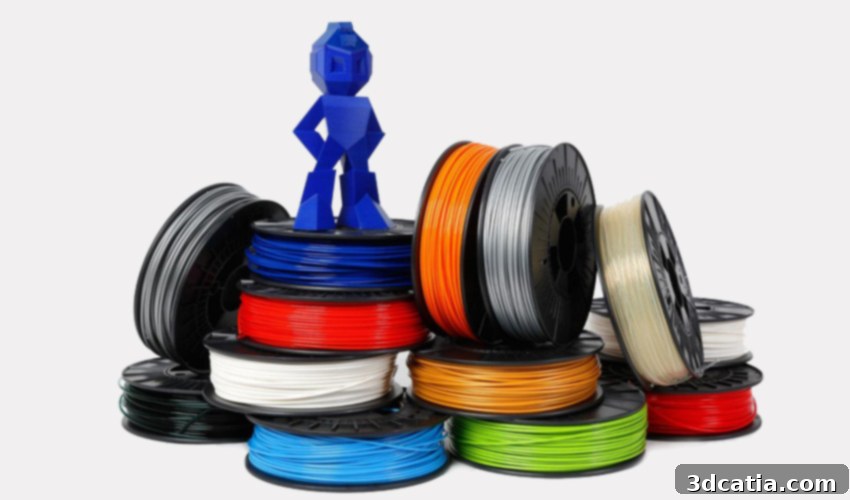
Filament, as a material in additive manufacturing, has undeniably become the most prevalent choice today. This popularity is a direct consequence of the dominance of Fused Deposition Modeling (FDM) technology, also widely known as filament extrusion. FDM, initially developed and patented by the industry giant Stratasys, revolutionized accessible 3D printing. For many years, Stratasys held exclusive rights to this groundbreaking technology. However, upon the expiration of their foundational patent, a new era dawned for the 3D printing sector. This pivotal moment opened doors for numerous companies to innovate and develop their own equipment based on the same FDM principles. This democratization of the technology led to an explosion in the market for FDM 3D printers, which in turn, naturally propelled the growth of the filament market, making it an indispensable segment of the broader 3D printing industry.
Ameco Research meticulously constructed its predictions by leveraging a rich tapestry of historical data. Their methodology involved a thorough examination of various secondary sources, including industry news, in-depth articles, specialized publications, annual corporate reports, and comprehensive white papers. To further validate and enrich their findings, the research firm also engaged in direct consultations with key opinion leaders and influential stakeholders within the market. This dual approach of extensive data analysis and expert insights allowed them to identify the core drivers behind the anticipated growth. A paramount factor identified was the surging usage of 3D printing across a vast array of applications, ranging from rapid prototyping and functional part creation to intricate tooling and customized consumer goods. Furthermore, a significant trend observed by Ameco Research is a noticeable shift towards eco-friendly plastics, moving away from traditional petrochemical-based plastics. This environmental consciousness is expected to significantly increase investment in 3D printing technologies and materials globally, as industries strive for more sustainable manufacturing practices.
Delving into specific filament types, the report highlights the dynamics of material preference. In 2017, Acrylonitrile Butadiene Styrene (ABS) material commanded the largest market share within the global 3D printing filament material market. ABS is highly valued for its robust mechanical properties, including good strength, impact resistance, and heat deflection, making it suitable for functional prototypes and end-use parts. However, its printability can be challenging due to warping and the emission of fumes. Conversely, Polylactic Acid (PLA) is projected to experience the most significant growth over the forecast period. Unlike ABS, PLA boasts the distinct advantage of being biodegradable, making it a more environmentally conscious choice. It is manufactured from renewable raw materials such as cornstarch, sugarcane, or tapioca roots, aligning perfectly with the global push for sustainability. PLA is also known for its ease of printing, lower printing temperatures, and minimal warping, making it a favorite for beginners and a wide range of non-industrial applications, including educational projects, toys, and aesthetic models. ABS, on the other hand, is a tough thermoplastic comprising a polybutadiene-based elastomer, which imparts its superior flexibility and shock resistance, albeit at the cost of being petroleum-derived. According to the report, it is precisely PLA’s biodegradable and eco-friendly properties that are expected to be the primary catalyst for its accelerated growth and wider adoption. Beyond material types, the report also segments the market by end-user. The industrial sector emerged as the largest end-user market for 3D printing filament material in 2017, utilizing filaments for complex prototyping, manufacturing aids, jigs, fixtures, and even short-run production. This dominance is strongly anticipated to persist and even strengthen throughout the forecast period, driven by ongoing industrial automation and the quest for agile manufacturing solutions.

PLA is one of the most popular materials for filaments – it is easy to print, low cost and has applications for a wide-range of industries. Also, it is renewable and biodegradable unlike ABS | Photo Credits: Simplify3D
Geographically, North America consistently holds its position as the largest region contributing to the growth of the 3D printing filament materials market. This sustained leadership can be primarily attributed to the significant presence of major 3D printing industry players, including leading printer manufacturers, material developers, and a robust ecosystem of research and development institutions. The region also benefits from early adoption rates across various industries and a supportive regulatory environment. However, the Asia-Pacific (APAC) region is demonstrating an equally compelling upward trend. It is forecast to experience a particularly significant growth rate over the upcoming period. This surge in APAC is fueled by several factors, including the rapid industrialization in countries like China and India, increasing government investments in advanced manufacturing technologies, and the burgeoning number of local 3D printing players and raw material providers entering the market. Europe also remains a crucial market, driven by strong industrial demand, sophisticated R&D, and a focus on sustainable manufacturing, further contributing to the global market’s expansion.
The explosive growth in sales of FDM 3D printers and the subsequent rise in demand for filaments have not gone unnoticed by the chemical industry. Many leading chemical companies recognized this burgeoning opportunity and have made substantial investments to expand their production capabilities for thermoplastics specifically used in 3D printing filaments. This strategic pivot is evident in the significant ventures and collaborations initiated by global players such as BASF, SABIC, and Mitsubishi, among others. These companies are not only scaling up production but also actively engaging in research and development to introduce specialized and high-performance engineering plastics tailored for additive manufacturing. The report identified several leading players that are shaping the global market. These key innovators and manufacturers include, but are not limited to, Filabot, Evonik Industries, Voxeljet AG, Solvay AG, LG Chem, Markforged, Inc., Carbon, Inc., Proto Labs, Inc., and Materialise NV. These entities encompass a diverse range of contributions, from advanced material science and filament production to pioneering new printing technologies and offering comprehensive 3D printing solutions.

This newer type of filament is flexible filament, usually made out of TPE or TPU – offering applications in industries such as fashion or design | Photo Credits: Simplify3D
The comprehensive findings and detailed analysis presented in the full report are available for those seeking deeper insights into the market dynamics, competitive landscape, and future projections. You can access the complete Ameco Research report directly on their official website HERE.
The future of 3D printing filaments appears exceptionally bright, marked by continued innovation, a strong focus on sustainability, and expanding applications across virtually every industry. As FDM technology continues to evolve and new material science breakthroughs emerge, the market is poised for sustained exponential growth, fundamentally transforming how products are designed and manufactured.
What are your thoughts on Ameco Research’s predictions for the 3D printing filament market? Do you foresee even greater growth or perhaps new challenges? We invite you to share your insights in a comment below or join the conversation on our Facebook and Twitter pages! Don’t forget to sign up for our free weekly Newsletter, to receive all the latest news and updates in 3D printing delivered straight to your inbox!