

The Future of Furniture Design: Philipp Aduatz Pioneers Innovation with 3D Printing and Additive Manufacturing
Design freedom stands as one of the most compelling advantages of additive manufacturing, profoundly influencing various sectors, especially the creative industry. This revolutionary technology offers unprecedented possibilities in the design process, systematically breaking down traditional barriers to creativity. From replicating intricate natural forms through bionics to facilitating bold, experimental designs, 3D printing empowers designers to explore realms previously unattainable. For Austrian product designer Philipp Aduatz, additive manufacturing has not just become a tool but an integral philosophy underpinning his design work for many years. His innovative approach brilliantly showcases how to leverage the full spectrum of 3D printing’s capabilities, from crafting initial prototypes to producing exclusive, limited-edition furniture pieces. In an insightful conversation, Philipp Aduatz shared his journey with additive manufacturing, detailing its application in his business and elucidating how this transformative technology fundamentally shapes his unique design process and aesthetic vision.
3DN: Can you briefly introduce yourself and your work, Philipp?

Philipp Aduatz
I am a product designer based in Vienna, and my work is situated at the intriguing intersection of design and art, with a strong focus on leveraging advanced technology and pioneering material sciences. My creative process is distinguished by a blend of experimental exploration and rigorous scientific theoretical principles. The culmination of this approach results in unique objects, often produced in small, highly coveted limited editions. Additive manufacturing, or 3D printing, has consistently played a pivotal role in my practice since its early days. Initially, around 2005, I primarily utilized it for rapid prototyping, enabling me to quickly produce small working models that facilitated an agile and iterative design process. This allowed for immediate physical feedback and refinement during the early stages of a project. However, in recent years, the technological advancements in 3D printing, particularly concerning possible dimensions and material capabilities, have dramatically evolved. This progression has opened up new avenues, and since 2018, I have been able to produce large-scale objects, including full 1:1 scale furniture pieces, directly through additive manufacturing. This shift has been monumental, transforming 3D printing from merely a prototyping tool into a core method for final production, allowing for an unprecedented level of complexity and scale in my work.
3DN: What are the primary advantages of additive manufacturing in the design and manufacturing process of your objects, especially for your distinct furniture creations?
For me personally, the benefits of additive manufacturing are multifaceted and profoundly impactful. The most significant advantage, from a practical and economic standpoint, is the complete elimination of complex mold construction for production. In traditional manufacturing, creating intricate molds can involve substantial financial investment and considerable time, often becoming a significant bottleneck and cost driver. With 3D printing, this entire phase is bypassed, leading to substantial economic savings and a much more streamlined production workflow. This directly translates into reduced upfront costs and a more efficient allocation of resources. Beyond the economic benefits, additive manufacturing offers unparalleled flexibility for iterative design and optimization. During pilot production, or even in the full manufacturing phase, minor modifications and enhancements can be implemented with relative ease. This agility was virtually impossible with conventional mold-based production methods; once a mold was created, any design change would necessitate costly and time-consuming retooling or entirely new mold fabrication, severely limiting design evolution. Furthermore, and crucially for a designer operating at the intersection of art and technology, 3D printing unlocks entirely new forms of design expression. The aesthetic dimension, in particular, presents an incredibly rich and fertile ground for creativity. Designers are no longer constrained by the limitations of subtractive manufacturing or the complexities of traditional fabrication techniques. This freedom allows for the creation of complex geometries, organic forms, and intricate patterns that would be impractical or impossible to achieve otherwise, pushing the boundaries of what is considered feasible in product and furniture design.
3DN: You recently unveiled a limited edition furniture series, uniquely additively manufactured from concrete. Could you elaborate on this groundbreaking project and its significance?
The recent concrete 3D printing furniture series represents a significant leap forward in innovative manufacturing. Concrete 3D printing itself is a nascent yet incredibly promising process that allows for the rapid creation of large, complex structures, which is perfectly suited for ambitious architectural and design applications. For this particular series, I collaborated closely with incremental3d, a pioneering company that is actively researching and developing methods to colorize concrete directly within the 3D printing process. This innovative approach involves the precise injection of color pastes into the nozzle of the concrete printer during the actual fabrication. This method dramatically streamlines the coloring process, leading to significant reductions in manual labor, material waste, and overall production delays. Crucially, it also allows for highly localized color design, meaning that color can be applied not just globally across the entire object, but precisely point by point, layer by layer. This granular control over color opens up extraordinary creative possibilities, enabling intricate gradient effects and complex color transitions directly embedded within the material. The core objective in developing this new furniture series was to seamlessly integrate cutting-edge additive manufacturing technology with advanced color design techniques, thereby creating truly innovative and visually striking products that redefine the aesthetic potential of concrete furniture.
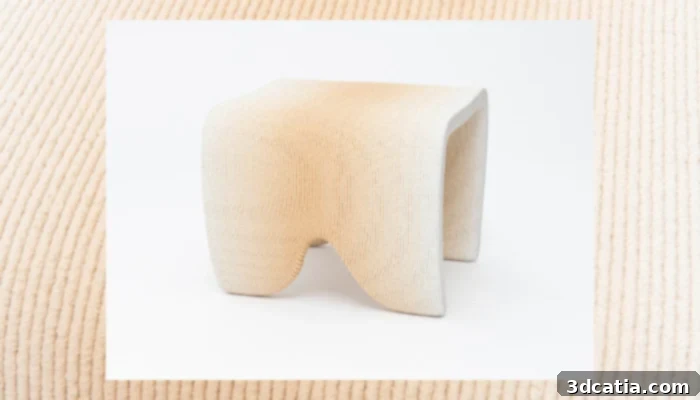
The “Gradient Stool” manufactured using 3D concrete printing. (Images: Philipp Aduatz)
3DN: Can you provide more details about the specific printers and materials you utilize for these advanced concrete creations?
For my work in concrete 3D printing, I continue my productive collaboration with the Austrian company incremental3d, which originated as a spin-off from the University of Innsbruck. Their expertise in this specialized field is invaluable. The core of our production setup involves a sophisticated six-axis industrial robot, which is meticulously programmed to apply an innovative, specially formulated cement-based mortar. This mortar is extruded through a precision nozzle, creating layers with customizable web widths typically ranging between 10 and 40 mm, and web heights between 5 and 10 mm. This control over layer dimensions is crucial for achieving both structural integrity and fine aesthetic detail. A key technological aspect of this process is the integration of an accelerator, which is mixed into the mortar directly during the printing process. This additive is critical because it ensures rapid setting of the concrete, allowing each successive layer to be deposited quickly without compromising the stability of the previously printed layers. This rapid solidification is what enables us to produce surprisingly large and complex geometries in a relatively short timeframe, significantly accelerating the manufacturing cycle. The combination of high material stability and the rapid strength build-up afforded by the accelerator is what empowers the printing of truly three-dimensional spatial structures – be they planar, single-curved, or complex double-curved forms. This technical capability allows for designs that push the boundaries of conventional concrete construction, offering unparalleled creative freedom in form and function for architectural and furniture applications.
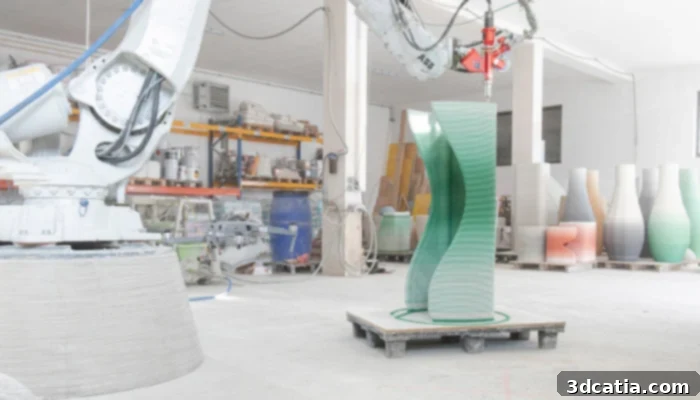
Layer by layer, the concrete objects of the “Gradient Furniture” series are created. (Image: Philipp Aduatz)
3DN: 3D printing is celebrated for its remarkable design freedom. To what extent does this influence the creation of your new projects, and where do you encounter creative limits within this innovative technology?
The influence of 3D printing on the creation of my new projects is, without exaggeration, enormous. The level of design freedom it offers is profoundly greater compared to conventional manufacturing technologies, liberating designers from many traditional constraints. This allows for an unparalleled exploration of form, complexity, and customization. However, it’s also important to acknowledge that even with such advanced technology, there are inherent limits that designers must work within. Concrete 3D printing, for instance, operates on principles somewhat analogous to the well-known FFF (Fused Filament Fabrication) process used with plastics. A critical distinction, however, is the impracticality or often impossibility of using dedicated support structures in concrete printing. This means that designing overhangs or complex unsupported geometries becomes a significant challenge because you are constantly contending with the immutable force of gravity as the material is deposited. The wet concrete needs to maintain its form until it sets, and excessive overhangs will simply collapse. Therefore, overhangs can only be designed to a certain, limited extent. Understanding and creatively navigating these physical limitations is a crucial part of the design process. When developing new objects, we consistently strive to push these boundaries as far as possible. This involves an iterative design approach, optimizing geometries to maximize the creative scope while respecting the material’s inherent physical properties and the printing process’s capabilities. It’s a continuous dance between ambition and practicality, ensuring that the final object is not only aesthetically compelling but also structurally sound and feasible to produce with the given technology.
3DN: Do you have any final words or insights you’d like to share with our readers, especially those interested in your work?
I would like to extend an invitation to your readers to explore my latest furniture creations. All my new furniture pieces, including the innovative concrete 3D printed series, are available for purchase. I am delighted to offer them in a variety of captivating colors, and for those seeking a truly unique touch, custom-made pieces are also available upon request. These bespoke options allow for a deeply personalized design experience, tailored to individual preferences and specific spatial requirements. The ability to customize dimensions, colors, and even specific details further highlights the incredible flexibility and potential that additive manufacturing brings to contemporary furniture design. If you are interested in acquiring one of these unique objects or wish to discuss a custom project, please do not hesitate to contact me directly. You can reach me via email at ph*****@***********tz.com. I am always keen to engage with individuals who share an appreciation for innovative design and the transformative power of advanced manufacturing techniques. Your interest in the future of furniture design, driven by technologies like 3D printing, is truly appreciated.
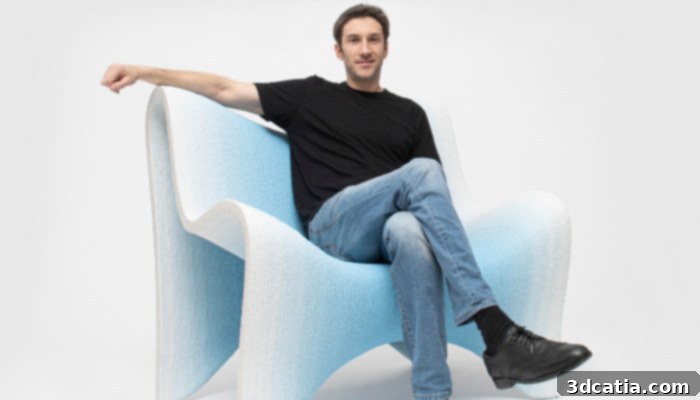
Designer Philipp Aduatz with the Gradient fauteuil. (Photo Credits: Philipp Aduatz)
What are your thoughts on Philipp Aduatz’s groundbreaking Gradient Furniture Collection and his innovative use of additive manufacturing in the creative industry? We invite you to share your insights and comments below, or engage with us on our social media platforms – find us onFacebook,Twitter, andLinkedIn! To stay at the forefront of the latest advancements in 3D printing technology, materials, and applications, sign up for our free weekly newsletter here, delivering the most relevant 3D printing news directly to your inbox!