
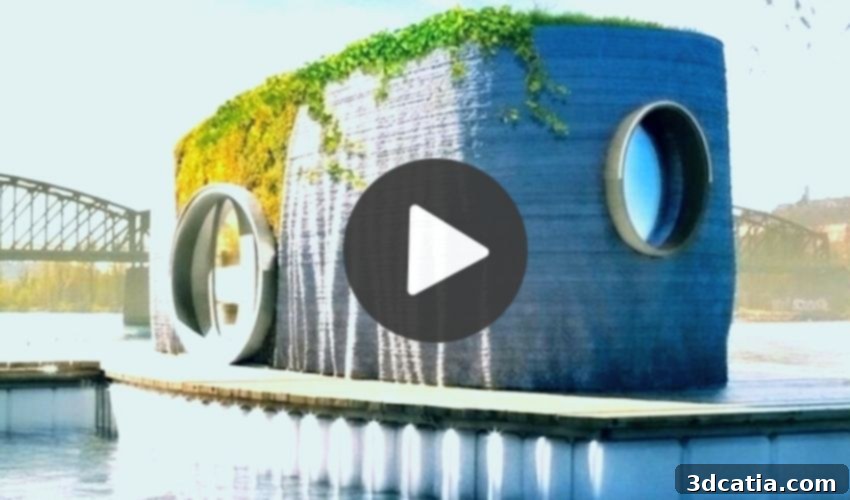
From 3D Printed Homes to Sustainable Energy: This Week’s Top 5 Additive Manufacturing Innovations
Welcome to our weekly showcase of the most captivating developments in the world of additive manufacturing. Every Sunday, we bring you a curated selection of the top five videos that highlight the dynamic and ever-expanding presence of 3D printing across diverse industries. Additive manufacturing, often referred to as 3D printing, is no longer a niche technology; it’s a transformative force reshaping sectors from construction and healthcare to industrial production and energy. This week, prepare to delve into groundbreaking applications, including a detailed look at the financial aspects and feasibility of 3D-printed houses, the meticulous process of creating medical models using advanced 3D printing techniques, and how leading companies like Stratasys are integrating their equipment to enhance traditional CNC manufacturing workflows. Furthermore, we explore the crucial role of additive manufacturing in driving the energy transition and offer a valuable replay of our recent insightful webinar on breaking boundaries with pellet 3D printing. Join us as we uncover these fascinating advancements and let us know which innovation captures your imagination the most! Happy Sunday and enjoy the future unfolding before your eyes.
Top 1: A Closer Look at the Realities of 3D Printed Houses
The promise of additive manufacturing in construction is revolutionary: faster build times, significantly enhanced efficiency, and substantially lower costs compared to conventional building methods. This week’s premier video dives deep into the burgeoning field of 3D-printed homes, presenting an invaluable overview for anyone curious about the future of housing. You’ll embark on a visual tour of existing 3D-printed residences, gaining insight into their structural integrity and aesthetic appeal. Beyond the impressive visuals, the video offers a balanced exploration of the pros and cons inherent in utilizing 3D printing for construction. It addresses critical questions about durability, regulatory compliance, and the long-term viability of these innovative structures. Furthermore, you’ll discover the pioneering 3D printing companies that are at the forefront of designing and constructing these advanced buildings, pushing the boundaries of what’s possible in the housing sector. Crucially, the segment provides practical information on the budget expectations associated with 3D-printed construction, helping to demystify the investment required for these modern dwellings. Is this groundbreaking approach truly the future of home construction? Watch the comprehensive video to uncover the compelling answers and form your own conclusions about this evolving architectural marvel!
Top 2: Precision in Healthcare: Utilizing 3D Printers for Medical Models
In an era defined by rapid advancements in automation, innovation, and digitization, digital manufacturing platforms are becoming indispensable tools across various industries. The Shapeways digital manufacturing platform exemplifies this trend, providing clients with unparalleled access to high-quality production for their intricate projects. Among the sectors reaping significant benefits from the precision and versatility of Shapeways’ technology is the medical field. Additive manufacturing, through platforms like Shapeways, is increasingly employed to produce highly accurate and detailed medical models, revolutionizing patient care, surgical planning, and medical education. The accompanying video offers an insightful explanation as to why additive manufacturing is exceptionally well-suited for the creation of these critical models. It highlights the technology’s ability to produce complex geometries and reproduce anatomical structures with remarkable fidelity, a capability often unachievable with traditional manufacturing methods. You’ll learn about the diverse applications that are now being realized through 3D printing in medicine, from pre-surgical planning models that allow surgeons to practice complex procedures, to patient-specific anatomical replicas for educational purposes, and even custom guides for medical interventions. This video illustrates how digital manufacturing is enhancing accuracy, speeding up development cycles, and ultimately contributing to better patient outcomes in the medical domain.
Top 3: Boosting Efficiency with Stratasys 3D Printed Soft Jaws for CNC Manufacturing
Optimizing manufacturing processes is a continuous pursuit for industrial companies, and integrating innovative technologies often provides a competitive edge. East/West Industries, a prominent player in its field, sought to alleviate the operational strain on its existing CNC (Computer Numerical Control) capabilities. Their solution involved strategically incorporating the advanced Stratasys Fortus 450mc 3D printer directly into their production workflow. This pivotal decision allowed them to leverage additive manufacturing for specific applications that traditionally consumed valuable CNC machine time. In this compelling video, the dedicated team at East/West Industries elaborates on the tangible benefits reaped from this integration. They highlight how 3D printing offers unique advantages over conventional CNC milling, particularly in terms of speed, cost-effectiveness, and design flexibility for certain components. The application of 3D-printed soft jaws serves as an excellent illustration of these benefits. Soft jaws, essential custom components used in vises to hold workpieces securely during machining, can be rapidly produced with specific contours using 3D printing, eliminating lengthy setup times and material waste associated with milling. The video clearly demonstrates why the Stratasys Fortus 450mc is ideally suited for implementing these types of solutions, showcasing its capability to produce durable, precise parts that complement and enhance traditional manufacturing processes. Discover how this synergy between additive manufacturing and CNC is driving greater efficiency and innovation.
Top 4: The Transformative Importance of Additive Manufacturing for Energy Transition
Additive manufacturing (AM) is rapidly emerging as a cornerstone technology for companies committed to innovation and sustainability, particularly within the energy sector. For Baker Hughes, a global leader in energy technology, AM is not just a tool but a critical enabler for revolutionizing their products and optimizing their manufacturing facilities. They are actively embracing 3D printing to explore novel design concepts that promise to significantly enhance the performance of their engines and dramatically reduce their environmental footprint. The inherent design freedom offered by additive manufacturing is a game-changer; complex geometries and intricate internal structures, once impossible or prohibitively expensive to produce, are now readily achievable. This capability allows engineers to create components with optimized airflow, improved thermal management, and reduced weight, all contributing to greater efficiency and durability. AM technology provides unparalleled flexibility and substantial cost reductions in the design and production of advanced gas turbines. Baker Hughes is strategically deploying this technology to engineer next-generation gas turbines capable of burning environmentally friendly fuels, such as hydrogen, with enhanced safety and efficiency, critically minimizing hydrogen leakage during their operational processes. The following video powerfully illustrates how additive manufacturing is facilitating the development of specialized parts for these advanced energy applications, showcasing components designed for extended service life, superior performance, and a cleaner energy future. Witness how AM is powering the energy transition forward.
Top 5: Breaking Boundaries and Expanding Material Possibilities with Pellet 3D Printing
In a recent and highly anticipated 3Dnatives webinar, we had the privilege of hosting industry innovators from Tumaker and EMPA (Swiss Federal Laboratories for Materials Science and Technology) to delve into the fascinating world of pellet 3D printing. This insightful session provided a comprehensive understanding of how pellet 3D printing functions, highlighting its fundamental differences and superior advantages over traditional filament-based extrusion methods. A key takeaway from the discussion was the immense potential of pellet 3D printing, especially when scaling up to more industrial additive manufacturing applications. The technology liberates manufacturers from the limitations of filament spools, allowing for the use of a significantly wider range of technical materials. This includes industrial-grade polymers, recycled plastics, and even custom-compounded materials, all at a substantially lower cost per kilogram compared to their filament counterparts. This reduction in material cost, combined with increased flexibility in material selection and processing, makes pellet printing an attractive option for high-volume and specialized manufacturing. The webinar also provided an in-depth look at various industries that are rapidly adopting pellet 3D printing, showcasing real-world application cases presented by EMPA. Notably, its utility in the demanding domain of soft robotics was explored, demonstrating how this innovative printing method enables the creation of complex, functional parts with unique mechanical properties. If you missed this illuminating live event, you can now watch the full replay in the video below and discover how pellet 3D printing is truly breaking new ground in additive manufacturing.
What are your thoughts on the “real cost” and widespread adoption potential of a 3D-printed house? We encourage you to share your insights and engage with our community by leaving a comment below, or by connecting with us on our social media channels: LinkedIn, Facebook, and Twitter! Don’t miss out on the latest advancements and breaking news in additive manufacturing; ensure you sign up for our complimentary weekly Newsletter here, delivering the most relevant 3D printing updates directly to your inbox. For a visual feast of all our exciting content, you can always visit and subscribe to our comprehensive YouTube channel. We look forward to hearing from you and continuing this exciting journey through the world of 3D printing!
*Cover Photo Credits: 3D printed house / Source: Prvok