

Kamui Cosplay Masterpiece: Crafting the Ultimate 3D Printed Fallout Pip-Boy Replica
For many enthusiasts of the post-apocalyptic action role-playing game *Fallout*, the Pip-Boy device is more than just a piece of in-game equipment; it’s an iconic symbol of survival and adventure in the desolate wasteland. Svetlana Quindt, an ardent fan and dedicated player of the series, found herself in a common predicament among collectors: the officially licensed Pip-Boy replica was simply too large for her wrist, diminishing the immersive experience she craved. This personal frustration ignited a spark of creativity, leading her to embark on an ambitious project. She enlisted the expertise of her design partner, Benni Schwarz, and his brother Jacob, to create a custom-fitted, 3D printed replica of the legendary Pip-Boy device. Leveraging the precision of a Zortrax M200 desktop 3D printer, the team not only achieved a perfect fit but also set a new standard for prop authenticity.
Svetlana and Benni are the visionary duo behind Kamui Cosplay, a name synonymous with excellence in the world of costume and prop design. Hailing from Germany, they officially launched their venture in 2003, transforming their passion for cosplay into a globally recognized business. Over the years, Kamui Cosplay has become a trusted partner for some of the biggest names in entertainment, including Blizzard Entertainment, Electronic Arts, and Lucasfilm Ltd., crafting breathtaking props and intricate costumes that bring digital worlds to life. Their work is a testament to the seamless integration of traditional handcrafting techniques with cutting-edge technologies like 3D printing, allowing them to elevate their designs to an unprecedented level of professional polish and intricate detail.
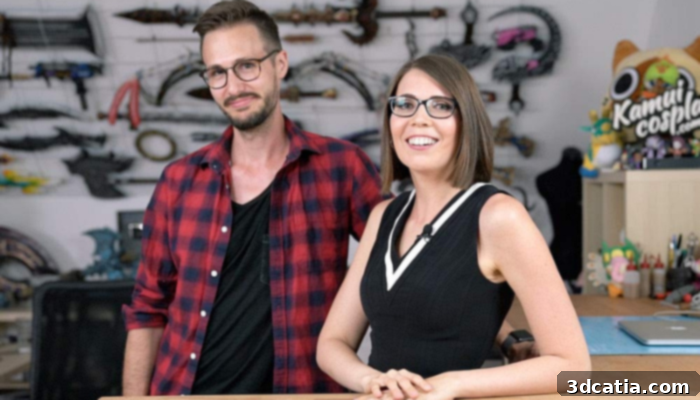
Svetlana Quindt and Benni Schwarz in their workshop. (Photo Credit: Kamui Cosplay)
Embracing Innovation: The Transformative Power of 3D Printing in Cosplay
The adoption of 3D printing marked a pivotal moment for Kamui Cosplay, opening up new avenues for creativity and efficiency that traditional methods alone couldn’t match. Svetlana articulates this synergy perfectly: “While you can still build pretty much everything with traditional materials, there is a certain ‘charm’ to things looking perfectly clean. So 3D printing is very good for that. Also, I can still build other things by hand while my printer is working on something so it’s a win-win situation.” This highlights a crucial benefit: 3D printing doesn’t replace handcrafting but augments it, allowing for parallel workflows and the achievement of a level of precision and smoothness often difficult to attain manually. The ability to produce complex geometries, fine details, and custom sizes with consistent quality has been instrumental in distinguishing Kamui Cosplay’s work in a highly competitive field.
Beyond aesthetic perfection, 3D printing introduced significant practical advantages. The technology enabled the Kamui team to rapidly prototype ideas, iterate on designs, and ultimately produce lightweight yet durable components in a fraction of the time compared to conventional fabrication. Svetlana further emphasizes this, stating, “With 3D printing now I can create lightweight and durable parts in a matter of hours.” This leap in efficiency has been a game-changer, facilitating the growth of Kamui Cosplay from a beloved hobbyist endeavor into a highly sought-after professional business, capable of meeting the rigorous demands of major video game publishers and film studios.
From Digital Blueprint to Physical Prop: The Pip-Boy Creation Process
Sourcing and Scaling the Digital Model
The journey to crafting a bespoke Pip-Boy began in the digital realm. The team initiated the project by downloading the necessary .stl files – the standard format for 3D printable models – from ytec3d, a renowned source for high-quality replica designs. This initial step is critical for any 3D printing project, as the quality of the digital model directly impacts the final physical product. Once acquired, the files were meticulously reviewed and, more importantly, scaled to ensure a perfect, customized fit for Svetlana’s wrist. This customization capability is a hallmark of 3D printing, allowing for personal adaptations that off-the-shelf items or mass-produced replicas simply cannot offer. The Pip-Boy design, consisting of approximately 40 individual pieces, required careful organization and planning before any material could be extruded.
Precision Printing with Zortrax M200 and Z-ABS Filament
With the digital preparations complete, the team moved to the manufacturing phase, utilizing their trusty Zortrax M200 desktop 3D printer. The Zortrax M200 is known for its reliability and precision, making it an ideal choice for detailed prop fabrication. For the Pip-Boy’s casing and numerous intricate components, they selected Z-ABS filament. Z-ABS is a versatile material particularly well-suited for short-series production of casings, accessories, and props, primarily due to its excellent mechanical properties and ease of post-processing. Its durability ensures that the finished Pip-Boy would withstand the rigors of cosplay events and handling, while its chemical and mechanical treatability simplify the finishing stages.
The printing of all 40+ pieces was a meticulous process, requiring precise calibration and patient oversight. Each component, from the main casing to the smallest button, was printed with a focus on accuracy and structural integrity. The choice of Z-ABS filament was strategic, offering a good balance between strength, printability, and the ability to achieve a smooth, professional surface finish through subsequent post-processing steps. This stage alone demonstrated the immense time-saving benefits of 3D printing; producing such complex, interlocking parts by hand would have demanded hundreds of hours of labor, whereas the Zortrax M200 efficiently brought the digital designs into the physical world.
The Art of Post-Processing: Bringing Realism to Life
Post-processing is undeniably the most crucial and labor-intensive phase in transforming a raw 3D print into a display-worthy replica. It’s where the printed plastic truly begins to emulate the weathered, functional appearance of the in-game Pip-Boy. The Kamui Cosplay team approached this stage with their characteristic attention to detail, employing a range of techniques to achieve an authentic finish.
Initial Cleanup and Sanding
Once all 40+ pieces emerged from the Zortrax M200, the first step involved carefully removing any support material. Supports are essential during the printing process to prevent overhangs from collapsing, but their removal requires precision to avoid damaging the delicate printed details. Following this, an extensive sanding process began. This wasn’t just about smoothing surfaces; it was about meticulously shaping and rounding edges to mimic the natural wear and tear of a utilitarian device from the *Fallout* universe. Starting with coarser grits and progressively moving to finer sandpaper, the team worked to eliminate layer lines and imperfections, preparing the surfaces for subsequent treatments.
Chemical Fusion and Structural Integrity
A unique advantage of ABS filament is its responsiveness to chemical treatments, particularly acetone. To ensure a robust and seamless assembly, the team utilized acetone to dissolve small amounts of ABS material, creating a powerful ABS slurry. This “liquid plastic” acted as an incredibly strong adhesive, effectively bonding the various casing components together, resulting in a cohesive and durable structure that felt less like individual prints and more like a single, manufactured unit. This method not only provided superior adhesion but also helped to fill minor gaps and create a more unified appearance.
The Alchemy of Painting and Weathering
The final, and perhaps most artistic, stage was painting and weathering. To achieve the iconic, worn-and-weathered rusty metal look of the Pip-Boy, the team employed a multi-layered painting technique. This involved a base coat, typically a metallic shade, followed by strategic application of acrylic paints mixed with water. This dilution allowed for the creation of translucent washes that could be layered to build up depth and texture, simulating grime, rust, and general degradation. Dry-brushing techniques were used to highlight raised areas and simulate worn edges, while darker washes settled into recesses, accentuating details and adding to the illusion of age. The artistic skill involved in this stage cannot be overstated; it’s the difference between a painted plastic prop and a believable artifact from the *Fallout* universe.
The Impact of Innovation: Beyond a Single Prop
The creation of Svetlana’s custom Pip-Boy replica stands as a shining example of how 3D printing is revolutionizing the cosplay and prop-making industries. It underscores the potential for personalized creation, allowing individuals to overcome the limitations of mass-produced items and achieve perfect anatomical fit and desired aesthetics. For Kamui Cosplay, this project further cemented their reputation as pioneers, demonstrating their ability to blend traditional artistry with advanced manufacturing techniques. Their success story serves as an inspiration for hobbyists and professionals alike, highlighting that with vision and the right tools, highly detailed, durable, and customized props are within reach. The synergy between digital design and physical fabrication continues to push the boundaries of what’s possible, empowering creators to bring their favorite fictional worlds to tangible reality with unparalleled authenticity.
What do you think of Kamui Cosplay’s meticulously crafted 3D printed Pip-Boy? Share your thoughts and join the conversation in a comment below, or connect with us on our Facebook and Twitter pages. Don’t miss out on the latest innovations and stories from the world of additive manufacturing – be sure to sign up for our free weekly newsletter, delivering all the essential 3D printing news straight to your inbox!
Cover Photo Credit: Kamui Cosplay