
Revolutionizing Metal 3D Printing: Cambridge Researchers Harness Holography for Enhanced Speed, Precision, and Quality
At the prestigious University of Cambridge, a groundbreaking three-year research program has commenced, aiming to fundamentally transform the landscape of metal additive manufacturing. This pioneering initiative leverages the advanced capabilities of computer-generated holography to significantly accelerate the production of 3D printed metal parts. Holography, a sophisticated photographic process, skillfully reproduces the intricate relief of objects by utilizing the interference patterns generated by two laser beams. This innovative approach promises not only to drastically improve the quality and mechanical integrity of the resulting printed components but also to offer unprecedented control over the metallic powder dynamics during the complex printing process. Effective management of metal powder remains a critical challenge in current additive manufacturing techniques, often subject to numerous technical prerequisites and difficulties in real-time monitoring. By overcoming these existing technical constraints, this ambitious research program is poised to catalyze the broader adoption of metal additive manufacturing across various industries, unlocking its full potential.
While the metal 3D printing industry experiences robust growth year after year, it continues to be characterized by its technical complexity, substantial cost, and relatively cumbersome implementation. These factors have, to some extent, hindered its widespread industrial application. In response to these persistent challenges, Professor Tim Wilkinson and his dedicated team at the University of Cambridge are at the forefront of efforts to refine and optimize laser powder bed fusion (LPBF) technology through the innovative application of computer-generated holography. Peter Christopher, a PhD student specializing in ultra-precision engineering and a key member of the research team, articulates the increasing relevance of 3D printing in modern society: “3D printing is becoming ever more popular today, both for hobbyists and for commercial projects. During the COVID-19 pandemic for example, we have seen thousands of scientists, engineers, researchers and medical professionals, 3D printing parts for ventilators in mere hours, whereas traditional approaches would have taken months or years to set up. Metallic 3D printing or additive manufacture (AM) has been slower to catch on, in part due to high expense, difficulty of use and technical challenges. Nowadays though, it is beginning to find use in small batches of complex parts.” This observation underscores the urgent need for innovations that can reduce costs, simplify operations, and mitigate technical hurdles, thereby expanding the applicability of metal AM beyond niche markets.
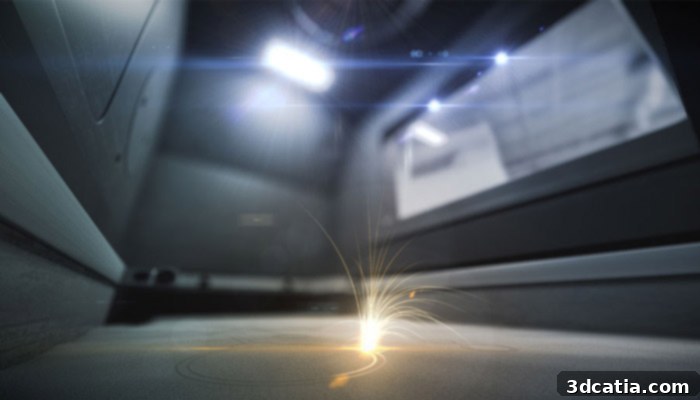
The laser powder bed fusion process is one of the most widely used metal AM technologies and the focus of Cambridge’s holographic research.
Unveiling the Power of Holograms: Precision Heat Distribution in Metal AM
As widely understood in the additive manufacturing community, the laser powder bed fusion process operates on a fundamental principle: a powerful laser precisely melts layers of metallic powder, releasing intense thermal energy, before a new layer of material is successively added to build the desired part. However, the meticulous control of this localized thermal energy distribution is notoriously difficult. Inadequate or uneven heat distribution can lead to a cascade of problems, including significant part distortion, residual stresses within the material, porosity, and an overall reduction in the mechanical properties and dimensional accuracy of the final component. These challenges pose significant barriers to the consistent production of high-quality metal parts for demanding applications such as aerospace, medical implants, and automotive components.
This is where the transformative potential of holography comes into play. With this advanced optical technique, the energy from the laser can be precisely distributed not just in two dimensions, but throughout the three-dimensional volume of the melt pool using sophisticated optical diffraction principles. Imagine a hologram as a dynamic, reconfigurable lens that can sculpt laser light with unprecedented precision. Instead of a single, fixed laser beam, the hologram effectively allows for the creation and simultaneous control of multiple, independent light beams. This multi-beam capability means that heat can be applied to various points within the powder bed concurrently and with varying intensities, enabling a much more nuanced and efficient melting process. Crucially, this fusion process can be monitored in real-time, feeding data back into a control system that can instantaneously recalculate and adjust the hologram. This dynamic feedback loop empowers continuous control over the shape, size, and thermal profile of the melt pool, ensuring optimal fusion conditions at every step. The research team emphasizes that the ultimate goal of this intricate system is a dual benefit: dramatically improving printing speed without compromising part quality, and effectively eliminating the array of technical constraints that currently limit the widespread industrial adoption of metal AM.
Advanced Control and Future Innovations Through Holographic AM
Peter Christopher further elaborates on the profound impact of their innovative holographic technique: “As a result of our holographic technique, we can use multiple light beams at the same time in order to build up a structure in a more three-dimensional way, and we can control the direction in which the light is travelling. This allows us greater control over any imperfections.” This statement highlights a pivotal advantage: the ability to precisely direct and shape laser energy in three dimensions offers an unprecedented level of control over the material’s microstructure and macro-structure. By mitigating localized overheating or underheating, the risk of common defects such as porosity, cracks, and delamination is significantly reduced. This leads to parts with superior mechanical properties, including enhanced strength, ductility, and fatigue resistance, critical for high-performance applications. The capacity to build structures in a more intrinsically three-dimensional manner, rather than layer-by-layer as is typical, could also pave the way for entirely new part geometries and material compositions.
Moreover, the research team envisions a broader impact extending beyond just the AM process itself. Peter adds, “We also hope that a new generation of liquid crystal displays will be produced as a result of this research, designed specifically for high power laser illumination in AM processes.” This ambitious goal points towards the development of specialized optical components capable of handling the intense laser power required for metal fusion, while simultaneously providing the high resolution and rapid reconfigurability essential for holographic beam shaping. Such advancements in display technology could not only enhance the performance and longevity of holographic AM systems but also find applications in other fields requiring precise laser manipulation. The synergy between holographic research and optical component development exemplifies the potential for cross-disciplinary innovation stemming from this project.
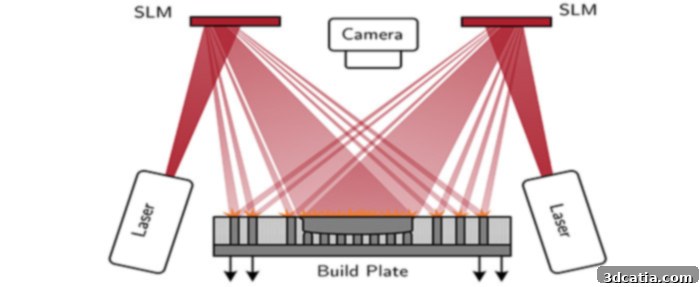
The innovative configuration of the new holographic metal 3D printing process | Credits: Peter Christopher
The Broader Impact of Holographic Metal 3D Printing
The implications of this research extend far beyond academic interest, promising to profoundly influence various industrial sectors. For the aerospace industry, where lightweighting and complex geometries are paramount, holographic metal 3D printing could enable the creation of even more intricate, performance-optimized parts with enhanced structural integrity, leading to more fuel-efficient aircraft and advanced spacecraft. In the medical field, the ability to precisely control material properties and part quality opens doors for customized implants and prosthetics that perfectly match patient anatomy and biological requirements, reducing rejection rates and improving patient outcomes. The automotive sector could benefit from faster production of complex, high-strength components, facilitating rapid prototyping and enabling innovative designs for next-generation vehicles.
Furthermore, the increase in printing speed coupled with enhanced quality control addresses two of the most significant bottlenecks currently facing metal additive manufacturing. By reducing production times and minimizing post-processing requirements (due to fewer defects and better surface finish), the overall cost-effectiveness of metal 3D printing will improve dramatically. This enhanced efficiency makes the technology more accessible to small and medium-sized enterprises (SMEs), fostering innovation and competitiveness across the manufacturing landscape. The research from Cambridge University, a beacon of scientific excellence, is not just about a technological advancement; it’s about building a foundation for a more efficient, precise, and sustainable future for industrial manufacturing.
You can delve deeper into the specifics of this groundbreaking research project by visiting the official University of Cambridge engineering news page HERE. This direct source offers further technical details and insights from the team leading this transformative work.
We’d love to hear your thoughts on this exciting development! What do you think about the potential of using holograms to propel metal 3D printing into a new era of efficiency and quality? Share your opinions, questions, and insights in the comments section below, or join the conversation on our Facebook and Twitter pages. Don’t forget to sign up for our free weekly Newsletter to ensure you receive all the latest news, trends, and breakthroughs in the dynamic world of 3D printing directly to your inbox!