
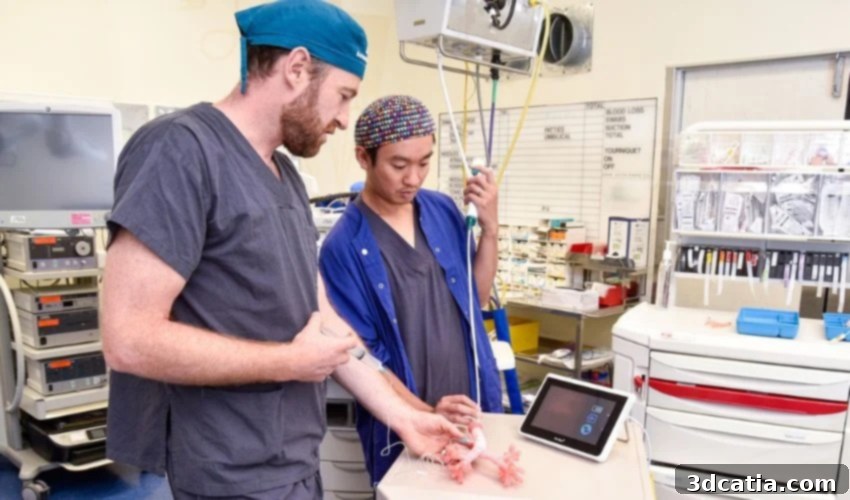
Simpath: Revolutionizing Medical Training with Hyper-Realistic 3D Printed Anatomical Models
The landscape of healthcare has been profoundly transformed by the advent of 3D printing technology. Its capacity to produce highly customized models, ranging from intricate anatomical replicas to patient-specific implants, has opened new frontiers in medical practice and education. At the forefront of this innovation is Simpath, a dynamic startup established in 2023. Simpath is dedicated to developing exceptionally realistic 3D models specifically tailored for anesthesia and respiratory medicine. By harnessing advanced additive manufacturing techniques, Simpath crafts anatomical structures with unparalleled detail, promising to significantly enhance medical simulation, training methodologies, and the crucial development of new medical devices. In an exclusive interview with the Simpath team, we delved into how these groundbreaking models are poised to shape the future of medical education and explored the intricate process behind their creation, particularly focusing on their advanced tracheal models.
Simpath’s Genesis: Founders, Vision, and the Role of 3D Printing in Medical Innovation
The foundation of Simpath is built upon a diverse and highly specialized team, comprising experts from both the medical and design fields. Anesthetists James Broadbent and Jeremy Young, alongside industrial designers Bernard Guy and Nicole Hone, bring a unique synergy to the company. Each team member possessed extensive experience in 3D printing within their respective disciplines even before Simpath’s inception. Their individual careers were marked by continuous engagement with cutting-edge technologies through academic pursuits and rigorous research activities. Pioneering work, such as 3D-printed pediatric tracheostomies and advanced 4D pneumatic printing techniques, laid the essential groundwork for what would eventually evolve into Simpath. The team’s collaboration began through joint projects between universities and hospitals, where they recognized the immense potential in combining their varied expertise to address critical needs in medical training.
Simpath was born from a very clear and ambitious objective: to dramatically elevate the quality of training tools available for airway management and patient care. The founders identified a significant void in the market for anatomical models that not only offered visual and tactile realism but also accurately captured the dynamic and complex nature of the human body. Their driving ambition is to engineer interactive models that effectively bridge the divide between conventional physical models and emerging digital simulations. This integrated approach aims to deliver a more comprehensive and deeply immersive learning experience for healthcare professionals at all stages of their careers.
One of Simpath’s most distinctive strengths lies in the robust and continuous collaboration between its clinicians and designers. This interdisciplinary approach ensures that every model is both medically accurate and innovatively designed. The healthcare professionals contribute invaluable contextual expertise, pinpointing the specific needs and challenges within the industry, and conducting rigorous testing to validate the models’ efficacy. Concurrently, the design team approaches these identified needs with creative problem-solving, translating complex medical requirements into concrete, functional, and highly innovative solutions that push the boundaries of medical simulation.
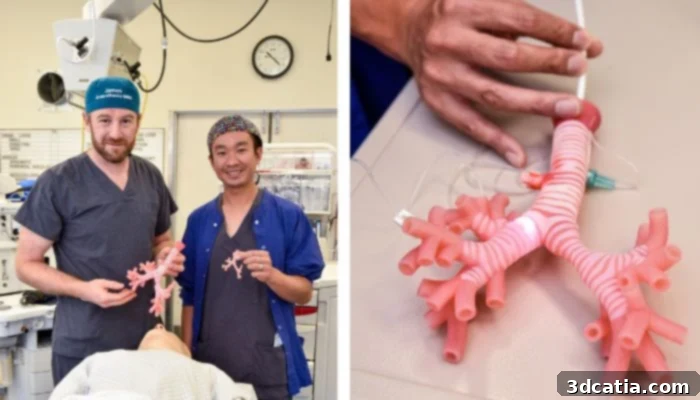
James Broadbent (left), Jeremy Young (right), and a close-up of their model.
Innovating Medical Training: Current Projects and Noteworthy Models
Simpath is actively engaged in several cutting-edge projects aimed at enhancing medical training. A primary focus is the development of a pediatric model specifically engineered for training in the critical CICO (Can’t Intubate, Can’t Oxygenate) procedure. This sophisticated training device incorporates multiple components designed for realism and repeated practice. It features a fixed head and neck section, complemented by a flexible, interchangeable trachea. This modular design allows trainees to practice the CICO procedure repeatedly under conditions that closely mimic real-life scenarios, thereby building confidence and proficiency in a high-stakes medical emergency.
Simultaneously, the team is continuously refining and expanding its dynamic airway model. This advanced model is being enhanced by integrating surrounding anatomical structures, thereby making the simulation experience even more lifelike and comprehensive. Designed to replicate an adult trachea with an unprecedented level of realism, this model incorporates dynamic pathologies and innovative features that are truly transforming how airway management training is conducted. The ability to simulate changing conditions within the airway provides a training experience far beyond what static models can offer.
The key differentiator for Simpath’s models, especially the trachea, lies in their ability to replicate complex internal abnormalities and dynamic functions. Unlike conventional static models or those crafted from a single material, Simpath’s trachea can simulate crucial physiological processes such as dilation and constriction, active bleeding, and even arterial pulsations. This sophisticated approach delivers an immersive and interactive simulation experience, providing both vital visual and tactile feedback. It is precisely this tangible dimension – the ability to feel and interact with a lifelike anatomical structure – that grants physical models a decisive advantage over purely virtual simulations, allowing for a deeper, more embodied understanding of complex medical procedures.
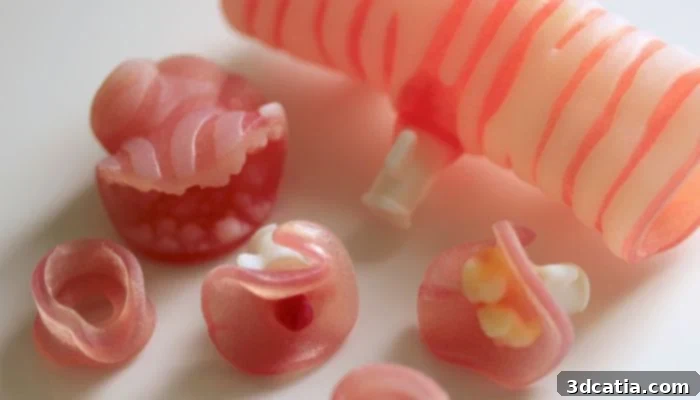
Dynamic airway model with various realistic components.
Simpath’s dynamic models empower medical professionals to simulate a wide array of complex procedures and critical emergency scenarios. For instance, the models facilitate the practice of precise interventions: injecting fluid through a minute opening in the tracheal wall can realistically replicate the active bleeding of a tumor, allowing trainees to practice hemorrhage control. The intricate design also supports advanced surgical exercises, such as the creation of a fluid-filled cyst, followed by a meticulous incision and aspiration of its contents. Furthermore, users can accurately recreate common pathologies like tracheal stenosis, where the inner walls of the trachea can be inflated or constricted to form a narrowed passageway, providing invaluable experience in managing compromised airways.
Applications of Simpath’s Anatomical Models
Simpath’s advanced anatomical models are primarily designed to significantly enhance surgical and medical training across various specialties. Clinicians, from residents to experienced surgeons, and medical students can utilize these hyper-realistic models to practice an extensive range of procedures, preparing them thoroughly for real-world emergency situations. The models offer an ethically sound and highly effective alternative for performing complex surgical or exploratory techniques, delivering an unmatched level of realism without involving live subjects. This ethical aspect is paramount in modern medical education, allowing for repeated practice and mastery of skills in a safe and controlled environment.
Beyond training, these sophisticated models serve as invaluable tools for product testing and the development of new medical devices. In these applications, the accuracy of anatomical conditions is absolutely essential for rigorously evaluating the performance, safety, and efficacy of prototypes and emerging technologies. Manufacturers can test how devices interact with realistic tissue properties and complex anatomical structures, accelerating innovation cycles. Additionally, Simpath’s models are excellent educational aids for patient communication. By providing a tangible, visual, and interactive representation of medical conditions and proposed treatments, these models help patients and their families understand complex diagnoses and procedures more clearly, fostering informed decision-making and alleviating anxiety.
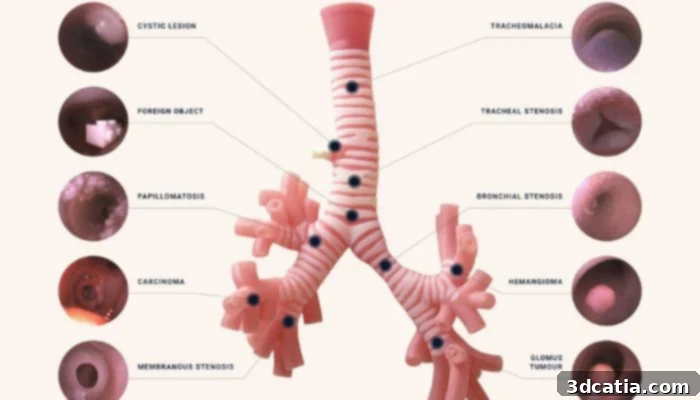
The 3D model allows for the simulation of various emergency scenarios.
Materials and Advanced Manufacturing Processes
Simpath’s design philosophy is meticulously centered on capturing the unique individuality of each case, accounting for factors such as age, specific health status, and anatomical variations. This approach represents a significant evolution from traditional anatomical models, moving beyond static, generic representations to truly data-based and patient-specific simulations. To achieve this high level of customization and ensure seamless compatibility with existing medical devices, Simpath integrates advanced medical imaging techniques like CT scanning with sophisticated 3D modeling software, including Rhino and ZBrush. These digital models then serve as the blueprint for manufacturing.
The manufacturing process relies heavily on PolyJet multi-material 3D printing, a technology chosen for its ability to create remarkably realistic textures and varying material properties within a single print. PolyJet printers jet minute droplets of photopolymer material that are immediately cured by UV light, allowing for the precise layering of different materials. This versatility is crucial for Simpath, as it enables them to replicate the diverse consistencies of human tissues, from the delicate softness of epithelium to the firm elasticity of cartilage. The ability to print multiple materials with different Shore hardness values within one model ensures that the tactile feedback is as accurate as the visual representation, enhancing the realism for training purposes.
Clinical validation forms an indispensable step in Simpath’s rigorous development process, ensuring that their models are not only anatomically correct but also functionally suitable for simulation use. This involves extensive testing and feedback from medical professionals. For instance, their advanced trachea model can be utilized to vividly visualize complex respiratory conditions such as asthma or bronchoconstriction. This allows trainees to understand precisely why patients experience breathing difficulties under these conditions and effectively demonstrates the critical role of pharmacological treatments in inducing bronchodilation. Such direct, experiential learning significantly deepens the understanding of disease mechanisms and treatment responses.
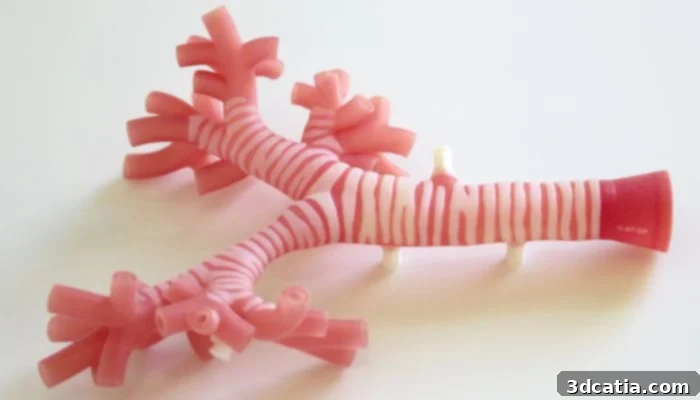
Close-up of the trachea model.
Navigating the Challenges of 3D Printed Anatomical Models
Creating advanced 3D printed anatomical models for medical training is not without its significant challenges. One of the foremost hurdles for Simpath is achieving a delicate balance between hyper-realism and functional utility. Unlike static models that merely require visual accuracy, Simpath’s designs must actively replicate dynamic physiological conditions. This necessitates an exceptionally precise control over both the material composition and the intricate geometric structures of the models, all optimized to ensure peak realism without compromising performance during simulation. For instance, replicating the flexibility of a trachea while maintaining the texture of its internal lining requires sophisticated material science and printing expertise.
Furthermore, the materials employed in PolyJet printing, while versatile, can present inherent fragility, particularly when forming very small or intricate structures. This fragility demands careful design considerations and post-processing techniques to ensure the longevity of the models. Another major challenge is guaranteeing the long-term durability of these sophisticated models. They must be robust enough to withstand repeated, intensive use in training environments without any degradation in their realism or functional integrity. This often involves developing novel reinforcement strategies or combining materials in innovative ways. Overcoming these challenges is vital for Simpath to deliver reliable, high-fidelity training tools that can withstand the demands of medical education.
Simpath’s Vision for the Future of Medical Education
Drawing inspiration and methodology from their research published in the esteemed journal Anaesthesia and Critical Care, Simpath is committed to an ambitious long-term vision. Their goal is to develop comprehensive surgical training programs, cutting-edge simulation models, and highly accurate physical anatomical representations that will profoundly enhance the understanding and skills of both clinicians and patients. They recognize that while digital representations in medicine are continually advancing, they can sometimes lack the consistency and tangible feedback necessary for hands-on procedural training. Simpath’s new generation of high-resolution, full-color physical models of the human body provides an unparalleled wealth of information, effectively addressing and overcoming the limitations that still exist in purely virtual or emerging digital simulation platforms.
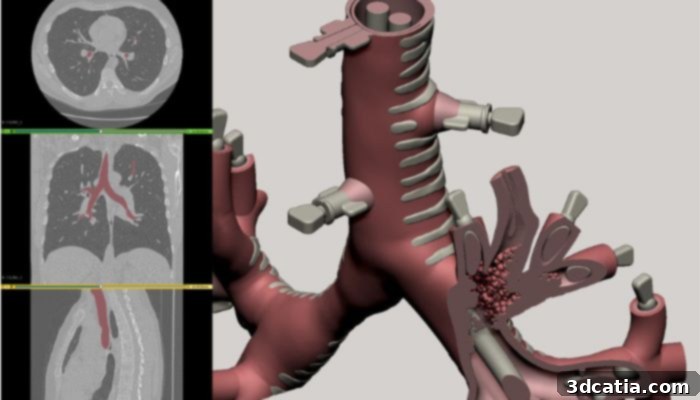
Simpath’s 3D airway model.
Simpath envisions their advanced anatomical models playing a pivotal role in simulation centers worldwide, benefiting a broad spectrum of users from aspiring medical students to highly experienced professionals seeking to refine their skills. They also identify significant opportunities for strategic collaboration with leading medical technology companies, offering their models as precision platforms for rigorous testing and comprehensive evaluation of new devices. By continuously staying at the cutting edge of 3D printing technologies and integrating ongoing, invaluable clinical feedback from practitioners, Simpath aims to be a driving force of innovation in medical education. Ultimately, their mission is to make a profound and positive impact on patient care by enabling better-trained medical professionals. To learn more about Simpath’s groundbreaking work or to get in touch with their team, you can click HERE.
We invite you to share your thoughts on Simpath’s innovative work. Let us know what you think in a comment below or connect with us on our LinkedIn or Facebook pages! Additionally, don’t miss out on the latest advancements in additive manufacturing by signing up for our free weekly Newsletter, delivered directly to your inbox. You can also explore all our videos and interviews on our YouTube channel. For more news and insights into 3D printing within the medical sector, please visit our dedicated page HERE.
*Photo credits: Simpath