
ORNL Unveils Comprehensive 3D Printing Datasets to Advance Additive Manufacturing Quality Control and Industrial Adoption
The Department of Energy’s Oak Ridge National Laboratory (ORNL) continues its unwavering commitment to fostering the growth and industrialization of additive manufacturing across the United States. While often recognized for breakthroughs in 3D printed components and advanced materials, ORNL has now taken a crucial step beyond physical innovation. In a recent significant announcement, the institution has publicly released an extensive collection of 3D printing datasets. This groundbreaking initiative aims to empower manufacturers and researchers alike, providing them with the necessary tools to rigorously verify the quality and integrity of additively manufactured parts, critically, without the reliance on time-consuming and often costly post-production analysis.
One of the most formidable hurdles impeding the widespread industrial adoption of additive manufacturing is the challenge of robust and efficient quality control. Despite numerous demonstrations proving that 3D printed parts can achieve parity with, or even surpass, the quality of components produced by conventional manufacturing techniques, the relative novelty of the additive sector means that comprehensive quality control research and standardized methodologies are still in their formative stages. Traditional manufacturing boasts decades, if not centuries, of accumulated data and refined processes for quality assurance. In contrast, additive manufacturing’s layer-by-layer nature introduces unique complexities and variables that demand innovative approaches to ensure consistent, reliable part performance. This recent announcement from ORNL marks a pivotal moment, promising to eliminate a substantial amount of the guesswork and uncertainty currently associated with certifying additively manufactured components, thereby building greater confidence in the technology.
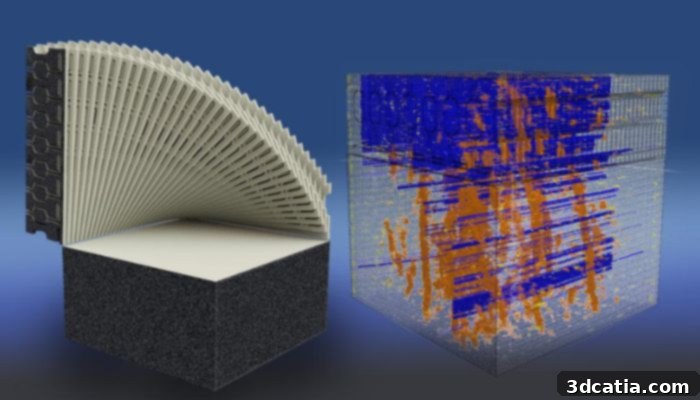
The 3D printing datasets from the ORNL are available publically and can be used for quality control (photo credits: ORNL)
Vincent Paquid, who leads the Secure and Digital Manufacturing section at ORNL, underscored the profound impact of this initiative, stating, “We are providing trustworthy datasets for industry to use toward certification of products. This is a data management platform structured to tell a complete story around an additively manufactured component. The goal is to use in-process measurements to predict the performance of the printed part.” This declaration highlights a fundamental shift in quality assurance philosophy. Instead of waiting until a part is fully fabricated to assess its quality, which often involves destructive testing or limited non-destructive methods, ORNL’s approach focuses on capturing critical data *during* the manufacturing process itself. These “in-process measurements” offer an unprecedented window into the part’s formation, allowing for real-time monitoring and, crucially, predictive analysis of its final performance. Such a holistic “story” of each component, from design parameters to printer behavior and material reactions, is indispensable for achieving the rigorous certification levels demanded by highly regulated industries like aerospace and medical.
Unveiling Extensive 3D Printing Datasets From ORNL
This recent public announcement concerns what is the fourth, and arguably the most comprehensive and extensive, in a growing series of additive manufacturing datasets released by the ORNL. The foundational data for these invaluable resources has been meticulously collected and curated over a remarkable period of more than a decade at the Department of Energy’s Manufacturing Demonstration Facility (MDF), located at ORNL. During this extensive period, ORNL researchers have relentlessly analyzed, experimented with, and thoroughly tested countless components manufactured using a diverse array of 3D printers and processes. This dedication has yielded an unparalleled wealth of information. The datasets encapsulate a broad spectrum of research efforts aimed at pushing the very boundaries of 3D printing technology, encompassing insights into novel manufacturing techniques, advanced material behaviors, and sophisticated control strategies. This decade-long investment underscores the depth and reliability embedded within these datasets.
The highlight of this latest release is a monumental 230-gigabyte dataset. This vast repository comprehensively covers the entire lifecycle of additive manufacturing for specific parts, from their initial digital design and the intricacies of their printing process to the rigorous physical testing of the final components. The dataset specifically includes information derived from five distinct sets of parts, each featuring unique geometric shapes, all fabricated using the highly precise and widely adopted laser powder bed fusion (LPBF) technique. Users accessing this data gain unprecedented insight into various critical aspects of the printing process. This includes granular machine health sensor data, offering clues about equipment performance and potential anomalies, alongside detailed laser scan paths that trace the precise movement and power of the laser during fabrication. Furthermore, the dataset contains an astonishing 30,000 high-resolution powder bed images, which are crucial for detecting defects, irregularities, and inconsistencies within each printed layer. To validate material integrity, 6,300 tests of the material’s tensile strength are also included, providing essential mechanical property data. Beyond these core elements, the datasets are intelligently structured to facilitate targeted searches for specific information, such as details pertaining to rare failure mechanisms that are notoriously difficult to predict or analyze. They also provide valuable tools for the development of innovative online analysis software and even sophisticated models for predicting and understanding material properties under various conditions. Significantly, this latest release builds upon and complements previous datasets from ORNL that focused on other additive manufacturing processes, specifically electron beam melting and binder jetting, showcasing ORNL’s broad expertise across the AM landscape.
The release of these comprehensive 3D printing datasets from ORNL represents a crucial advancement, particularly when considering the inherent limitations of current part evaluation techniques. Many traditional methods for monitoring part quality are either destructive, necessitating the sacrifice of the object—such as destructive mechanical testing to determine strength limits—or they are significantly limiting in scope. For instance, non-destructive techniques like X-ray computed tomography, while powerful, often prove impractical or entirely ineffective for inspecting large-scale additively manufactured parts due to equipment size limitations and scanning complexities. ORNL harbors significant hope that these newly released 3D printing datasets will emerge as the definitive answer to achieving better, more reliable, and ultimately more efficient quality control in the additive manufacturing sector. The institution further emphasizes that the intrinsically comprehensive nature of these datasets makes them ideally suited for training advanced machine learning models. Such models, once trained, could drastically improve the precision and speed of quality assessment for virtually any type of component produced through additive manufacturing, moving towards a future of truly smart and autonomous quality assurance.
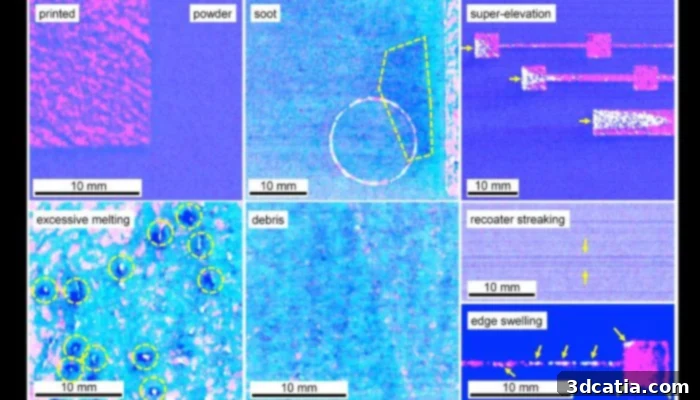
In the datasets, ORNL researchers were able to track common powder bed fusion errors and how they came about, including the ones shown above (photo credits: ORNL)
Furthermore, rigorous testing conducted by ORNL researchers has not only demonstrated the practical applicability of these datasets but has also unequivocally proven their reliability. By training a sophisticated machine learning algorithm using the wealth of measurements collected during the 3D printing process, researchers were able to establish a powerful predictive tool. The studies revealed that when this algorithm was paired with high-performance computing methods, it could reliably predict the outcome of a mechanical test, indicating whether a part would meet specific performance criteria or fail. Most impressively, this AI-driven approach resulted in 61% fewer errors when predicting the ultimate tensile strength of a part compared to traditional methods. This significant reduction in predictive error dramatically enhances confidence in the manufacturing process and reduces the need for expensive and time-consuming physical testing. The overarching hope is that this capability will empower manufacturers to make more informed decisions about whether additional, costly physical tests are truly necessary, thereby streamlining the certification process and accelerating time to market for new products.
In his concluding remarks, Piquet powerfully summarized the strategic importance of this initiative: “This is a key enabler to additive manufacturing at industry scale, because they can’t afford to characterize every piece. Using this data can help them capture the link between intent, manufacturing and outcomes.” This statement perfectly encapsulates the economic and operational imperative driving the project. For additive manufacturing to truly scale into mainstream industrial production, the prohibitively high cost and time associated with exhaustively characterizing every single part must be overcome. By providing a comprehensive, data-driven framework, ORNL’s datasets enable manufacturers to establish a clear and verifiable connection between the initial design intent, the actual manufacturing process, and the final performance outcomes. This holistic traceability is essential for meeting stringent industry standards and unlocking the full potential of additive manufacturing. The best part for the global manufacturing and research community is that these invaluable 3D printing datasets from the ORNL are freely available for public use. Interested parties can access them by clicking HERE.
These publicly released 3D printing datasets from the ORNL represent a monumental leap forward for the entire additive manufacturing ecosystem. They promise to democratize access to critical quality control insights, accelerate innovation, and significantly bolster confidence in 3D printed components. The implications for industrialization and wider adoption of additive manufacturing are profound, paving the way for more reliable, cost-effective, and efficient production processes globally.
What are your thoughts on these groundbreaking, publicly released 3D printing datasets from the ORNL? Do you believe they will play a pivotal role in the continued industrialization and broader adoption of additive manufacturing across various sectors? We encourage you to share your insights and opinions in a comment below, or engage with our community on our LinkedIn, Facebook, and Twitter pages! For the very latest updates and essential news in the world of 3D printing delivered directly to your inbox, don’t forget to sign up for our free weekly newsletter here! You can also explore all our informative videos and engaging content on our dedicated YouTube channel.