
Top 5 Weekly 3D Printing Innovations: From 3DEXPERIENCE World Highlights to Sustainable Manufacturing Breakthroughs
Welcome, innovation enthusiasts, to our latest and most exciting compilation of the top five 3D printing videos of the week! As always, we’ve meticulously curated a selection that promises to inspire, inform, and showcase the incredible advancements happening in the world of additive manufacturing. This week’s roundup is particularly diverse, kicking off with an exclusive 3Dnatives original report from the highly anticipated 3DEXPERIENCE World event. Our dedicated team ventured through the exhibition halls, unearthing the most captivating and groundbreaking projects, and we’re thrilled to bring their discoveries directly to you.
Beyond the event highlights, our chosen videos delve into critical industry applications and sustainable practices. We explore how Japanese automotive giant Toyota is leveraging additive manufacturing to revolutionize die casting processes, leading to significant improvements in efficiency and part quality for the automotive sector. Another segment shines a light on Stratasys’s cutting-edge automation in their production lines, illustrating the profound benefits this brings to productivity, cost-effectiveness, and scalability in industrial 3D printing. For those keenly interested in specialized applications, we feature a compelling video detailing how additive manufacturing is enhancing the production of electric powertrains, a crucial area for the future of transportation. Finally, we tackle one of the most pressing issues of our time: sustainability in manufacturing, by examining the transformative potential of 3D printing with recycled materials. Prepare to dive deep into these fascinating topics and uncover the latest trends shaping the future of manufacturing. Enjoy the journey through this week’s most impactful 3D printing stories!
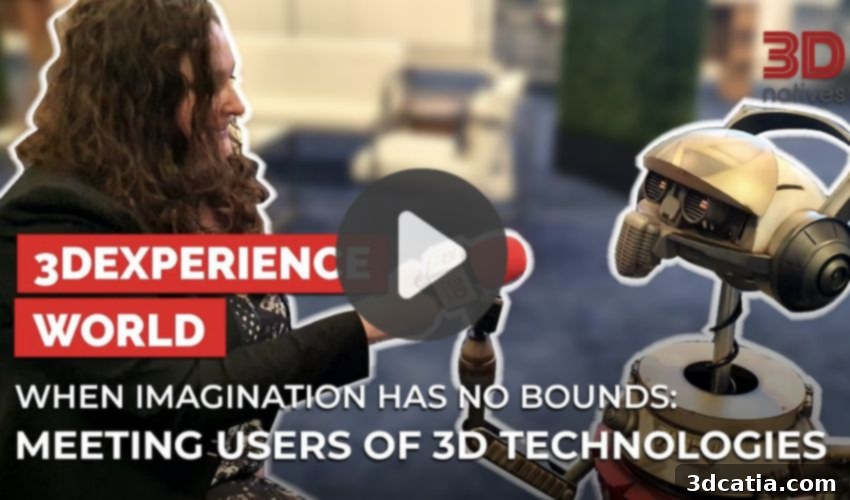
Top 1: 3DEXPERIENCE World Through 3Dnatives’ Eyes – Unveiling Future Innovations
Have you ever imagined holding a conversation with a robot crafted entirely through 3D printing? This past week, two of our esteemed team members, Madeleine and Lucia, immersed themselves in the vibrant atmosphere of 3DEXPERIENCE World in Tennessee. This premier event is a global gathering that brings together designers, engineers, manufacturers, and innovators from various industries, all converging to explore the latest trends and technologies in 3D design and simulation. Our team had the unique opportunity to scout out some of the most exciting, quirky, and truly unique projects on display, showcasing the boundless creativity enabled by advanced design and additive manufacturing technologies.
From an interactive, talking Star Wars-inspired robot that captivated attendees with its detailed articulation and functionality, to innovative 3D-printed guitar accessories designed to enhance musical performance and customization, the variety was astounding. The video below offers an exclusive glimpse into these remarkable creations, revealing the inspirations behind their conception, the diverse building methods employed (including various 3D printing techniques), and the practical as well as imaginative applications of these products. These projects not only demonstrate the technical prowess of 3D printing but also highlight its role in pushing the boundaries of what’s possible in product development and user experience. 3DEXPERIENCE World took place from February 12th to 15th, 2023, serving as a pivotal platform for sharing knowledge and fostering collaboration within the global engineering and design community. For a more comprehensive overview and detailed insights from the show, you can find our full report HERE.
Top 2: Toyota’s Strategic Adoption of Additive Manufacturing for Die Casting
Our second featured video of the week comes from the renowned Japanese automotive giant, Toyota, spotlighting their progressive adoption of additive manufacturing (AM) in their production processes. While 3D printing has long been an invaluable tool in the automotive industry for rapid prototyping and the creation of complex, lightweight end-use parts with significantly shorter lead times and improved mechanical properties, Toyota’s application goes a step further. This video reveals how Toyota is strategically employing AM to enhance the die casting process, a critical manufacturing technique for producing intricate metal parts in large volumes.
Traditionally, die casting molds face challenges related to uniform cooling and heat management, which can impact part quality and production efficiency. Toyota’s innovative approach utilizes 3D printing to create dies with advanced, three-dimensional cooling channels. Unlike conventionally machined cooling channels that are often limited to linear paths, additive manufacturing offers unparalleled design freedom, allowing engineers to design highly optimized, conformal cooling channels that closely follow the contours of the die. This geometric flexibility enables superior cooling and more uniform heat homogenization across the die surface. The immediate benefits are profound: optimal temperature control during the casting process, reduced hot spots, and consequently, a significant decrease in defects in the final cast parts.
Furthermore, the integration of these advanced cooling solutions reduces the need for extensive post-processing, such as polishing. According to the video, Toyota has successfully eliminated the need for polishing on an astonishing 80% of the part surface. This not only streamlines the manufacturing workflow but also drastically cuts down on manufacturing time and labor costs. By leveraging the precision and design capabilities of additive manufacturing, Toyota is not only improving the quality and efficiency of their die casting operations but also enhancing the overall operational rate and contributing to a more sustainable production cycle. This is a prime example of how AM is not just a tool for creating new parts, but also a powerful technology for optimizing and revolutionizing established manufacturing processes in the automotive sector.
Top 3: Stratasys P3 Production Cell – Driving Automation in 3D Printing
Stratasys, undeniably one of the pioneering giants in the 3D printing industry, continues to push the boundaries of innovation with its latest developments. Their most recent update, unveiled at the prestigious Formnext 2022 exhibition, is particularly noteworthy: the P3 Automated Production Cell. This groundbreaking system represents a significant leap towards fully automated efficiency in additive manufacturing, designed to meet the increasing demand for high-volume, reliable 3D printed parts. The P3 Production Cell integrates advanced robotics and intelligent automation to streamline the entire production workflow, from build preparation to post-processing, minimizing human intervention and maximizing output.
At the heart of the P3 cell is a sophisticated robotic arm solution, meticulously engineered to handle critical tasks such as automatically replacing and moving parts within the build chamber, as well as managing the build head itself. This robotic precision ensures consistent placement and manipulation, which is crucial for maintaining part quality across numerous builds. Once printing is complete, a specialized conveyor system seamlessly transports the newly printed parts to the post-processing station. Here, they undergo essential steps like washing to remove support materials and UV curing to enhance material properties, ensuring the parts meet desired specifications and achieve optimal strength and finish. Following these processes, the robotic arm efficiently removes the finished parts from the build head, preparing the system for the next production cycle.
The benefits of this level of automation are transformative for industrial 3D printing. Firstly, it guarantees exceptional **accuracy and repeatability**, ensuring that every part produced adheres precisely to design specifications, which is vital for critical applications. Secondly, automation significantly **reduces operational costs** by minimizing manual labor, material waste, and potential human errors, leading to a more economical production model. Thirdly, the P3 Production Cell boasts **high throughput and scalability**, enabling manufacturers to rapidly scale their production capabilities to meet fluctuating demands without compromising quality or efficiency. This continuous, lights-out operation also ensures higher utilization rates and faster turnaround times. By bringing unprecedented levels of automation to additive manufacturing, Stratasys is not only enhancing productivity but also paving the way for wider industrial adoption of 3D printing for mass customization and serial production, solidifying its role as a competitive manufacturing method for the future.
Top 4: Electric Powertrains Revolutionized by Additive Manufacturing
This insightful video originates from the leading software company Dassault Systèmes, renowned for its cutting-edge design and simulation platforms, and focuses on the groundbreaking work of Helix, an innovative electric powertrain developer. Helix collaborates closely with prominent motorcycle and automotive companies, striving to push the boundaries of electric vehicle performance and efficiency. At the core of Helix’s success is their extensive use of Dassault Systèmes’ 3DEXPERIENCE platform, an integrated environment that significantly reduces the lead time from initial concept to the final development and manufacturing of complex electric powertrain components.
Helix’s proprietary technology, known as Scalable Integrated Motor and Inverter (SIMI), exemplifies the pinnacle of electric powertrain engineering. This advanced system delivers an impressive 130kW (equivalent to 177PS or 175bhp) of peak power, as demonstrated in its application for the high-performance motorcycle brand Triumph. To achieve such remarkable power density and efficiency within often compact footprints, Helix harnesses the full potential of the 3DEXPERIENCE platform. This platform allows them to conduct extensive virtual prototyping, simulation, and optimization, ensuring that every design iteration meets the stringent technical requirements for high-performance electric vehicles while adhering to tight development deadlines.
Additive manufacturing plays a pivotal role in this process, enabling Helix to translate their highly optimized digital designs into physical components with unprecedented speed and accuracy. The design freedom offered by AM allows for the creation of intricate internal geometries, such as optimized cooling channels within the motor and inverter housing, which are critical for thermal management and sustaining peak performance. Furthermore, AM facilitates the lightweighting of components without compromising structural integrity, contributing to the overall efficiency and range of electric vehicles. By leveraging this integrated digital workflow, Helix can iterate designs rapidly, validate performance virtually, and then efficiently begin 3D printing, ensuring that their innovative powertrains are brought to market faster and with superior performance. This synergy between advanced simulation software and additive manufacturing is not only accelerating the development of next-generation electric powertrains but also setting new benchmarks for performance and efficiency in the burgeoning EV market.
Top 5: 3D Printing with Recycled Materials – A Sustainable Future
In an era where environmental consciousness is paramount, sustainability has become an imperative keyword across all manufacturing sectors, and 3D printing is no exception. As industries worldwide strive to minimize their ecological footprint, firms are increasingly eager to demonstrate their commitment to environmental responsibility. This can manifest in various ways, from implementing carbon-neutral production systems and sourcing materials locally to, crucially, integrating recycled materials into their manufacturing processes. The fifth video in our weekly roundup delves into this vital topic, exploring the exciting possibilities of 3D printing with recycled materials and its broader implications for a circular economy.
The video provides a comprehensive overview of the diverse range of recycled materials currently available for 3D printing, showcasing how these materials are being repurposed to create new, functional objects. Among the prominently featured options are PETG (Polyethylene Terephthalate Glycol), a durable and easy-to-print thermoplastic often sourced from recycled plastic bottles; TIPS (Totally Isotropic and Perpendicular Structures), which can be developed from recycled plastics; and ABS (Acrylonitrile Butadiene Styrene), a robust plastic frequently recycled from consumer goods. Beyond these, the video also highlights the emergence of various biosourced materials, which are either entirely or partially derived from renewable biomass sources, further enhancing the sustainability credentials of additive manufacturing.
While the potential for sustainable 3D printing with recycled materials is immense, the video also candidly addresses the existing barriers to their widespread adoption. These challenges are multi-faceted, encompassing social, supply chain, and technical hurdles. On the social front, there can be a resistance to change and a lingering perception that recycled materials might be inferior to virgin ones, necessitating greater awareness and education about their capabilities. Supply chain issues involve the complexities of efficiently collecting, sorting, and processing waste plastics into consistent, high-quality filaments or powders suitable for 3D printing. Establishing robust collection and recycling infrastructures is key to overcoming this. Technically, a significant challenge lies in material degradation; plastics can lose some of their mechanical properties and consistency if they are reused or reprocessed too many times, impacting the quality and reliability of the final 3D printed product. Ensuring that recycled materials maintain their specifications and performance characteristics is an ongoing area of research and development.
Despite these challenges, the drive towards sustainable practices in 3D printing is gaining significant momentum. The video offers valuable insights into the best initiatives and practices for sourcing and utilizing recycled materials effectively, from innovative recycling programs to advancements in material science that improve the longevity and performance of recycled feedstocks. For anyone passionate about environmental responsibility and the future of manufacturing, this segment is an essential watch, demonstrating how 3D printing can be a powerful tool for building a more sustainable and circular economy.
We hope this expanded weekly roundup has provided you with valuable insights into the dynamic world of 3D printing. From the cutting-edge innovations showcased at 3DEXPERIENCE World to Toyota’s advancements in automotive manufacturing, Stratasys’s strides in automation, Helix’s revolutionary electric powertrains, and the critical discussions around sustainable materials, it’s clear that additive manufacturing continues to evolve at an astonishing pace. What are your thoughts on 3Dnatives’ coverage from 3DEXPERIENCE World, or any of the other compelling topics presented this week? We’d love to hear from you!
Share your opinions and engage with our community by leaving a comment below or by connecting with us on our social media channels: find us on LinkedIn, Facebook, and Twitter! Don’t miss out on staying informed about the very latest in additive manufacturing news and updates. Remember to sign up for our free weekly Newsletter here, delivering the most important 3D printing news directly to your inbox every week. Furthermore, you can find all our engaging video content, including this week’s selections and much more, conveniently available on our official YouTube channel. Thank you for joining us, and stay tuned for more exciting developments in 3D printing!