
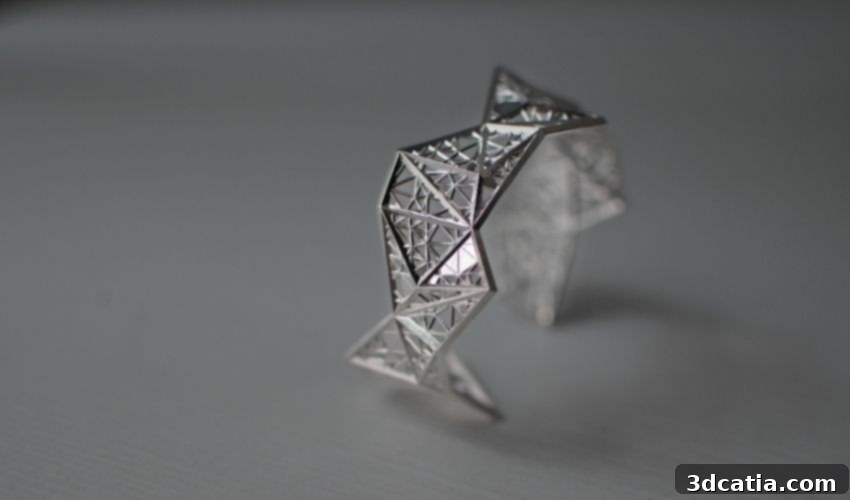
3D Printing Revolutionizes Jewelry Design: An Exclusive Interview with Invaerso’s Maria Clelia Scuteri
The jewelry industry has long been a realm of intricate detail, artistic expression, and meticulous craftsmanship. In recent years, however, additive manufacturing, commonly known as 3D printing, has emerged as a truly transformative force within this traditional sector. Its ability to create complex geometries and highly customizable pieces has repeatedly proven its immense value and potential. A striking example of this disruptive innovation is the achievement by the Indian 3D printing service, Imaginarium, which made global headlines by producing a record-breaking ring adorned with an astonishing 7,801 diamonds, all made possible through advanced 3D printing techniques. This feat alone sparks a compelling question: How precisely are 3D technologies reshaping the way we conceive, design, and produce exquisite jewelry? Beyond the technical capabilities, it’s crucial to consider the myriad benefits and potential limitations this revolutionary manufacturing method brings to a field steeped in history and artistry. To delve deeper into these fascinating developments and explore the practical applications and philosophical implications, 3Dnatives had the privilege of meeting with Roman designer Maria Clelia Scuteri, the visionary founder of the company Invaerso. In 2020, Invaerso received significant recognition by being awarded the prestigious “Worth Partnership Project,” an EU-funded initiative dedicated to fostering collaboration and supporting the European creative industry in forging innovative partnerships within the spheres of design and technological advancement.
 3DN: Could you please introduce yourself and tell us more about Invaerso?
 3DN: Could you please introduce yourself and tell us more about Invaerso?
Certainly! My name is Maria Clelia Scuteri, and I am an architect and product designer based here in Rome. Invaerso, my company, officially came to life in 2020. However, its genesis is the culmination of many years—indeed, almost a decade—of dedicated research, extensive testing, and countless prototypes that I developed in the preceding years. The core idea for Invaerso first sparked in my mind back in 2013, the very year I completed my architectural studies. During that formative period, I began accumulating invaluable know-how and practical experience, gradually cultivating a profound passion for product design. What truly fascinates me about this field is the ability to conceptualize and meticulously design a product, then proceed to produce it, rigorously test its functionality, and recalibrate it with precision until it achieves absolute perfection. The entire process, from initial thought to refined reality, can now occur within a remarkably short timeframe thanks to modern technologies. This immediate feedback loop is incredibly stimulating and exciting for me as a designer, allowing for rapid iteration and creative refinement.
3DN: Why did you choose 3D printing as a core technology? How do you integrate it into Invaerso’s processes?
My introduction to 3D printing happened several years ago, and as someone who has always been deeply enthusiastic about innovation, production methodologies, and cutting-edge research, it immediately captivated me. Once I truly understood its capabilities and potential, I knew there was no turning back. For me, it represents a genuine revolution in manufacturing and design.
While 3D printing is absolutely central to my work, it’s important to clarify that I don’t exclusively rely on it. Instead, I leverage its strengths by strategically combining it with a variety of other traditional and modern production techniques to achieve optimal results. For instance, I frequently utilize 3D printing for rapid prototyping, a phase where almost any resin, even more affordable options, can be effectively used. This allows me to quickly and efficiently test the functional and aesthetic aspects of a product, determining whether it meets my design intent or requires further modification and iteration. But its utility extends far beyond simple prototyping. I also employ 3D printing to create highly detailed models for final casting, particularly in cases involving lost-wax casting, a time-honored method in jewelry making. Furthermore, in certain instances, I can even directly cast metal components using specialized 3D printing processes. The possibilities truly are endless, adapting to the specific needs of each project. The entire production process at Invaerso is meticulously optimized based on the desired final result, the inherent level of complexity, and the required precision and detail for each unique piece. This flexible and integrated approach allows for unparalleled design freedom and production efficiency.
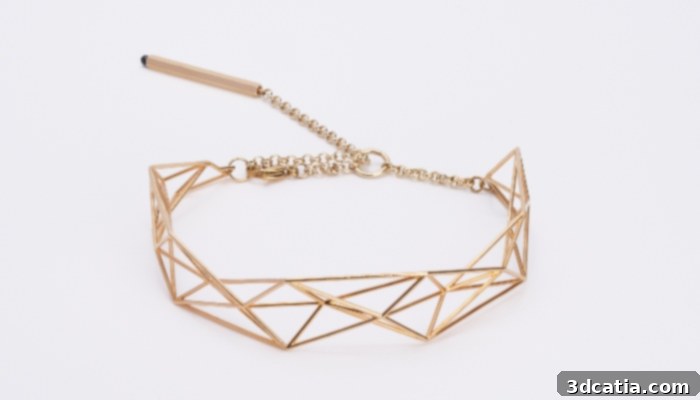
Photo Credits: Invaerso
3DN: What significant role does innovation play within your specific field of jewelry design?
In my view, innovation is fundamentally about the freedom to experiment and push boundaries. It’s about continuously exploring new methods and materials to not only optimize the entire production process but also to elevate the final outcome itself. This relentless pursuit of improvement and creative exploration is what drives progress. Specifically, for me, 3D printing in the intricate world of jewelry design acts as an indispensable tool. It empowers me to translate my exact design vision into tangible pieces, faithfully reproducing the complex geometries I meticulously create in the digital realm. This precision allows me to craft jewelry that embodies a pure, almost abstract aesthetic, characterized by clean lines and unique forms that would be exceedingly difficult, if not impossible, to achieve with traditional handcrafting methods alone. It ensures that the artistic intent, from the initial sketch to the final product, remains uncompromised and perfectly realized.
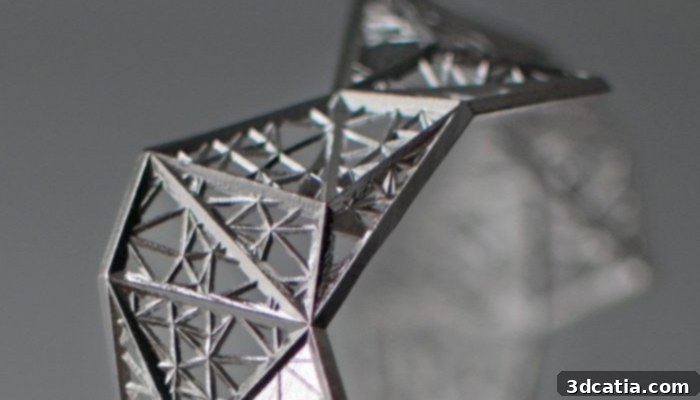
Photo Creidts: Invaerso
3DN: In your expert opinion, what are the primary advantages and perceived limitations of 3D printing within the jewelry sector?
The advantages of integrating 3D printing into jewelry creation are, without a doubt, quite numerous and profoundly impactful. One of the most compelling benefits is the unparalleled ability to fabricate exceptionally complex, exquisitely refined, and intricately detailed shapes that were previously unattainable through conventional manufacturing processes. This includes delicate filigree work, internal structures, and organic forms that push the boundaries of design. The final result is consistently precise and rigorously faithful to the original digital geometry, ensuring that every curve, angle, and facet is exactly as intended by the designer. Furthermore, the speed with which prototypes for testing can be produced is remarkable; these can be quickly generated using a wide variety of resins, facilitating rapid design iteration and validation. This significantly shortens the development cycle. An additional, often overlooked, advantage is the environmental benefit: 3D printing, especially when optimized, typically produces minimal material waste compared to subtractive manufacturing methods, contributing to more sustainable production practices.
When I consider “limitations,” I genuinely prefer to view them as opportunities for growth and further innovation within the realm of 3D printing. Rather than seeing barriers, I see paths to expand what’s possible. That being said, it is absolutely essential that we, as an industry, never lose sight of the profound and irreplaceable value of handwork and traditional craftsmanship. These are not competing entities but rather distinct and complementary disciplines. 3D printing brings forth a future-oriented approach, allowing for digital precision and complexity, while traditional craftsmanship embodies centuries of knowledge, skill, and human touch, imparting a unique character and soul to each piece. We need to embrace technological advancement to look confidently towards the future, fostering new creative avenues, and simultaneously, we must maintain deep respect for, and actively preserve, the invaluable heritage of traditional knowledge and artisanal skills. The synergy between these two worlds, rather than their separation, is where the true potential lies for the evolving jewelry industry.
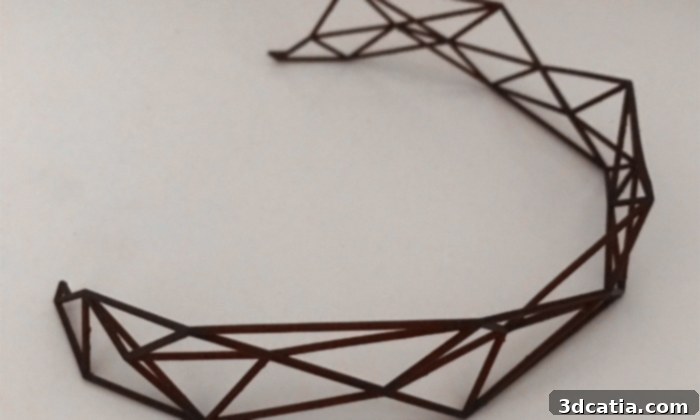
Photo Credits: Invaerso
3DN: What specific challenges do you encounter in your work with Invaerso, and do you have any exciting future projects or aspirations in mind?
One of the most significant and constant challenges we face at Invaerso is undoubtedly the intricate process of harmonizing and reconciling the various, often disparate, elements within our production chain. Each unique object we create has a distinct journey, an individualized process tailored to its specific design and material requirements. Consequently, every single product truly tells its own unique story, a singular narrative of creativity, engineering, and craftsmanship. Ensuring that all these different stages and techniques seamlessly integrate is a complex but rewarding endeavor. As for future plans? Our overarching aspiration is to continuously inspire and ‘amaze’ our audience with innovative designs and cutting-edge techniques. We are committed to unrelenting research and development, constantly pushing the boundaries of what’s possible with advanced manufacturing. However, this pursuit of innovation will never overshadow our fundamental commitment to the aesthetic component. Beauty, form, and artistic expression will always remain at the very heart of everything we do at Invaerso, ensuring our creations are not just technologically advanced but also visually stunning and emotionally resonant.
3DN: Do you have any final thoughts or a message for our esteemed readers?
Absolutely! I firmly believe that the best is truly yet to come, both for Invaerso and for the exciting convergence of technology and artistry in the jewelry world. I invite all your readers to explore our creations and learn more about our philosophy. You can find the Invaerso website and our online store by clicking HERE. Thank you for your interest!
We hope you enjoyed this insightful interview with Maria Clelia Scuteri of Invaerso. What are your thoughts on the evolving role of 3D printing in the jewelry industry, and the innovative approach taken by Invaerso? We would love to hear your perspectives. Please feel free to share your comments below or engage with us on our social media platforms: connect with us on LinkedIn, join our community on Facebook, and follow our updates on Twitter! Don’t miss out on the latest advancements and news in the additive manufacturing world; make sure to sign up for our free weekly Newsletter here, delivering the most current 3D printing insights directly to your inbox. Additionally, you can discover a wealth of engaging content, including interviews and demonstrations, by visiting our YouTube channel.
*Cover Photo Credits: Invaerso