
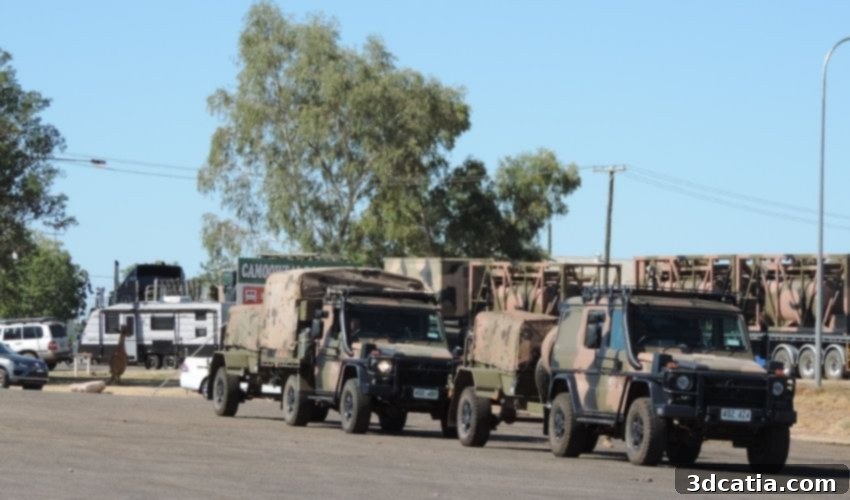
Revolutionizing Military Readiness: Australian Army Pioneers Field Metal 3D Printing for Armored Vehicle Parts with SPEE3D
The integration of additive manufacturing (AM) within military operations is not a novel concept; its application has been steadily growing for an extended period. From critical personal equipment like advanced combat helmets to essential infrastructure components such as runway mats, the inherent speed, adaptability, and localized production capabilities of 3D printing have consistently demonstrated immense value to armed forces across the globe. This transformative technology empowers defense organizations to overcome traditional logistical hurdles, enhance operational flexibility, and significantly improve battlefield readiness. In a recent, groundbreaking development, the Australian Army has once again pushed the boundaries of military AM by successfully proving the viability of 3D printing and replacing vital armored vehicle parts directly in the field, leveraging innovative technology developed by SPEE3D.
The Strategic Imperative: Additive Manufacturing in Modern Defense
For decades, military logistics have faced persistent challenges, primarily stemming from complex global supply chains, the need for extensive spare parts inventories, and the vulnerability of long lead times during active deployments. Traditional manufacturing and procurement processes often struggle to keep pace with the rapid demands of modern warfare, where equipment can be damaged or require specialized components in remote or hostile environments. Additive manufacturing offers a compelling solution to these issues, enabling on-demand production of parts, reducing reliance on centralized supply depots, and significantly shortening the repair cycle. This shift from “stockpiling” to “printing on demand” represents a paradigm change, promising greater agility, cost efficiency, and operational independence. The ability to produce mission-critical parts at the point of need can mean the difference between prolonged downtime and sustained combat effectiveness, enhancing the overall resilience and responsiveness of military forces.
SPEE3D’s Revolutionary Cold Spray Technology: A Game Changer for Field Operations
At the heart of this Australian Army initiative is SPEE3D’s pioneering cold-spray additive manufacturing technology. We have previously highlighted SPEE3D’s innovative approach and its remarkable usefulness across various industries, including its application in the SPAC3D project which explores the creation of rocket engines using metal 3D printing. What sets SPEE3D’s cold spray apart is its unique ability to achieve high-speed metal deposition without melting the material. Instead, metal particles are accelerated to supersonic speeds and impact a substrate, bonding instantly through kinetic energy. This process circumvents many of the complexities associated with traditional fusion-based metal 3D printing, such as thermal stresses, warping, and the need for inert gas environments, making it exceptionally well-suited for rugged field conditions.
For these particular trials, the Australian Army utilized the WarpSPEE3D 3D metal printer. This impressive machine stands out as SPEE3D’s largest printer, boasting a substantial build volume of 1000mm x 700mm. Its capability to print large metal parts, up to 40 kg, at an astonishing rate of 1 kg per minute, provides a significant advantage over other metal manufacturing processes available on the market. This unparalleled speed and agility are precisely what armed forces require to address immediate repair needs, minimizing vehicle downtime and ensuring operational continuity. The WarpSPEE3D’s robust design and ability to operate effectively in challenging environments were crucial factors in its selection for these rigorous field tests, aiming to demonstrate its capacity to reliably produce spare parts for combat vehicles.
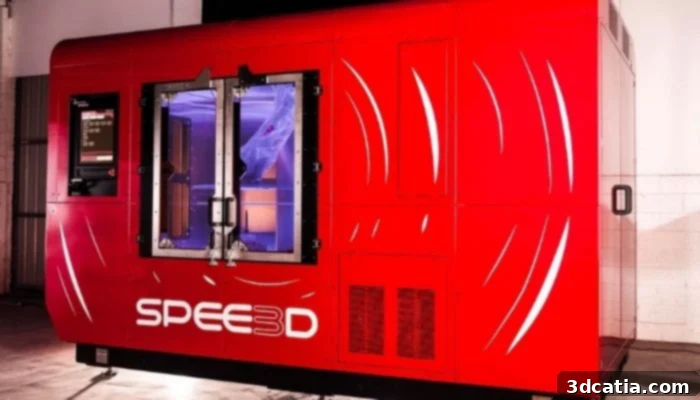
The critical parts were printed using the advanced WarpSPEE3D 3D metal printer (photo credits: SPEE3D)
Australian Army’s Groundbreaking Field Trials with SPEE3D
SPEE3D has a well-established history of collaboration with the Australian government, working closely with both the Australian Army and the Royal Australian Navy. These collaborations have consistently focused on exploring and validating the potential for deploying metal 3D printing technologies, not only in controlled barracks environments but crucially, directly in the field where operational demands are most acute. As part of this ongoing partnership, SPEE3D has played a pivotal role in training technicians from the Australian Army’s Additive Manufacturing Cell (AMC). These highly skilled technicians are at the forefront of military AM innovation, entrusted with the critical task of leading and executing these groundbreaking tests.
The recent trial, a continuation of robust case studies initiated in 2020 which successfully demonstrated the printer’s resilience and reliability within the harsh Australian bushland, focused on producing replacement parts for the M113 Armored Personnel Carrier. This specific exercise took place during the annual bilateral military exercise, Exercise Koolendong, an event known for its demanding conditions and realistic operational scenarios. The M113, a versatile and widely used armored vehicle, served as an ideal platform for testing the practicality and effectiveness of on-site metal 3D printing for critical repairs. The expeditionary nature of these trials underscores a significant shift in military logistics, moving towards self-sufficiency and rapid response capabilities directly within active operational zones.
On-Demand Production: Critical Parts in Challenging Environments
During the intensity of the trial, the AMC team successfully manufactured more than a dozen diverse replacement parts for the M113 vehicle. The primary objective was to conclusively prove that metal 3D printing could produce military-grade components capable of being not only fabricated but also rigorously validated and certified directly in the field. This capability is paramount for maintaining fleet readiness and reducing the logistical footprint traditionally associated with supplying spare parts. Each of these parts was produced on-site using the WarpSPEE3D printer, undergoing immediate certification protocols before being seamlessly installed onto the armored vehicles, demonstrating an unparalleled level of logistical agility.
One particularly illustrative example was the production of a wheel bearing cover. This specific part was printed in a remarkable 29 minutes, incurring a material cost of only $100 AUD. The significance of this particular component lies in its vulnerability; wheel bearing covers are frequently damaged during prolonged journeys through Australia’s rugged and unforgiving bushland terrains. The ability to rapidly and cost-effectively replace such a commonly failing part via 3D printing represents an enormous strategic and operational advantage for the army. Instead of waiting days or weeks for a replacement to arrive from a distant depot, or having to ground a vehicle, troops can now produce the needed part on-site within hours, dramatically improving vehicle uptime and operational tempo. This translates directly into enhanced mission capability and significant cost savings over the lifespan of the fleet.
Byron Kennedy, CEO of SPEE3D, eloquently summarized the profound implications of these trials, stating: “This is a great example of how expeditionary Metal 3D Printing can improve Defence readiness. Field trials conducted in 2020 proved SPEE3D technology was deployable. This year’s trial extension was bigger, longer, and more remote, making it the world’s toughest and longest metal 3D printing trial so far.” Kennedy’s comments underscore the unparalleled robustness and operational suitability of SPEE3D’s technology for the most demanding military applications. The trials not only validated the technical capabilities of the WarpSPEE3D printer but also demonstrated the human element—the effectiveness of the trained AMC technicians in integrating this advanced technology into their operational routines. This pioneering effort sets a new global benchmark for military additive manufacturing in field conditions, paving the way for wider adoption across defense forces seeking to enhance their logistical resilience and operational agility.
A New Era for Military Logistics and Readiness
The successful deployment of SPEE3D’s metal 3D printing technology by the Australian Army marks a significant milestone in military logistics and readiness. This capability provides defense forces with unprecedented autonomy in maintaining their equipment, particularly in remote or forward operating bases. The strategic advantages are manifold: a drastic reduction in vehicle downtime, improved mission continuity, and a bolstered ability to sustain operations without relying on fragile or extended supply chains. Economically, this approach promises substantial cost savings by minimizing inventory requirements, reducing transportation expenses, and enabling the rapid production of parts that might otherwise be obsolete or prohibitively expensive to source. Furthermore, the environmental footprint is also positively impacted through reduced shipping and waste. This move towards decentralized, on-demand manufacturing positions the Australian Army, and potentially other defense forces, at the vanguard of modern military innovation.
Looking Ahead: The Future of Additive Manufacturing in Defense
Beyond immediate spare parts replacement, the implications of these trials for the broader defense industry are enormous. Additive manufacturing’s versatility allows for rapid prototyping of new designs, customized tools, and even the potential for creating entirely new components with optimized geometries and material properties. This fosters an environment of continuous innovation, enabling military personnel to adapt to evolving threats and operational requirements with unmatched speed. The training of specialized AMC technicians is also a crucial aspect, building an in-house expertise that will drive future advancements and ensure the long-term sustainability of AM initiatives within defense. As military doctrines continue to emphasize agility, expeditionary capabilities, and technological superiority, the role of metal 3D printing, especially robust field-deployable solutions like SPEE3D’s, will undoubtedly expand, shaping the future of military logistics, engineering, and operational effectiveness for decades to come. This successful collaboration between SPEE3D and the Australian Army serves as a powerful testament to the transformative potential of additive manufacturing in the defense sector, setting a new standard for rapid, resilient, and responsive military support.
What are your thoughts on the Australian Army’s pioneering metal 3D printing tests and their strategic adoption of SPEE3D’s advanced technology for critical vehicle replacement parts? We invite you to share your insights in a comment below or engage with our community on our LinkedIn, Facebook, and Twitter pages! Don’t forget to sign up for our free weekly Newsletter here to receive the latest 3D printing news directly to your inbox. You can also discover all our compelling videos on our YouTube channel.
*Cover Photo Credits: Kerry Raymond, CC BY 4.0, via Wikimedia Commons