
Revolutionizing Defense: US Army Pioneers 3D Printable High-Strength AF96 Steel Alloy
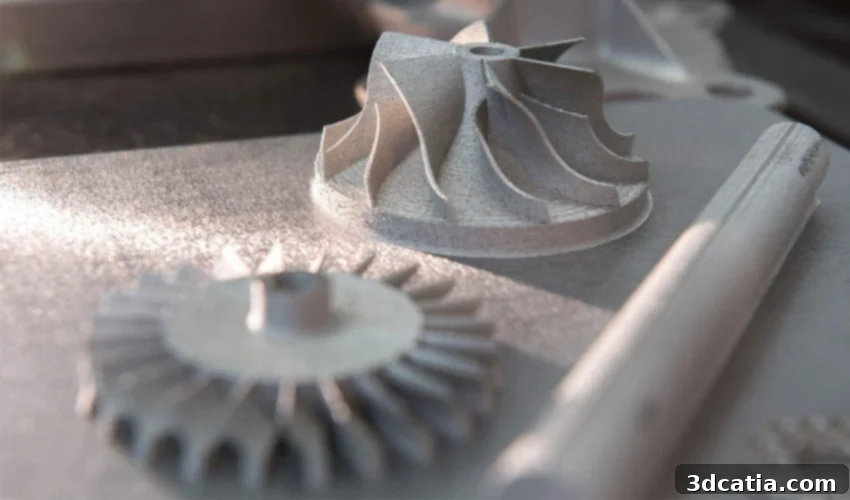
A groundbreaking advancement from the U.S. Army Combat Capabilities Development Command Research Laboratory is set to redefine possibilities in military manufacturing. A dedicated team of researchers has successfully adapted a custom-made, incredibly robust steel alloy, known as AF96, to be fully compatible with advanced 3D powder-bed fusion printing technology. This innovative development promises a significant leap forward, enabling the production of parts that are not only up to 50% stronger than current market offerings but also capable of achieving far greater geometric complexity. Such a breakthrough holds immense potential, particularly for critical applications within the American Air Force and across various branches of the military, signaling a new era for defense logistics and operational readiness.
The impact of additive manufacturing, commonly known as 3D printing, reverberates deeply within the military sector, offering transformative solutions, especially for logistical challenges. This cutting-edge technology presents remarkably efficient avenues for producing crucial spare parts precisely when and where they are needed, dramatically improving manufacturing lead times and optimizing intricate supply flows. However, the military domain is inherently stringent, characterized by exceptionally high demands for quality, reliability, and rigorous certification standards. These strict requirements have historically limited the widespread application of additive manufacturing in combat-ready scenarios. Nevertheless, the pioneering research being unveiled by this US military team could serve as a pivotal catalyst, significantly accelerating the adoption and integration of 3D printing into core defense operations.
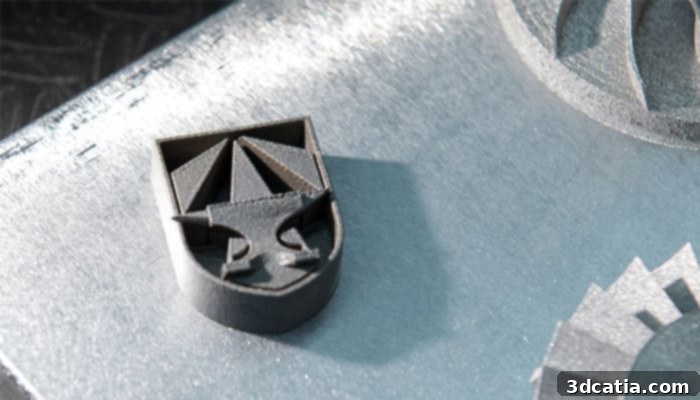
Credits: David McNally
Transforming High-Strength Steel into a Versatile 3D Printing Material
At the core of this innovation lies the material AF96, an exceptionally resistant steel alloy. Originally conceived and developed by the US military for the formidable task of manufacturing bunker buster bombs, AF96 is renowned for its superior strength and durability under extreme conditions. The research team embarked on the complex challenge of converting this robust alloy into a fine powder, specifically engineered to be compatible with advanced powder bed fusion technology. This sophisticated manufacturing method typically employs focused energy sources, such as electron beams or lasers, to selectively fuse metallic powder particles layer by layer, constructing a three-dimensional object with intricate precision. Dr. Brandon McWilliams, who leads the laboratory’s science and technology branch, acknowledges that while the parts produced are not yet entirely reliable for immediate deployment in every scenario, the long-term vision is clear: “additive manufacturing will have a huge impact on component maintenance. It will truly revolutionise logistics. Instead of worrying about transporting everything in a truck, as long as you have the raw materials and a 3D printer, you can potentially make anything you need.” This statement underscores the strategic shift from traditional, often lengthy, supply chains to a more agile, on-demand manufacturing paradigm, promising unparalleled flexibility and responsiveness in the field.
The process of transforming AF96 steel into a usable 3D printing powder involved overcoming significant material science challenges. Achieving the optimal powder characteristics – including particle size distribution, spherical morphology, flowability, and purity – is paramount for successful powder bed fusion. Any imperfections in the powder can lead to defects in the final part, compromising its mechanical properties. The team’s success in this area is a testament to their deep understanding of material science and additive manufacturing processes. The electron beam powder bed fusion (EBM) method, which uses electron beams as an energy source, is particularly well-suited for high-performance alloys like AF96 due to its ability to process materials at higher temperatures, which can reduce residual stresses and improve microstructure, leading to superior mechanical properties in the final component. This meticulous conversion process ensures that the inherent strength and toughness of AF96 are preserved, and indeed enhanced, through the additive manufacturing route.
This breakthrough has particularly promising implications for the maintenance and readiness of ground combat vehicles. The vast majority of components within these critical assets are currently fabricated from various steel alloys. This makes them ideal candidates for replacement with 3D printed AF96 parts. The ability to produce these parts using additive manufacturing promises not only a more resistant and durable result, significantly extending the operational lifespan of vehicles and reducing wear and tear, but also offers substantial advantages in terms of optimizing lightness and reducing overall costs. The superior strength-to-weight ratio achieved with 3D printed AF96 parts could lead to improved vehicle maneuverability, fuel efficiency, and reduced logistical burden. Dr. McWilliams enthusiastically confirms the material’s unparalleled performance, stating that “the material we have printed and developed is probably 50% stronger than any other material available on the market.” This remarkable increase in strength means that parts can be designed to be lighter without sacrificing structural integrity, or they can withstand far greater stresses than previously possible, opening doors for innovative designs and enhanced performance in demanding military environments.
The potential impact on battlefield logistics is immense. Imagine a scenario where a critical spare part for a tank or an armored personnel carrier breaks down in a remote location. Instead of waiting weeks or months for a replacement to be shipped from a central depot, a forward-deployed unit equipped with a 3D printer and the necessary raw materials could fabricate the part on-site within hours or days. This capability would drastically reduce vehicle downtime, improve operational readiness, and free up valuable logistical resources that would otherwise be tied up in complex supply chains. Furthermore, the geometric complexity afforded by 3D printing allows for the consolidation of multiple components into a single, optimized part, reducing assembly time, inventory counts, and potential points of failure. This represents a paradigm shift in military maintenance, moving from reactive repairs to proactive, on-demand fabrication that supports continuous mission accomplishment.
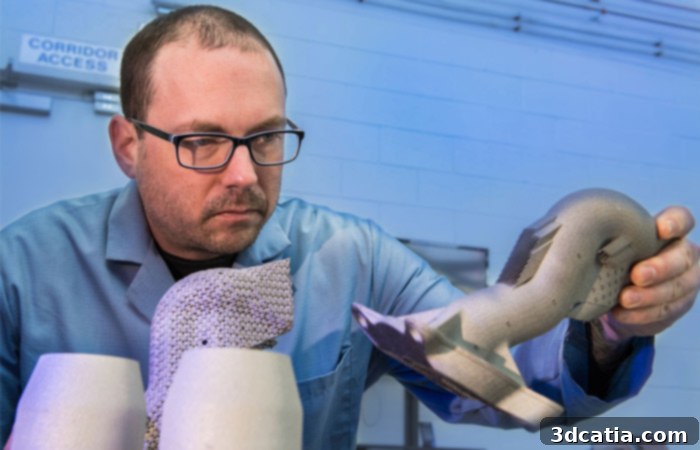
David McWilliams (Credits: David McNally)
Navigating the Path to Military Qualification and Certification
Despite the immense potential, the journey from successful material adaptation to widespread military application involves a crucial and rigorous phase: qualification and certification. The researchers have already demonstrated the functional capabilities of their innovation by creating 3D printed fan rotors for the turbine engine of one of their main battle tanks. While these parts are fully functional in a laboratory setting, they are not yet officially certified for combat deployment. The paramount challenge now is to definitively prove that additive manufacturing offers a more reliable, cost-effective, and performance-superior alternative compared to established conventional production methods. This involves extensive testing, validation, and adherence to stringent military specifications (MIL-SPECs) that govern every aspect of material and component performance, from fatigue life and fracture toughness to environmental resistance and ballistic protection. The qualification process for military-grade parts is notoriously demanding, requiring meticulous documentation and repeatable results to ensure operational safety and mission success under extreme conditions.
To address these complex challenges and pave the way for broader adoption, two distinct but complementary strategies are being systematically implemented. Firstly, researchers are focusing on printing spare parts in 3D on demand, primarily for enhanced vehicle maintenance directly on the battlefield. This “point-of-need” manufacturing approach aims to drastically reduce repair times and improve operational readiness by enabling rapid replacement of damaged or worn components. It also helps to build a robust dataset for material performance under various real-world stresses. Secondly, the team is dedicated to producing parts for final solutions, meaning components that can be integrated into new vehicle designs or serve as permanent replacements for existing structures. This strategy requires a deeper level of certification, ensuring that the 3D printed parts meet or exceed the performance of conventionally manufactured counterparts for the entire lifespan of the system. This dual-pronged approach allows for both immediate, tactical benefits and long-term, strategic integration of additive manufacturing into the defense supply chain. To achieve this ambitious goal, the US Army laboratory is actively collaborating with original equipment manufacturers (OEMs) and various industrial partners. These collaborations are vital for leveraging external expertise in design, manufacturing scalability, and established certification processes, ultimately facilitating the broader qualification of additive manufacturing processes within the demanding military ecosystem and accelerating its journey from research to full operational capability.
The qualification process involves multiple stages, beginning with material characterization to understand the microstructure, mechanical properties, and consistency of the 3D printed AF96. This is followed by component-level testing, where prototypes like the fan rotors undergo rigorous performance evaluations, including endurance, vibration, and thermal cycling tests. Finally, system-level validation integrates the 3D printed components into full systems to assess their performance under operational loads and environmental conditions. Each stage generates critical data that informs design iterations and builds confidence in the reliability and durability of additive manufactured parts. By working closely with industry partners who possess extensive experience in navigating regulatory frameworks and scaling production, the Army aims to streamline this complex qualification pathway, ensuring that the benefits of 3D printed AF96 steel can be realized on a larger scale across various defense applications.
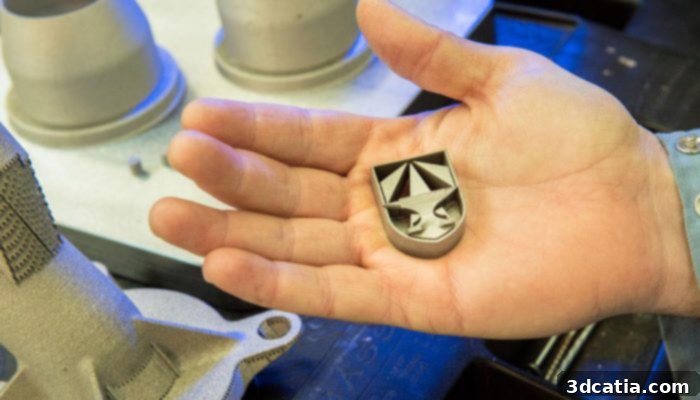
Photo Credits: David McNally
The successful integration of 3D printable AF96 steel represents a monumental step for military capabilities. It promises not just stronger, lighter, and more complex components, but also a fundamental shift in how defense forces approach manufacturing, maintenance, and logistics. As certification hurdles are overcome, this technology will undoubtedly empower armed forces with unprecedented agility and resilience in an increasingly complex global landscape.
Don’t forget to comment below or on our Facebook and Twitter page! Don’t forget to sign up for our free weekly Newsletter, with all the latest news in 3D printing delivered straight to your inbox!