
Weekly 3D Printing Innovations: Top Videos on Rapid Tooling, New Printers, and Industry Growth
Welcome to our weekly dive into the fascinating world of additive manufacturing! As another Sunday arrives, we’re excited to bring you a curated selection of the top five 3D printing videos that have captured our attention this week. This roundup is designed to keep you informed about significant advancements, practical applications, and emerging trends within the dynamic 3D printing industry. From foundational techniques like rapid tooling to cutting-edge printer reviews, professional opportunities, and transformative industrial implementations, there’s something here for every enthusiast and professional. Our goal is to provide a comprehensive, yet easily digestible, overview of the most impactful developments, ensuring you stay at the forefront of this innovative sector. Join us as we explore how global leaders and new innovators are pushing the boundaries of what’s possible with 3D technology.
Top 1: Mastering Rapid Tooling and 3D Printing with Formlabs
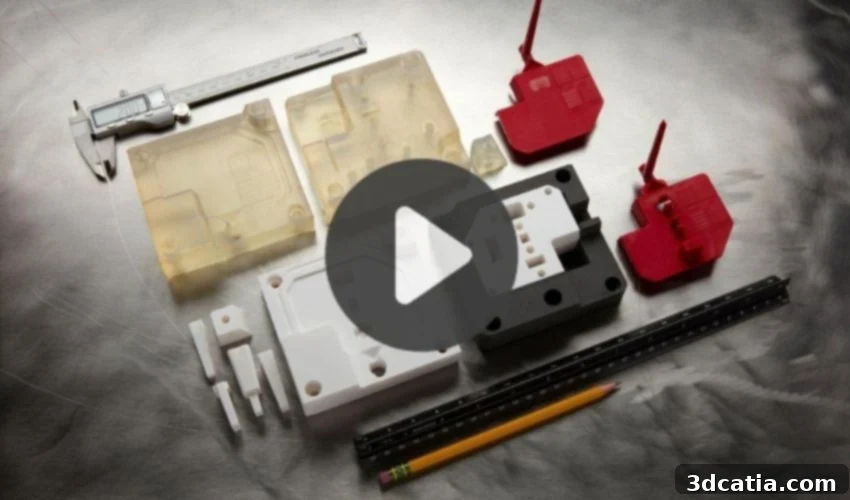
Our first featured video comes from Formlabs, a renowned name in professional 3D printing solutions. This insightful presentation delves deep into the fundamentals of utilizing 3D printing for one of its most common and impactful applications: rapid tooling. Rapid tooling involves the swift and efficient production of custom-made tools, molds, jigs, and fixtures directly from digital designs, which are then used for manufacturing end-use parts. This method offers significant advantages over traditional tooling processes, drastically reducing lead times and costs, especially for low-volume production or intricate designs. The video expertly explains not only what rapid tooling entails but also details its operational mechanics when integrated with 3D printing technologies. Viewers will gain a clear understanding of its diverse applications across various industries, supported by compelling real-world examples. By adopting 3D printing for rapid tooling, manufacturers can accelerate product development cycles, iterate designs more freely, and bring innovative products to market faster than ever before. Formlabs, known for its high-resolution Stereolithography (SLA) and Low Force Stereolithography (LFS) printers, demonstrates how their technologies are perfectly suited for producing durable and precise tools, making this a must-watch for anyone involved in manufacturing and product development. Discover how these techniques are revolutionizing the production floor in the video below:
Top 2: Introducing the Nova 3D Printer by Cosmyx
Next up, 3Dnatives continues its popular series of in-depth hardware reviews, this time shining a spotlight on the Nova 3D printer from the innovative French manufacturer Cosmyx. Launched in 2021, the Nova is a desktop 3D printer that leverages the widely adopted Fused Deposition Modeling (FDM) process, making it an accessible yet powerful tool for a broad range of users. FDM technology, known for its versatility and cost-effectiveness, builds objects layer by layer by extruding heated thermoplastic filament. The Nova offers a generous print volume of 300 x 200 x 270 mm, providing ample space for prototyping and creating functional parts. This robust machine is compatible with a variety of standard thermoplastics, including popular materials like PLA (Polylactic Acid) and ABS (Acrylonitrile Butadiene Styrene), which are favored for their ease of use, mechanical properties, and broad application spectrum. Cosmyx has meticulously designed the Nova to deliver a simplified user experience, making it an attractive option for educational institutions, small businesses, and professional designers seeking reliable performance without unnecessary complexity. With a starting price point from 2,990 euros, the Nova positions itself as a competitive option in the mid-range desktop FDM market. This video review provides an extensive evaluation of its features, performance, and overall value, helping potential buyers understand what sets the Nova apart. To learn more about its capabilities and how it performs in real-world scenarios, delve into our complete test of the Nova 3D printer:
Top 3: Exploring New Professional Opportunities in 3D Printing
Following a period of economic uncertainty and disruption in the global job market, particularly exacerbated by recent health crises, we are now witnessing a robust resurgence, especially within the additive manufacturing sector. This segment of the industry is not just recovering; it’s thriving, with an increasing number of companies actively seeking skilled professionals. This growth underscores the critical role 3D printing plays in modern manufacturing, enabling innovation, customization, and efficient production workflows. One such company at the forefront of this hiring wave is Humtown Additive, a leader in advanced manufacturing. In a recent insightful webinar, Humtown Additive extended an open invitation for individuals to explore the exciting career paths available within their organization. The company is actively looking to fill a variety of roles, ranging from specialized 3D technicians who operate and maintain sophisticated printing equipment to highly skilled additive manufacturing engineers who design and optimize complex parts and processes. These professionals will contribute to Humtown Addative’s core business, which involves designing and producing intricate molds for diverse industries, including the demanding railway sector, where precision and durability are paramount. The expansion of such companies highlights the increasing demand for specialized talent capable of navigating the intricacies of additive manufacturing, from material science and software development to design for additive manufacturing (DfAM) and post-processing techniques. This trend signifies a shift towards more digitized and flexible manufacturing practices, creating a wealth of opportunities for those with expertise in 3D printing technologies. Watch the webinar for insights into how you can become part of this rapidly expanding field:
Top 4: BMW’s Revolutionary Integration of 3D Printing in Automotive Manufacturing
For those who have been closely following the advancements in 3D printing over recent years, it comes as no surprise that this transformative technology has been widely adopted across the automotive industry. The illustrious German automaker, BMW, stands as a prime example of a company leveraging additive manufacturing to its fullest potential. BMW has been at the forefront of utilizing 3D printing since the early 1990s, establishing an Additive Manufacturing Campus that consistently pushes the boundaries of what’s achievable in vehicle production. Whether it’s for developing intricate prototypes to accelerate design iterations, producing custom jigs and fixtures for assembly lines, or even manufacturing final, end-use parts for specific models or classic car restoration projects, the Bavarian company harnesses the power of additive manufacturing to enhance its entire production process. This includes everything from the initial design phase, where unparalleled geometric freedom allows for complex, lightweight structures, through to the printing process itself, utilizing a variety of materials and technologies such as Selective Laser Sintering (SLS) and Direct Metal Laser Sintering (DMLS), and extending to advanced post-processing techniques that ensure parts meet BMW’s rigorous quality standards. The integration of 3D printing enables BMW to achieve unprecedented levels of customization, reduce material waste, and significantly shorten development cycles. For instance, additive manufacturing has facilitated the creation of ergonomic tools for production line workers, customized components for limited-edition vehicles, and even parts for the legendary Rolls-Royce, a brand under the BMW Group. This deep dive offers a compelling look at the firm’s diverse range of 3D printed parts and their impact on innovation and efficiency within one of the world’s leading automotive brands:
Top 5: Enhancing Production with the IONA System from Insphere
Our final video highlights the critical role of automation in modern additive manufacturing, featuring James Allum, a Senior Manufacturing Research Engineer at AMRC Cymru (Advanced Manufacturing Research Centre, Wales). In this compelling discussion, James articulates the core of his professional activities, focusing on the myriad benefits that additive manufacturing brings to industrial processes. More specifically, he delves into the innovative solution employed by AMRC Cymru to streamline and optimize their production workflows: the IONA system, developed by Insphere. The IONA system represents a significant leap forward in manufacturing automation, designed to integrate seamlessly with 3D printing operations. This intelligent system helps automate various stages of the production process, from handling raw materials and managing print queues to intricate post-processing tasks and quality control inspections. Automation, in the context of additive manufacturing, addresses key challenges such as labor intensity, ensuring consistent quality, and scaling production efficiently. By leveraging the IONA system, AMRC Cymru is able to enhance operational efficiency, reduce human error, and achieve higher throughput, thereby demonstrating how smart automation can unlock the full potential of 3D printing for large-scale industrial applications. This approach is vital for the future of manufacturing, moving towards Industry 4.0 paradigms where interconnected systems and intelligent automation drive productivity and innovation. James Allum’s insights provide a valuable perspective on how cutting-edge research and practical implementation are converging to reshape manufacturing landscapes, making production more agile, reliable, and cost-effective. Witness how the IONA system is transforming additive manufacturing:
What are your thoughts on Formlabs’ detailed video exploring the fundamentals of rapid tooling with 3D printing, or perhaps the innovative applications showcased by BMW? We are eager to hear your perspectives on these groundbreaking advancements and how they might impact the future of manufacturing. Share your insights in a comment below or connect with us on our LinkedIn, Facebook, and Twitter pages! For those who want to stay continually updated on the very latest developments, news, and breakthroughs in the 3D printing world, don’t forget to sign up for our free weekly Newsletter here, delivering essential industry insights straight to your inbox. You can also explore our extensive library of videos and discover more in-depth content by subscribing to our dedicated YouTube channel. Join our community and keep your finger on the pulse of additive manufacturing innovation!
*Cover Photo Credits: Formlabs