
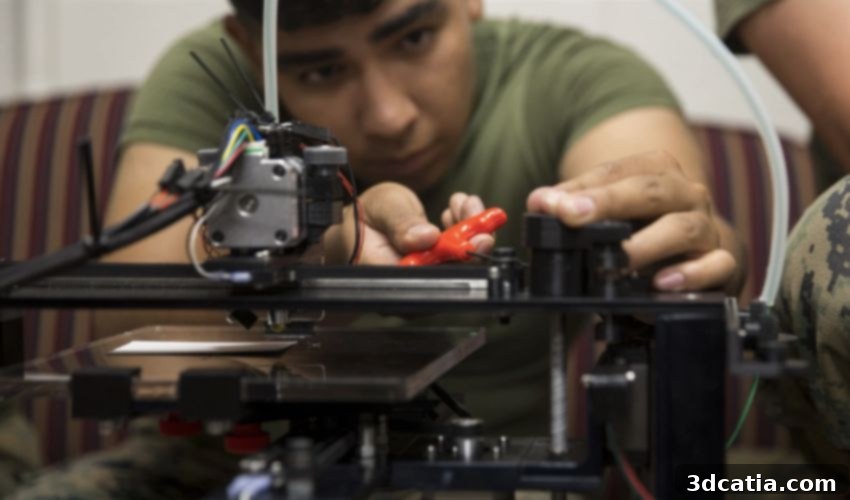
Revolutionizing Military Logistics: The U.S. Marine Corps Embraces Advanced 3D Printing
Within the dynamic realm of additive manufacturing, branches of the United States military have consistently spearheaded the integration of 3D printing technologies and advanced manufacturing techniques into their strategic and operational arsenals. This transformative adoption spans a wide array of applications, from the construction of military buildings and the intricacies of naval ship construction to providing critical support on the very frontlines of combat. The military 3D printing sector is not merely growing; it is rapidly expanding into a multi-billion dollar industry, underscoring its pivotal role in modern defense. Most recently, the United States Marine Corps (USMC) published a comprehensive report, casting a spotlight on the critical contributions of the Marine Corps Systems Command Advanced Manufacturing Systems (AMS) team in tackling the complex challenges of supply chain effectiveness and logistics through the innovative application of additive manufacturing.
The USMC’s keen interest in the diverse applications of 3D printing is a direct reflection of its elevated strategic importance within the Corps’ new, ambitious restructuring plan known as Force Design. This forward-thinking initiative fundamentally reorients the Armed Forces branch to confront potential threats and complex conflict scenarios predominantly in the Indo-Pacific region. In such demanding environments, the Marine Corps recognizes the absolute necessity for a “fully-integrated logistics enterprise”. As articulated in their official guidance document, this enterprise must be robustly capable of supporting “multi-domain and distributed operations in contested environments”. The overarching objective of this strategic overhaul is to guarantee that Marines and soldiers alike have unimpeded access to state-of-the-art equipment and essential replacement parts. This proactive approach aims to eliminate the severe stresses associated with extensive, often vulnerable, supply lines and overcome significant geographical obstacles that historically complicate logistical operations, ensuring unparalleled readiness and operational agility.
The USMC’s Strategic Imperative: Force Design and Pacific Operations
The Marine Corps’ Force Design initiative represents a profound shift in military strategy, acknowledging the evolving geopolitical landscape and the unique challenges presented by potential conflicts in the Pacific theater. This region, characterized by vast distances, numerous island chains, and challenging maritime environments, necessitates a logistical framework that is inherently resilient, adaptable, and highly responsive. Traditional linear supply chains, reliant on large, fixed infrastructure, are ill-suited for the dynamic, distributed operations envisioned by Force Design. Additive manufacturing emerges as a cornerstone technology to address these vulnerabilities, enabling the USMC to decentralize manufacturing capabilities and bring production closer to the point of need. This strategic pivot reduces dependence on vulnerable global supply routes, minimizes lead times for critical components, and enhances the self-sufficiency of forward-deployed units, thereby bolstering their endurance and operational tempo in contested areas.
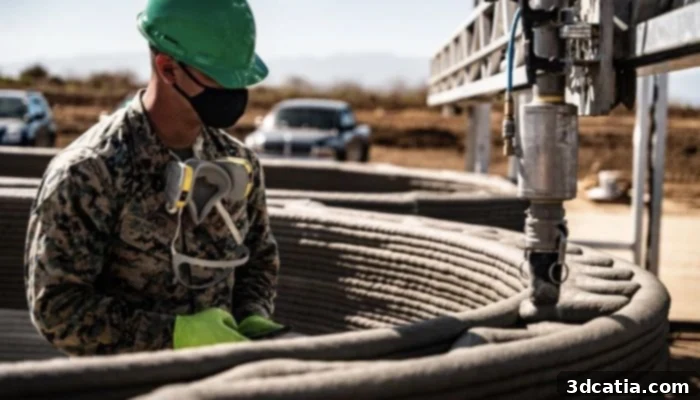
The USMC has previously been involved with various AM projects including 3D printed concrete structures, demonstrating versatility. (Photo credits: ICON)
Redefining Battlefield Logistics: On-Demand 3D Printing
The integration of 3D printing capabilities directly onto the battlefield is rapidly transforming the conventional paradigms of military logistics and maintenance. Matt Audette, a dedicated program analyst for the Advanced Manufacturing Systems team, expresses profound confidence in the game-changing potential that 3D printed parts offer in operational settings. He succinctly states, “In a nutshell, additive manufacturing is a game-changer for the Marine Corps. It allows us to repair equipment and innovate solutions right on the frontline. With its smaller footprint and easy-to-use technology, we can construct essential components right on the battlefield, making us nimbler and more responsive in any combat scenario.” This capability significantly reduces the logistical tail, allowing units to operate with greater independence and sustained effectiveness, particularly in remote or hostile environments where traditional supply lines are impractical or dangerous.
Audette’s insights resonate deeply with the strategic vision driving the Marines’ AMS team, embodying an idealistic yet highly practical commitment to additive manufacturing. Robert Davies, the esteemed lead of the AMS team, further underscores the unequivocal, no-nonsense utility that 3D printing provides for delivering concrete solutions in high-stakes environments. He articulates the harsh realities of military operations by stating, “Parts break—that’s the reality of the battlefield. You used to have two simple choices: bring the parts or order the parts. Our advanced manufacturing solutions rewrite that playbook. Now, we can actually manufacture essential components right in the combat zone. When something breaks, a call is made: ‘We need a component.’ No more ‘We forgot it’ or ‘It’ll take months to arrive.’ We contact our machinists and within a couple of hours, we’re making and sending parts back up to the frontline.” This paradigm shift empowers commanders with unprecedented agility, minimizing equipment downtime and maximizing combat readiness by ensuring that crucial repairs can be executed swiftly and efficiently, bypassing traditional logistical bottlenecks entirely.
The ability to produce parts on demand transforms operational planning and execution. Imagine a scenario where a critical component for a communication system fails deep in enemy territory. Instead of awaiting a lengthy resupply or attempting a hazardous extraction, a forward operating base equipped with a 3D printer can fabricate the needed part within hours. This not only saves invaluable time and resources but also mitigates risks to personnel involved in logistical operations. The strategic advantage of such decentralized production is immense, allowing the USMC to sustain operations in environments where external support is severely constrained or entirely cut off. This local manufacturing capability fosters a culture of innovation and problem-solving among Marines, who can design and print custom solutions for unforeseen challenges, further enhancing their operational effectiveness and adaptability.
Tangible Benefits: Mobility, Customization, and Operational Readiness
Ultimately, the widespread adoption of 3D printers confers unparalleled benefits in terms of mobility and customization, meticulously tailored to the precise parameters of each mission. The applications for this groundbreaking technology are virtually limitless, extending from specialized medical supplies and critical vehicle parts to bespoke tools and innovative repair solutions. The advantages are immediately apparent, not only in the dramatic reduction of travel time and the lighter weight of printed objects but also in the enhanced training and readiness of the personnel utilizing these systems. Unlike complex traditional manufacturing equipment such as CNC machines or welding devices, modern 3D printers require significantly less specialized training and expertise to operate effectively. This ease of use democratizes manufacturing capabilities, empowering more Marines to become proficient in producing essential items, thereby broadening the skill base within the Corps and boosting overall operational self-sufficiency.
The capacity for customization is particularly significant. In the unpredictable environment of the battlefield, a standard part might not always be the optimal solution. 3D printing allows for rapid iteration and design modifications, enabling the creation of components that are perfectly adapted to unique circumstances or upgraded for improved performance. This flexibility can mean the difference between mission success and failure, providing Marines with the exact tools and parts they need, precisely when and where they need them. Furthermore, the ability to print on-site reduces the need to carry a vast inventory of spare parts, thereby decreasing the logistical burden and increasing the mobility of units. This translates into lighter loads, faster deployment, and a smaller logistical footprint, all critical factors for agile and effective military operations.
Complementing, Not Replacing: The Future of Military Manufacturing
The AMS team has been unequivocal in its advocacy for 3D printing as a powerful enabler, yet equally clear in emphasizing that additive manufacturing is designed to complement, rather than supersede, traditional manufacturing methodologies. As AMS team lead Robert Davies cogently reiterates, “We’re not here to mass-produce hundreds of components in an hour—that’s for dedicated facilities. What we offer is the ability to produce a limited number of key components on-site when they’re urgently needed.” This distinction is crucial; 3D printing excels at low-volume, high-customization, and on-demand production, filling a vital gap in the existing supply chain that traditional methods cannot efficiently address. It allows for critical point-of-need fabrication, reducing logistical delays and enhancing tactical responsiveness without disrupting the established capabilities for large-scale production of standard military equipment.
This dual approach signifies a more robust and resilient supply ecosystem for the military. Traditional manufacturing facilities continue to produce equipment and parts on a massive scale, leveraging economies of scale and established quality control protocols. Meanwhile, additive manufacturing provides an invaluable agile layer, enabling rapid prototyping, urgent repairs, and the creation of specialized tools or adaptations in forward operating areas. This synergy means that the USMC can maintain a steady flow of standard supplies while possessing the crucial capability to react instantaneously to unforeseen breakages or unique requirements. The future of military manufacturing, therefore, lies not in choosing one method over the other, but in strategically integrating both to achieve optimal efficiency, flexibility, and unwavering readiness across all operational domains.
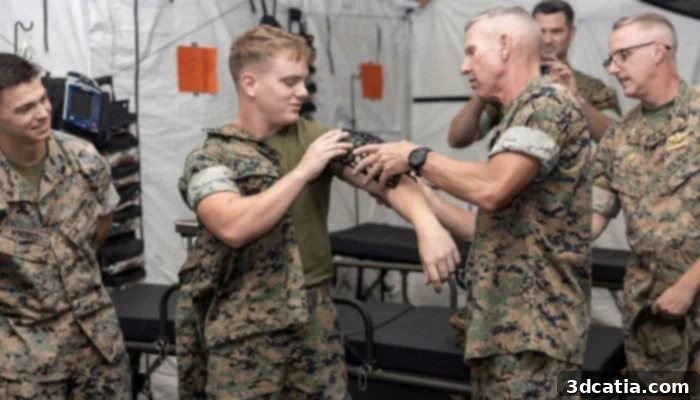
Marine Corps personnel utilize advanced manufacturing technologies for critical support. (Photo credits: Rachaelanne Woodward)
Broader Impact and Future Horizons
The strategic embrace of additive manufacturing by the U.S. Marine Corps, spearheaded by the innovative AMS team, marks a significant milestone in modern military logistics and operational readiness. This shift not only addresses immediate battlefield needs but also lays the groundwork for a more resilient, adaptable, and self-sufficient fighting force in the 21st century. The ability to manufacture parts on-site, on-demand, directly impacts mission success by reducing downtime, enhancing customization, and drastically shortening response times. While challenges such as material standardization, quality assurance in varied environments, and the security of digital design files remain, ongoing research and development are continuously refining these processes, ensuring the robustness and reliability of 3D printed components for even the most demanding military applications.
The implications extend beyond just repairs and spare parts. This technology fosters an environment of innovation within the ranks, encouraging Marines to actively participate in developing and refining solutions for their specific operational challenges. This empowerment through localized manufacturing capabilities strengthens the entire logistics enterprise, making it more robust against disruptions and more responsive to the dynamic nature of modern warfare. As the USMC continues to integrate these advanced manufacturing solutions, it solidifies its position at the forefront of defense innovation, setting a benchmark for other military branches globally. For further detailed insights into the transformative work being done by the USMC and their AMS team, we encourage you to read more HERE.
What are your thoughts on the Marine Corps’ groundbreaking AMS team and their use of additive manufacturing? Share your perspective in the comments below or join the conversation on our LinkedIn, Facebook, and Twitter pages! Don’t forget to sign up for our free weekly Newsletter here to receive the latest 3D printing news straight to your inbox! You can also find all our compelling videos on our YouTube channel for more visual insights into the world of additive manufacturing.
*Cover Photo Credits: Justin Updegraff