

Revolutionary 3D Printed Fabrics: Chainmail-Inspired Smart Materials That Stiffen on Demand
A groundbreaking collaboration between scientists from Nanyang Technological University (NTU) in Singapore and the California Institute of Technology (Caltech) has led to the development of innovative 3D-printed structured fabrics. These remarkable materials are engineered to support an astounding 50 times their own weight and possess the unique ability to stiffen on demand, increasing their rigidity by an impressive 25-fold. Drawing inspiration from the ancient protective armor, chainmail, this research opens up a new frontier in material science with vast potential for applications ranging from enhanced exoskeletons to advanced bulletproof vests and other high-impact protection systems.
The initial phase of this pioneering research focused on designing and fabricating these structures using nylon, a versatile and commonly used polymer in additive manufacturing. Following the successful validation of the nylon prototypes, the research team pushed the boundaries further by conducting the same experiments with aluminum, aiming to create even more robust and durable adaptive materials. The promising results from both nylon and aluminum iterations underscore the transformative potential of these structured fabrics, heralding a new era for materials that can dynamically adapt their mechanical properties to specific functional requirements.
Ancient Wisdom Meets Modern Innovation: The Chainmail Inspiration
Chainmail, an armor system that has protected warriors for millennia, is an exemplary demonstration of ingenious design. Composed of countless interlinked rings, it offers its wearer a crucial balance of comprehensive protection and remarkable flexibility. This historical precedent served as the core inspiration for the team of researchers. Their primary objective was to replicate this dual functionality – designing a lightweight structure capable of dramatically altering its shape and mechanical properties under the influence of a controllable external factor.
To achieve this modern interpretation of chainmail, the scientists envisioned a novel structure comprising multiple interconnected mesh components. The true innovation lies in its activation mechanism: when this 3D-printed fabric is placed under vacuum within a sealed plastic bag, its inherent flexibility gives way to profound hardness and rigidity. This transformation is not merely an incidental effect but a precisely engineered response, allowing for a material that can transition from soft and pliable to stiff and load-bearing in a controlled and repeatable manner.
Chiara Daraio, the G. Bradford Jones Chair in Mechanical Engineering and Applied Physics at Caltech, eloquently articulated the team’s vision: “We wanted to make materials that could change stiffness to order. We would like to create a fabric that goes from soft and pliable to stiff and load-bearing in a controllable way.” This statement perfectly encapsulates the ambition behind their work: to develop ‘smart’ materials that offer unprecedented adaptability, providing engineers and designers with a new toolkit for creating products with dynamic functionalities.
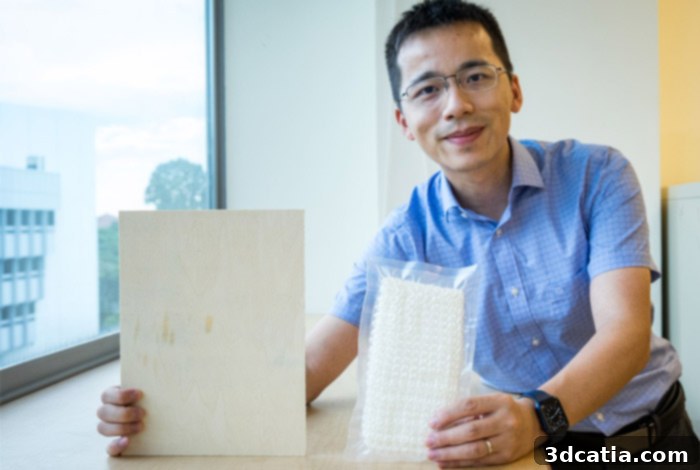
Once under vacuum, the structure is more resistant. (Photo Credit: NTU)
The Engineering Marvel: Construction, Mechanism, and Performance
The team detailed the construction of these structured fabrics, explaining their reliance on advanced 3D printing techniques to meticulously produce them from nylon. The fundamental building blocks of these materials are numerous octahedra – geometric shapes distinguished by their eight triangular faces. These octahedra are not simply stacked but are intricately interlocked, creating a sophisticated network of hollow spaces and inherent flexibility. This unique geometric arrangement is crucial to the material’s ability to transition from a compliant state to a rigid one. When this precisely 3D-printed structure is enveloped in a vacuum-sealed plastic, the differential pressure causes the interlocking octahedra to compress and lock into place, transforming its initial flexibility into remarkable hardness and rigidity.
To rigorously evaluate the enhanced properties of the stiffened fabric, the researchers devised a comprehensive testing protocol. They conducted impact tests by dropping a steel ball, weighing 30 grams, onto the structured material at a velocity of three meters per second. The results were striking: when the fabric was in its flexible state, it exhibited a significant deformation of 26 mm upon impact. However, when the same structure was stiffened under vacuum, the observed deformation was drastically reduced to a mere 3 mm. This demonstrates a profound increase in impact resistance and structural integrity. Furthermore, the team proudly asserted that the stiffened structure could sustain a total load of 1.5 kilograms, which is an astonishing 50 times greater than its own weight, validating its exceptional load-bearing capacity.
Transformative Applications: From Medical to Industrial Reinforcement
The successful development of such an adaptive fabric holds immense promise for addressing a diverse range of needs, particularly in scenarios where adjustable reinforcement is critical. The implications for various sectors are vast and exciting. Wang Yifan, an assistant professor at NTU’s School of Mechanical and Aerospace Engineering, highlighted the transformative potential in healthcare and assistive technology: “With a lightweight, adjustable engineering fabric – easily changeable from soft to stiff – we can use it to meet patient needs and of the aging population, for example, to create exoskeletons that can help them stand, carry loads and assist them in their daily tasks.”
This ability to shift between states of flexibility and rigidity on demand makes these materials ideal for next-generation exoskeletons. Imagine a device that is soft and comfortable during rest or natural movement, then stiffens instantly to provide robust support for lifting heavy objects or maintaining posture. This adaptability could dramatically improve the functionality and user comfort of assistive devices, mobility aids for the elderly, and rehabilitation equipment. Beyond medical applications, these materials could revolutionize protective gear, creating bulletproof vests or helmets that are lightweight and flexible for everyday wear but instantly harden upon impact to provide superior protection. Sports equipment, automotive safety components, and industrial protective clothing are other areas ripe for disruption by these smart fabrics.
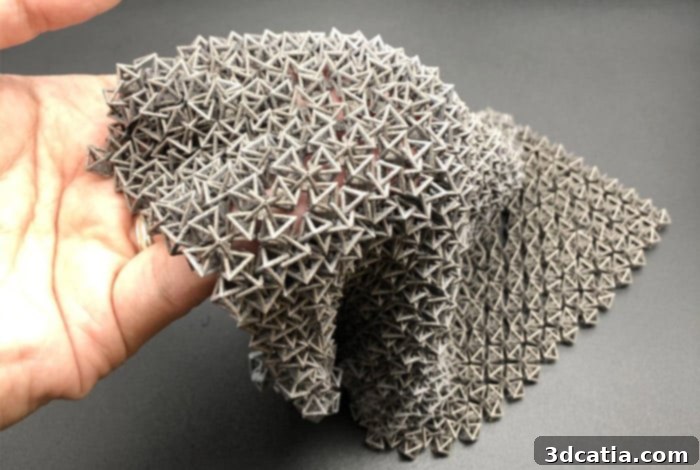
The team also 3D-printed aluminum. (Photo Credit: NTU)
Pushing the Boundaries: From Nylon to Robust Aluminum Structures
Driven by the encouraging results from the nylon prototypes, the researchers strategically extended their hypothesis to explore more resilient materials. Their next step involved replicating the same sophisticated experiment but with aluminum, with the overarching goal of designing an even more resistant and durable structure capable of withstanding greater stresses and environmental factors. The transition to metal 3D printing represents a significant technological leap, requiring specialized equipment and expertise to achieve the intricate geometries and material integrity necessary for these adaptive structures.
The team reported that the results obtained with aluminum were exceptionally encouraging. Crucially, the aluminum structure reacted in precisely the same dynamic way as its nylon counterpart, demonstrating the remarkable versatility of the underlying design principle across different material types. This success with aluminum opens up a wealth of possibilities for heavy-duty applications. Wang Yifan elaborated on these future prospects: “To further increase the stiffness and strength of the material, we are now working on fabrics made from various metals, including aluminum, which could be used for large-scale industrial applications requiring greater load capacity, such as bridges or buildings.”
The ability to scale this technology to metal structures implies a future where adaptive materials could be integrated into civil engineering and construction. Imagine bridges or buildings that can dynamically adjust their structural rigidity in response to environmental conditions like high winds or seismic activity, enhancing safety and longevity. This research lays a robust foundation for a new generation of intelligent infrastructure and high-performance components across countless industries, promising materials that are not only strong and lightweight but also inherently adaptive and responsive.
Conclusion: The Future of Adaptive Materials
The development of these chainmail-inspired, 3D-printed structured fabrics by researchers at Nanyang Technological University and Caltech represents a monumental leap forward in the field of material science. By successfully demonstrating materials that can transition from flexible to rigid states, support exponential loads relative to their weight, and be manufactured from both polymers and metals, this team has unveiled a truly revolutionary technology. The implications are profound, promising enhanced safety, improved functionality, and unprecedented adaptability across a multitude of applications, from medical rehabilitation to advanced structural engineering.
This breakthrough underscores the power of biomimicry – learning from nature and historical ingenuity – combined with cutting-edge additive manufacturing techniques. As research continues to explore other metals and refine the control mechanisms, we can anticipate a future where our materials are no longer passive but active participants in their environment, dynamically responding to challenges and offering solutions previously confined to the realm of science fiction. The journey from flexible nylon to robust aluminum structures is just the beginning for these adaptive, on-demand stiffening materials.
What are your thoughts on this incredible 3D-printed structure inspired by chainmail and its potential applications? We invite you to share your insights in a comment below or join the conversation on our Facebook and Twitter pages! Don’t forget to sign up for our free weekly newsletter to receive all the latest 3D printing news straight to your inbox and stay updated on such innovative discoveries!