
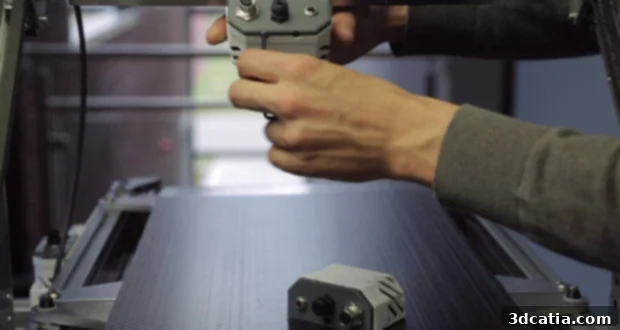
BlackBelt 3D Printer: Revolutionizing Continuous 3D Printing with Conveyor Belt Technology
Back in May, the world of additive manufacturing was introduced to a groundbreaking innovation: the BlackBelt 3D printer. This pioneering machine captured significant attention as the first 3D printer to seamlessly integrate a conveyor belt into its printing process. This ingenious design promised to redefine traditional limitations, particularly concerning print size and batch production capabilities. Since the initial announcement, the excitement surrounding BlackBelt has only intensified, largely propelled by a hugely successful Kickstarter campaign. The campaign quickly surpassed its initial goal of €50,000, raising an impressive €75,836, a clear testament to the market’s demand for such an innovative solution.
The core appeal of the BlackBelt lies in its ability to enable makers and manufacturers to create objects of virtually unlimited length, eliminating the size constraints inherent in most conventional 3D printers. The potential applications are vast, as demonstrated by examples on their website, showcasing everything from custom chairs to functional leg prostheses produced using this revolutionary technology. This capability not only opens doors for larger, more complex designs but also facilitates continuous printing and small-batch manufacturing. To delve deeper into the origins, technical challenges, and future aspirations of this disruptive technology, we recently had the privilege of sitting down with Stephan Schürmann, the visionary founder behind BlackBelt, to get his unique perspective on this exciting venture.
The Genesis of Innovation: Stephan Schürmann’s Journey into 3D Printing
3DN: What is your connection to 3D printing, and how did the idea of BlackBelt come to you?
Stephan Schürmann began by humbly acknowledging that while the concept of incorporating a conveyor belt into a 3D printer might have been contemplated by others, he is indeed the first to successfully bring this complex idea to tangible reality. His personal journey into the realm of 3D printing began during his industrial product design studies at the Fontys International Campus in Venlo. It was there that he had his initial encounter with 3D printing technology, an experience that quickly blossomed into a profound dedication and passion. He immersed himself in understanding the intricacies of additive manufacturing, including mastering the art of designing specifically for 3D printing processes.
From the outset, Schürmann keenly observed what he perceived as fundamental shortcomings in the existing 3D printing technologies of the time. He found them to be neither sufficiently mature nor truly simple in their operation, presenting significant barriers to wider adoption and innovative applications. This critical perspective fueled his desire to address these limitations. A pivotal moment arrived during one of his design classes, where he was tasked with a project focused on designing a more user-friendly 3D printer. This academic exercise laid the foundational groundwork for what would eventually evolve into the BlackBelt printer, with his early work visually resembling the conceptual design shown below. This project allowed him to explore new paradigms for printer functionality and user interaction, moving beyond the conventional bed-based systems. His commitment to the field was further solidified at the culmination of his studies, where he authored a comprehensive thesis on the renowned filament manufacturer colorFabb, culminating in a practical demonstration: the construction of a fully 3D printed bike, showcasing his deep understanding of materials, design, and manufacturing processes.
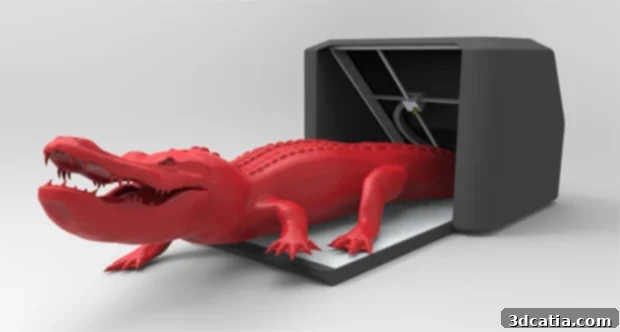
Stephan’s Graduation Project: A conceptual design that foreshadowed the BlackBelt.
Unveiling the BlackBelt’s Mechanics: How It Works and Overcoming Engineering Hurdles
3DN: How does the 3D printer work, and what challenges did you have to overcome during the development process?
The BlackBelt 3D printer distinguishes itself through a unique operational principle: it constructs objects from the side directly onto a moving assembly line, rather than a stationary print bed. This innovative approach involves printing at a specific, carefully calibrated angle, which allows for the continuous deposition of material onto the belt. As the object is printed, the conveyor belt slowly advances, effectively moving the finished sections away from the print head and making room for new layers. This angled printing, combined with the continuous motion of the belt, is what enables the production of parts of virtually infinite length, a capability previously unattainable with standard FDM (Fused Deposition Modeling) printers.
However, this revolutionary design presented significant engineering challenges. Stephan Schürmann highlighted that the most formidable obstacle during the machine’s development revolved around the assembly line itself. The conveyor belt, despite its continuous movement and considerable length, absolutely had to function as an impeccably stable and consistent print bed. This requirement posed a paradox: how to ensure mobility without compromising the rigidity and precision essential for accurate 3D printing? The surface of the belt needed to maintain perfect flatness under varying temperatures and pressures, adhere properly to the molten filament, yet allow for easy removal of the completed print. It also needed to be durable, resistant to wear, and capable of operating continuously for extended periods.
Achieving this delicate balance required extensive research and countless iterations. The team embarked on a rigorous trial-and-error process, experimenting with a multitude of different materials for the conveyor belt. Each material brought its own set of advantages and disadvantages, from thermal expansion and contraction issues to adhesion properties and structural integrity. Ultimately, after considerable testing and refinement, the team made a pivotal decision: to utilize a carbon fiber composite. This material proved to be the ideal choice due to its exceptional properties, including high stiffness-to-weight ratio, excellent thermal stability, and remarkable durability, providing the necessary robust and consistent platform for high-quality, continuous 3D printing.
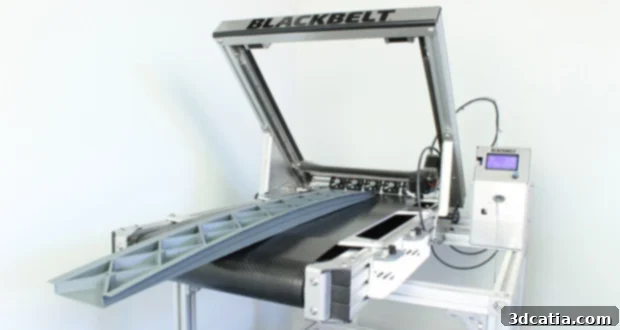
The BlackBelt 3D printer: A new paradigm for continuous and batch 3D production.
Peering into the Future: BlackBelt’s Vision for the Next Decade in Additive Manufacturing
3DN: Where do you see BlackBelt in the next 10 years?
Looking ahead, Stephan Schürmann outlined an ambitious yet pragmatic vision for BlackBelt. The immediate priority, once the highly successful Kickstarter campaign concludes, is to channel the momentum and resources into establishing a robust production line. This is a critical step towards scaling up manufacturing and ensuring that the BlackBelt printers can meet the anticipated demand with consistent quality and efficiency. Concurrently, a significant focus will be placed on the development of user-friendly software. While the hardware is revolutionary, intuitive software is essential to unlock its full potential for a broad user base, simplifying the design-to-print workflow and enhancing overall user experience. This includes advanced slicing capabilities tailored to the unique angled printing process and efficient print farm management features.
Schürmann candidly admitted that predicting the exact trajectory of BlackBelt in the long term involves a degree of speculation. The ultimate size, organizational structure, and strategic direction of the company will be heavily influenced by the aftermath and impact of the Kickstarter campaign, as well as evolving market dynamics. However, the team has meticulously considered various scenarios for the company’s growth and development, from maintaining a focused niche to expanding into a broader industrial presence. These strategic blueprints ensure that BlackBelt is prepared to adapt and thrive, regardless of how the landscape of additive manufacturing shifts.
Despite the rapid advancements in 3D printing, Stephan and his team hold a realistic view regarding its immediate future in domestic settings. They anticipate that while 3D printers may not become a common household appliance within the next decade, their true transformative power lies within industrial applications. BlackBelt’s continuous printing capabilities are perfectly poised to benefit a myriad of industries, offering solutions for everything from rapid prototyping and creating custom tooling to producing jigs, fixtures, and even small-batch manufacturing runs. The vision for BlackBelt is clear and bold: in at least 10 years, this innovative conveyor belt printing technology will not just be a niche solution, but an established, indispensable production tool widely adopted across diverse industrial sectors, fundamentally changing how products are conceived, iterated, and manufactured.
Secure Your BlackBelt: Availability and Community Engagement
For those eager to get their hands on this pioneering technology, the BlackBelt 3D printer is currently available through its highly successful Kickstarter campaign. Early adopters had the exclusive opportunity to secure the printer at a special price of just €6,500, though the initial Early Bird Reward slots have already sold out, underscoring the immense demand and enthusiasm for BlackBelt. However, potential buyers who are still convinced by the printer’s revolutionary capabilities need not worry; normal sales for the desktop version of the BlackBelt printer will commence at a price of €9,500. This price point reflects the advanced engineering and unique features that set it apart from conventional 3D printers, offering unparalleled value for continuous and extended print capabilities.
For comprehensive details about the printer’s specifications, technology, and further insights into the BlackBelt team’s mission, we strongly encourage you to visit the official BlackBelt website. Additionally, to participate in the ongoing crowdfunding effort and potentially secure one of the remaining rewards, be sure to check out their active Kickstarter campaign page. Engaging with the BlackBelt community and staying updated on their progress is also highly recommended.
Do you believe that the BlackBelt’s conveyor belt technology will indeed become a pivotal production tool in the next decade, transforming industrial additive manufacturing? We invite you to share your thoughts and predictions in the comments section below. You can also join the conversation and connect with us on our vibrant social media platforms, including Facebook and Twitter. Furthermore, to ensure you never miss out on the latest advancements, news, and exclusive insights from the dynamic world of 3D printing, remember to sign up for our free weekly newsletter, delivered directly to your inbox!